Amazon MGM Studios Cast Robert Pattinson as the Next James Bond. Was It Smart?

A study with neurotwins, grounded in real survey respondents. Predictions, not a poll.
Amazon MGM Studios chose Robert Pattinson. Was it smart?
Amazon MGM Studios went with Pattinson, 40 years old, with Denis Villeneuve directing and Amy Pascal and David Heyman producing. The Hollywood Reporter had reported his screen test a week earlier, and the MPA blog called him a surprise contender. Variety reported that Pattinson and Nicholas Hoult were among those who screen-tested. The Broccoli family handed creative control to Amazon MGM Studios, and this is the first Bond film made since.
The role is no longer open, so this post asks: did Amazon MGM Studios pick the Bond the twins would have picked, and was it a smart choice?
Who would 54,546 digital twins have chosen?
The study covers 54,546 digital twins, 39,007 for Europe and 15,539 for Germany, and 15 questions about the next Bond and five actors: Robert Pattinson, Nicholas Hoult, Callum Turner, Jack Lowden and Josh O'Connor. Every twin stands on a real person who answered a real survey, so every answer can be split by age, gender and values.
The twins were not told about the announcement. I ran the study on 19 November, three days after the announcement, with questions that treated the role as open. Read the answers as what the audience would have chosen, set against what Amazon MGM Studios chose.
Generations are age groups: Gen Z 15 to 27, Millennials 28 to 43, Gen X 44 to 59, Boomers 60 to 78, oldest 79 and up. All numbers are twin predictions, in percent, unless stated.
Overall, Lowden takes 51 % of Europe's first choices. Pattinson comes second at 18 %, narrowly ahead of O'Connor at 17 %. In Germany it is Lowden 57 %, Pattinson 16 %, O'Connor 13 %. So the twins' overall pick was not the man Amazon MGM Studios chose. Split the twins by age and that answer starts to move.
The older the twin, the safer the choice
Across Europe, Jack Lowden wins every generation, and his lead melts with youth: 62 % among the oldest, 57 % Boomers, 51 % Gen X, 46 % Millennials, 38 % Gen Z. Robert Pattinson runs the other way, from 9 % among the oldest to 28 % among Gen Z.
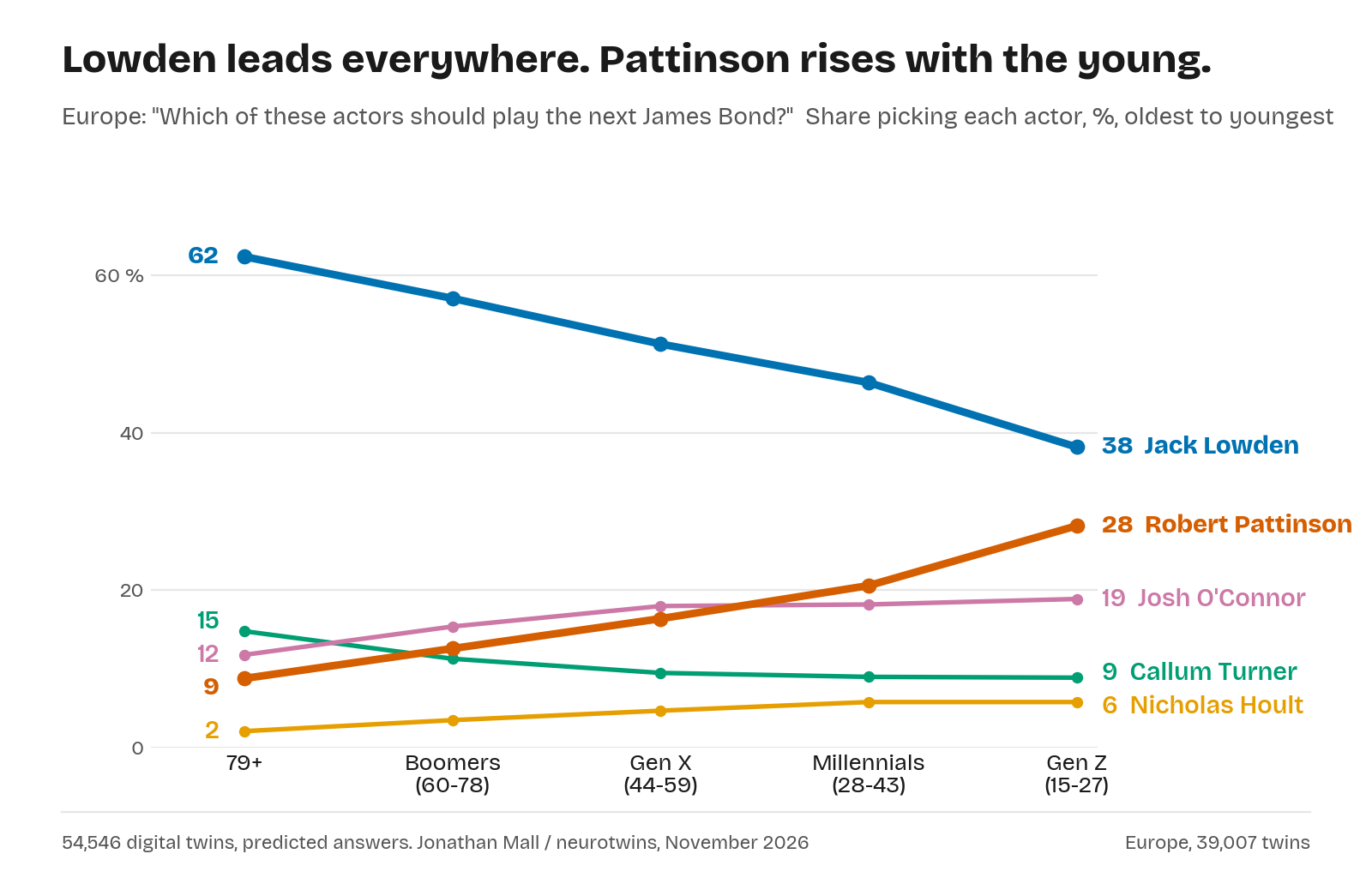
Look at Germany's Gen Z and the picture changes: Pattinson 41 %, O'Connor 29 %, Lowden 13 %. That generation has already switched.
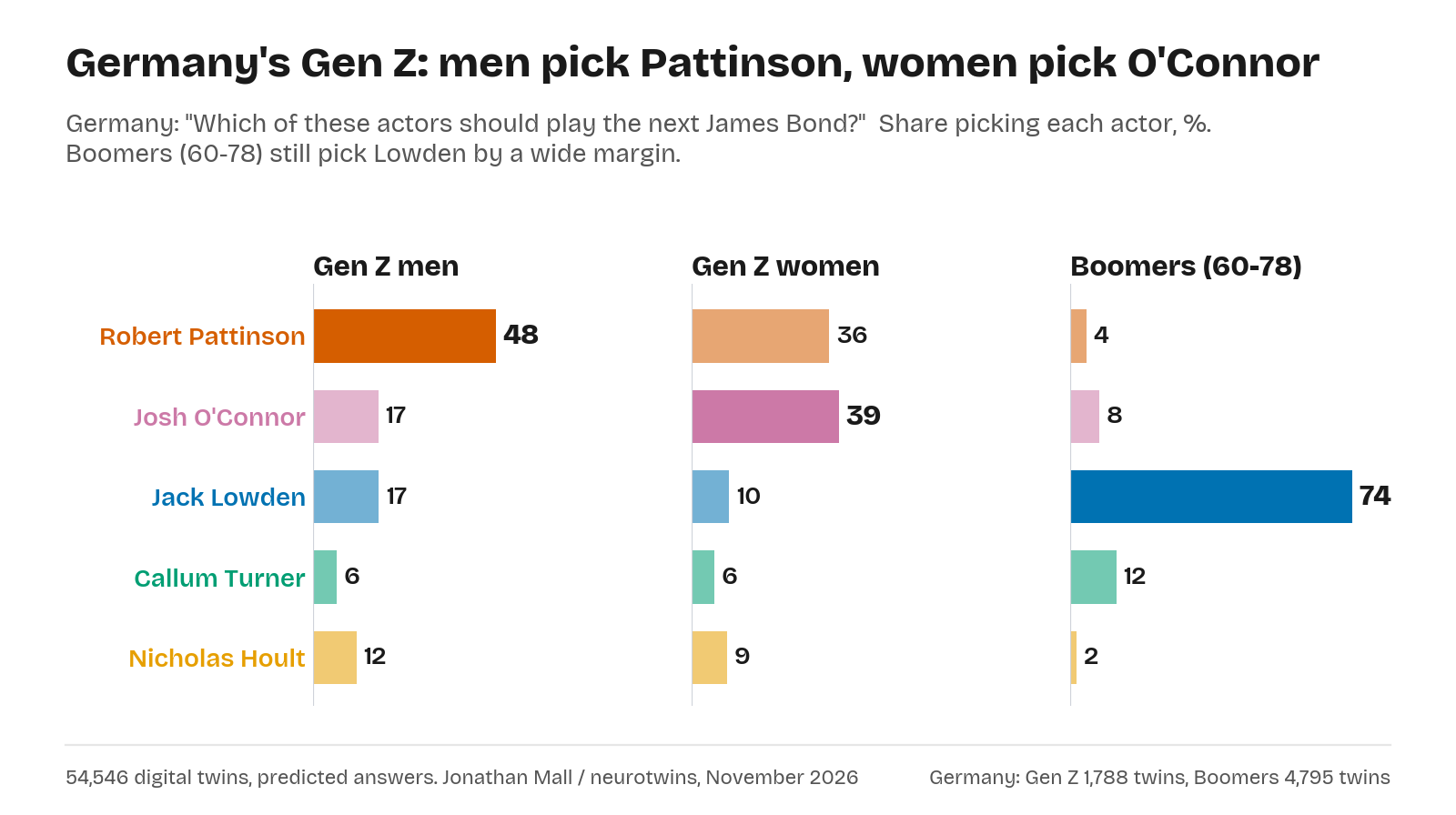
Inside Gen Z there is a gender split. In Germany young men pick Pattinson (48 %), young women pick O'Connor (39 %), and Boomers stay with Lowden (74 %).
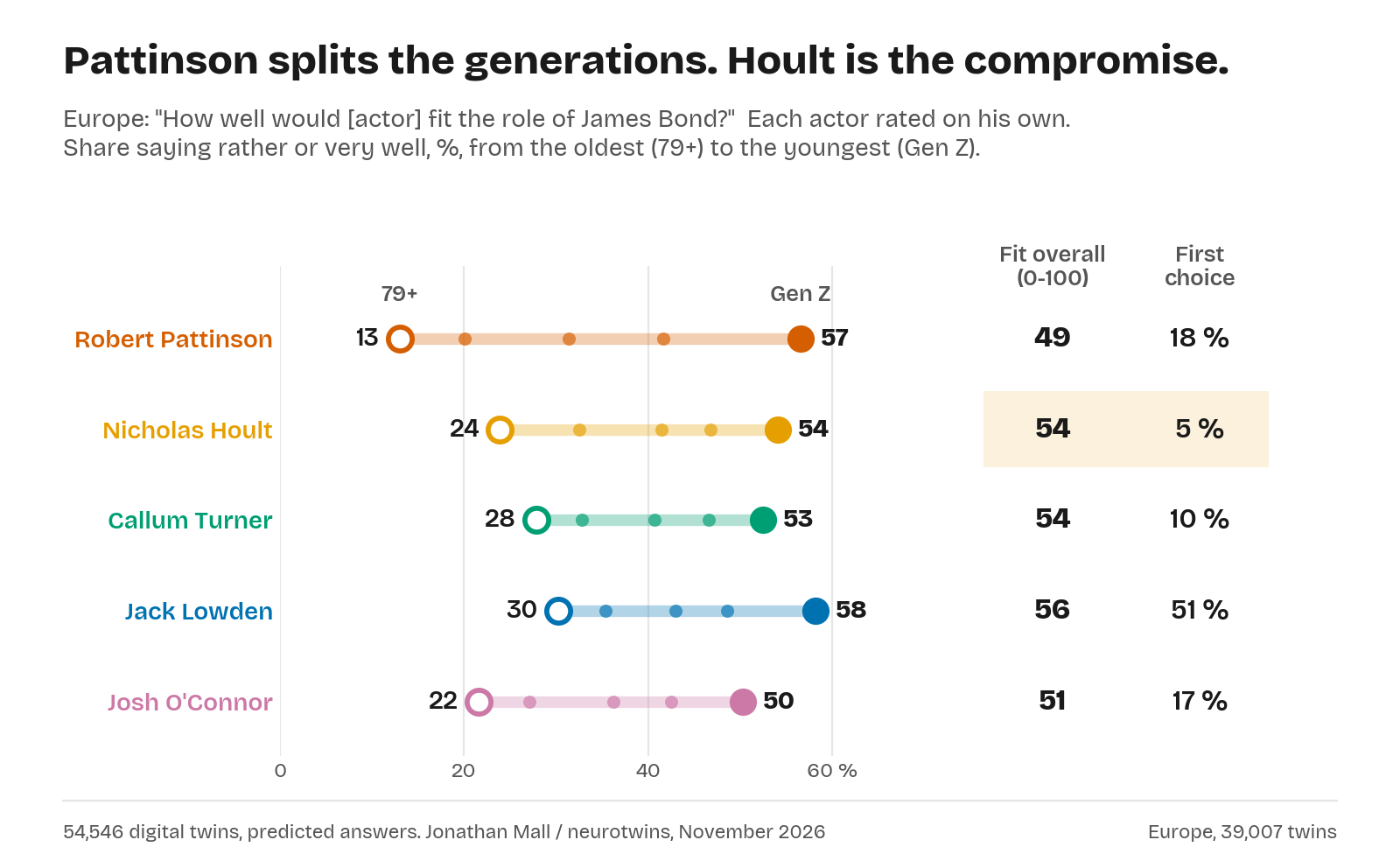
Rated one actor at a time, Pattinson is the most polarising name. 57 % of Gen Z twins in Europe say he fits the role, against 13 % of the oldest group. That is the widest gap of the five. Nicholas Hoult is almost nobody's first choice (5 %) and almost everybody's acceptable choice: overall fit 54 out of 100, level with Callum Turner and just behind Lowden's 56. Hoult screen-tested too. The compromise candidate was in the room.
Who picks whom
Because each twin stands on a real survey respondent, every pick comes with a values profile taken from that respondent's own survey answers. Treat this as directional, not as an effect size. In Europe, twins who pick Pattinson are more likely to say being rich, adventure and admiration matter to them, and they trust politicians and parliaments less. Lowden pickers skew male and lean right. O'Connor pickers skew female, back gender equality and a closer European Union, and trust institutions more.
Bond's future audience is young, and it wants a different Bond
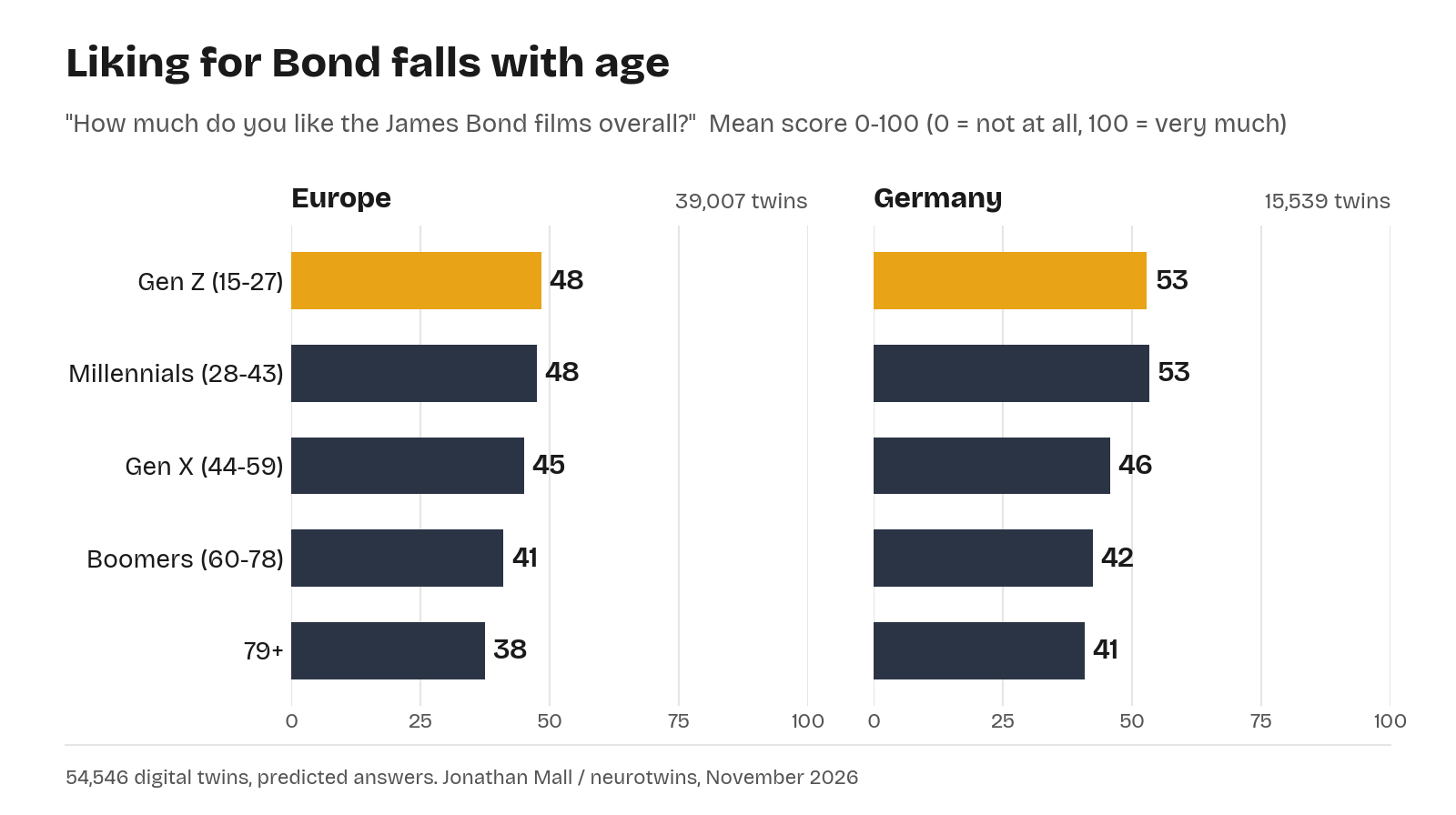
The age split matters because the young are the ones who like Bond most. My starting guess was that Bond belongs to the generation that grew up with Connery and Moore. The twins say the opposite. Asked how much they like the Bond films overall, Gen Z scores 48 out of 100 in Europe, Boomers 41, the oldest group 38. In Germany the same ladder reads 53, 42, 41.
The "not at all" answer makes it sharper: 6 % of Gen Z twins in Europe, 18 % of the oldest. And in Europe, Amazon does not scare the young. 42 % of Gen Z twins expect the films to get worse now that Amazon has creative control. Among the oldest it is 62 %. How that feels depends on your age.
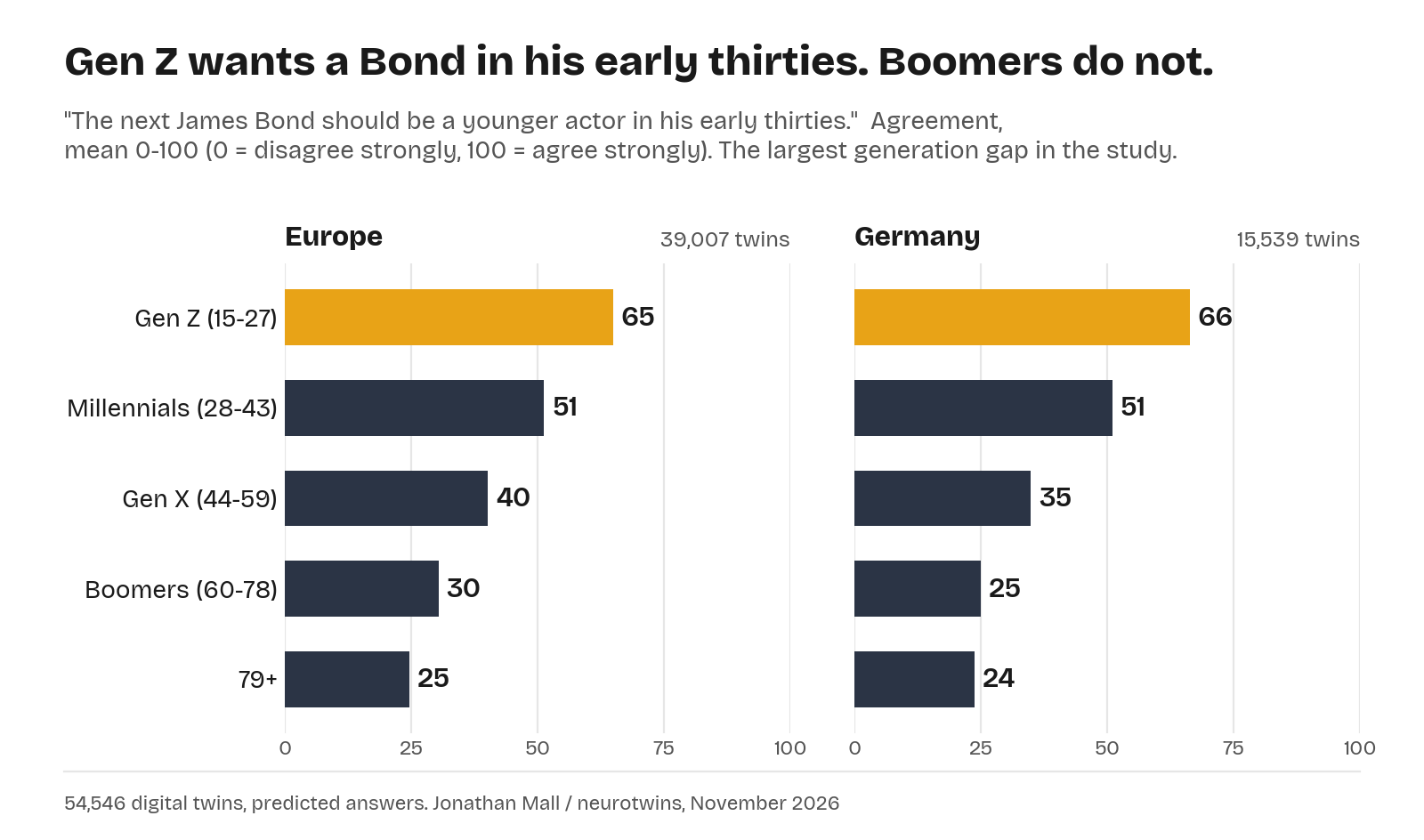
Gen Z likes Bond, but it wants a different Bond. Asked whether the next Bond should be an actor in his early thirties, Gen Z twins in Europe score 65 out of 100 on agreement. Boomers score 30. In Germany it is 66 versus 25. That is the largest generation gap in the whole study.
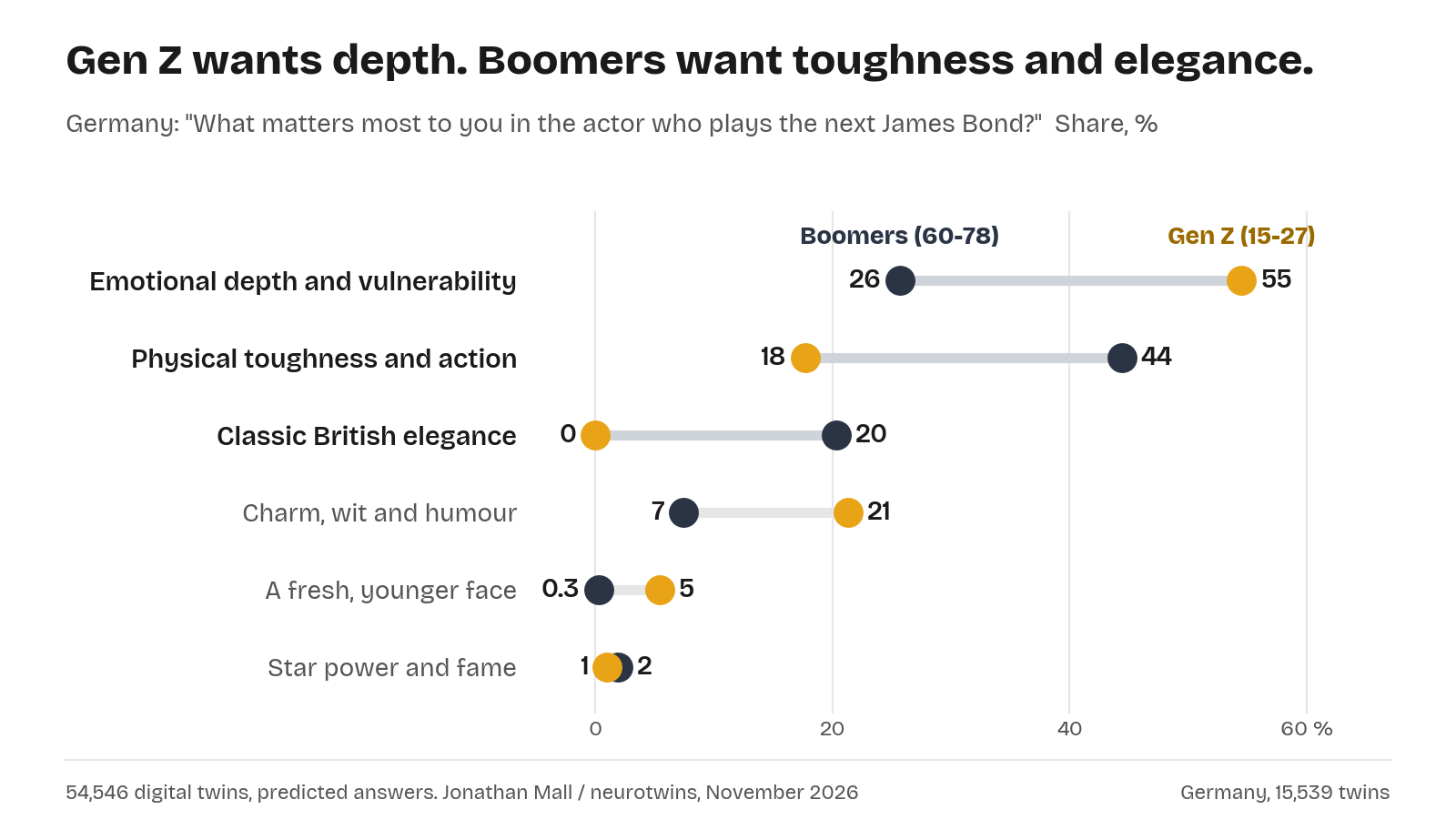
The reasons differ too. In Germany I asked what matters most in the actor. Gen Z twins say emotional depth and vulnerability (55 %) far ahead of physical toughness (18 %). Boomers flip it: toughness 44 %, depth 26 %. Classic British elegance matters most to 20 % of German Boomers and to nobody in Gen Z, not even a rounding error.
But where will they watch?
The young like Bond more. Asked where they would watch the next film, they pick the sofa. 79 % of Gen Z in Europe say streaming at home, and 90 % in Germany. The share who would go to a cinema, at any point, is about 13 % in every European generation. More love among the young buys no extra cinema seats.
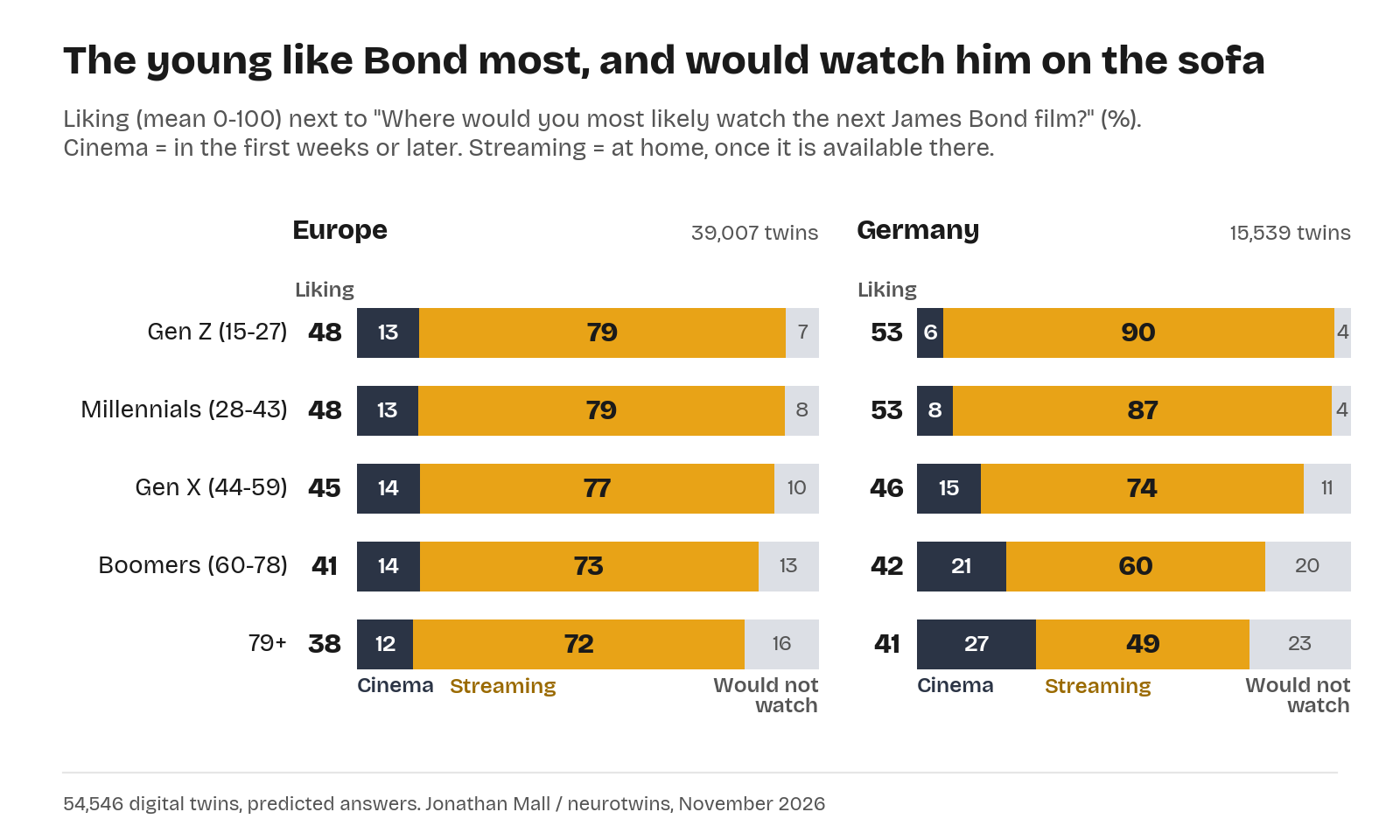
In Germany the predicted cinema audience is old: 6 % of Gen Z, 21 % of Boomers, 27 % of the oldest. The older audience is also the pickier one. In Europe, 26 % of Boomers say the actor decides whether they watch at all, against 16 % of Gen Z.
Real data points the same way, with a caveat. Germany's film board FFA found that the average cinema visitor in 2025 was 40.6 years old, with tickets up 13 % among the over-60s and down 7 % among 20 to 29 year-olds. In the UK, Kantar put over-55s at 24 % of the audience for No Time to Die. But teenagers still go: the same FFA study shows 64 % of 10 to 19 year-olds reached by cinema in 2025. Trade coverage of a Conecta study adds that Gen Z still goes if the trip is worth it. So read the low Gen Z cinema number as a signal about this one franchise, not about cinema in general.
Was it smart? Yes, for three reasons
The twins would have played it safe with Lowden. Amazon MGM Studios went with Pattinson. I think this was the right call, for three reasons. They are my reading, and Amazon has not said any of this.
1. Cast for the next fifteen years. The people deciding are looking at the next Bond era, beyond the next film. Daniel Craig played Bond in five films, from Casino Royale in 2006 to No Time to Die in 2021. Pattinson was born on 13 May 1986 and is 40. Whoever takes the role now can carry several films over many years, and today's young generation will still be the audience across that whole span. Among Gen Z in Europe, 28 % of twins pick Pattinson first, against 9 % of the oldest group. Lowden wins every generation in Europe, which makes him the safe Bond for today's audience.
2. Polarising gets talked about. The twins call Pattinson the most polarising name on the list: 57 % of Gen Z twins in Europe say he fits the role, against 20 % of Boomers. In my view that helps: the more people write about a casting, the more people want to check the film out. The evidence supports this only in part. Berger, Sorensen and Rasmussen (2010) found that negative publicity can raise purchase likelihood by increasing awareness, and that a negative New York Times review reduced sales of books by well-known authors while it increased sales of books with lower prior awareness. Bond is as well known as a product can be, which is the group where the paper found harm. So this point stays my opinion, and the paper does not settle it.
3. Stronger with men. Pattinson is strongest among men, and Bond's audience skews male. On its North American opening weekend, No Time to Die drew a 64 % male audience, according to exit polls reported by Screen Daily. That is one film in one market, and it fits an action franchise. In the twin data, Pattinson is the first choice of 33 % of Gen Z men in Europe against 23 % of Gen Z women. The same gap shows in every generation: Millennials 24 % vs 17 %, Gen X 19 % vs 14 %, Boomers 15 % vs 11 %. In Germany, Gen Z men pick him first at 48 %. Lowden is still men's first choice in Europe (46 % of Gen Z men), so Pattinson has an edge among men and no lead.
One tension remains. 79 % of Gen Z in Europe, and 90 % in Germany, would stream the next film at home. For a cinema release that is a problem. For Prime it is an audience already on the sofa.
How this was made
Each twin stands on one real respondent from survey datasets that measure the psychological drivers of behaviour, which we acquired and validated. The research behind this idea is public. Argyle and colleagues showed that language models conditioned on the backstories of real survey respondents can reproduce human response patterns. Park and colleagues built agents from two-hour interviews with 1,052 people; on a standard set of social-attitude questions the agents scored 69.4 % from the interview alone, against 60.4 % for demographics alone and 79.5 % for the participants' own retest two weeks later. Maier and colleagues reached 90 % of human test-retest reliability on 57 consumer surveys, none about film.
For this study, a few hundred twins per question were simulated directly, and the result was projected onto all 54,546. That is 15 questions at about a minute each. A follow-up is one more question put to the same people.
What this cannot tell you
These are predictions, not a poll. Nobody was asked. The twins are built from people who answered other questions in other surveys.
The method is not validated on entertainment questions. None of the papers above tested casting or film preferences. They tested politics, general social attitudes and consumer products.
The values profiles are directional. They show which way a pick leans, not how strongly.
Only Europe versus Germany is comparable. I do not rank individual countries against each other.
The three reasons are my opinion. The twins do not show that controversy sells tickets, and the one study I cite limits that effect to little-known products. The 64 % male audience comes from one film in one market.
The twins were not told about the announcement. They were run on 19 November 2026, three days after it, with the role treated as open. They predict a role that Amazon MGM Studios has since filled.
The streaming future has bonded
The fans Bond needs over the next fifteen years are young, want a more human Bond, and will largely watch him at home. Pattinson is strongest with that audience, and the men among them back him most strongly. Whether the people who fill cinemas today follow is the next question.
If you want to run a question like this for your own brand or category, you can book a call with me or find me on LinkedIn.
Questions I get asked
Who do digital twins predict should be the next James Bond?
Asked as if the role were still open, 54,546 digital twins picked Jack Lowden first overall (51 % in Europe, 57 % in Germany). Robert Pattinson came second at 18 % in Europe and 16 % in Germany, and led among Germany's Gen Z at 41 %.
Was Amazon MGM Studios right to cast Robert Pattinson?
I think so. The twins would have picked Jack Lowden, who wins every generation in Europe, but Pattinson is strongest among the young (28 % of Gen Z, 9 % of the oldest group) and has an edge among men, who were 64 % of the last Bond film's opening-weekend audience in North America. A new Bond may carry several films, and today's young audience will still be watching. This is my opinion, based on twin predictions, not a poll.
Who was announced as the next James Bond?
Amazon MGM Studios announced Robert Pattinson on 16 November 2026, with Denis Villeneuve directing. The film is untitled and has no official release date.
Which generation likes James Bond most?
Gen Z, according to the twins: 48 out of 100 in Europe and 53 in Germany, against 38 and 41 for the oldest group.
Will young people watch the next Bond in cinemas?
The twins predict mostly not. 79 % of Gen Z in Europe and 90 % in Germany say they would stream it at home. Only about 13 % of any European generation would go to a cinema.
Are these results from real people?
No. They are predictions by digital twins, each built on a real survey respondent. The method has not been validated on entertainment questions, so treat them as directional.
Sources
- CNBC, 16 Nov 2026: Robert Pattinson announced as the next James Bond
- Yahoo Entertainment, 16 Nov 2026: James Bond casting officially announced
- SlashFilm, 16 Nov 2026: Robert Pattinson cast as the next Bond
- Motion Picture Association, 9 Nov 2026, citing The Hollywood Reporter: Pattinson emerges as a surprise Bond contender
- Variety Australia, 9 Nov 2026: Bond screen tests
- TheWrap, 20 Feb 2025: Inside Amazon's James Bond takeover
- FFA, April 2026: Kinobesucher*innen 2025
- Celluloid Junkie, 10 Aug 2026: Gen Z is still going to the movies, but the trip has to be worth it
- Kantar UK, Dec 2021: Is the UK cinema making a comeback?
- Screen Daily, 10 Oct 2021: No Time to Die opens top in North America on $56m
- Wikipedia: Robert Pattinson (born 13 May 1986)
- Wikipedia: Daniel Craig (Bond 2006 to 2021, five films)
- Berger, Sorensen and Rasmussen, 2010: Positive Effects of Negative Publicity: When Negative Reviews Increase Sales (Marketing Science 29(5), 815 to 827)
- Argyle et al., 2022: Out of One, Many (Political Analysis, 2023)
- Park et al., 2024: Generative Agent Simulations of 1,000 People (arXiv 2411.10109; the current version is titled AI Simulations Grounded in Rich Self-Reports Increase Accuracy and Reduce Distortion)
- Maier et al., 2025: LLMs Reproduce Human Purchase Intent via Semantic Similarity Elicitation of Likert Ratings