Most companies use AI like a better Google search. That’s no longer enough.
ChatGPT has changed the world of work — at least on paper. In practice, the picture looks different: most teams use AI tools to rephrase emails, summarize texts, or get quick answers to knowledge questions. That’s Level 1. Useful, but not a competitive advantage.
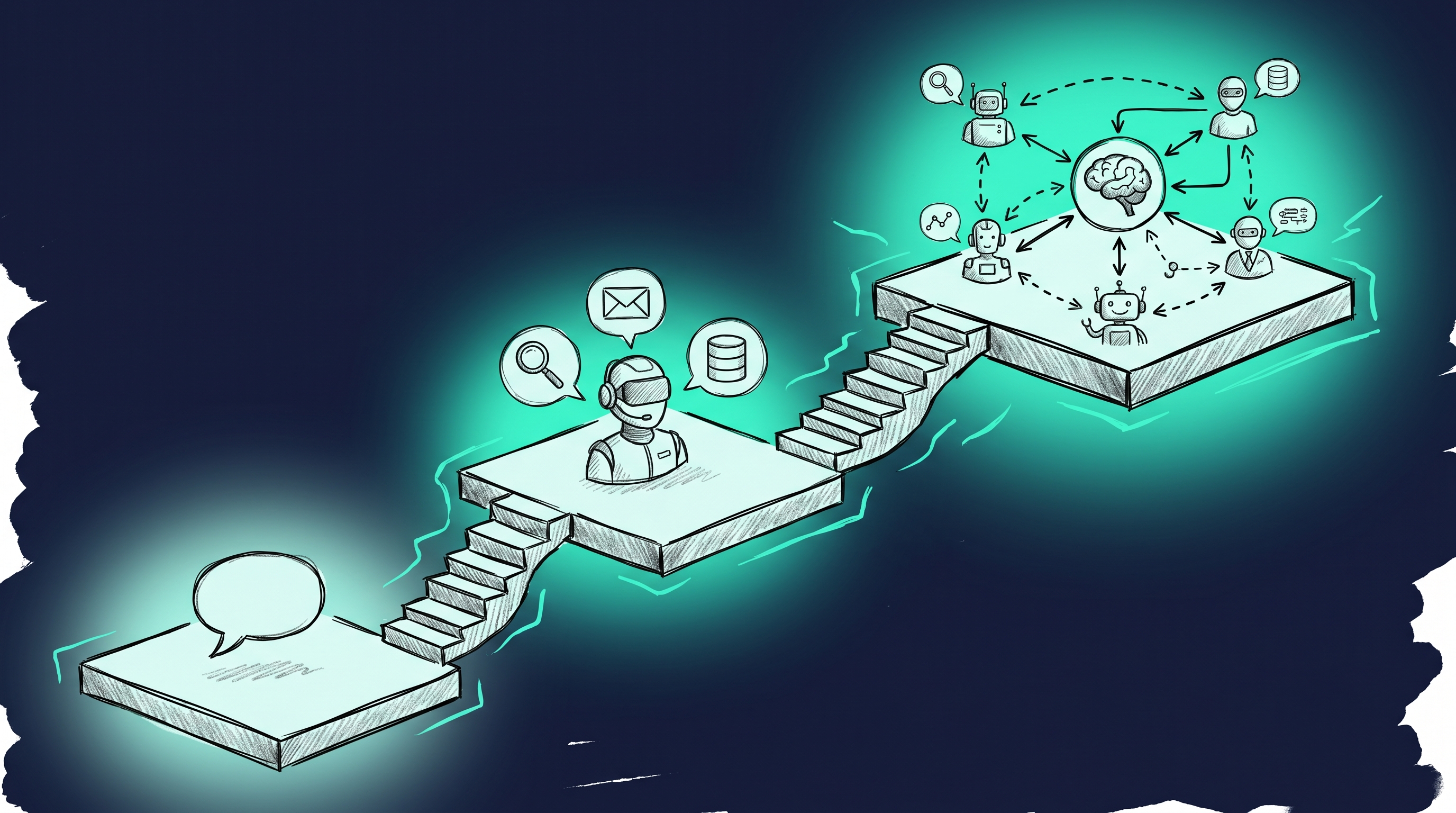
The real productivity leap only begins at Level 3: the AI Operating System (AIOS). Here, multiple AI agents work together in a coordinated fashion, share knowledge, access company data, and execute complex workflows autonomously — with human oversight at the right points.
The three stages of AI evolution in the enterprise:
- Level 1 — Chatbot: Reactive Q&A with no memory
- Level 2 — Agent: AI with tools that completes tasks independently
- Level 3 — AIOS: An orchestrated system of agents that understands the business
Companies that fail to build AIOS infrastructure now will face a gap in two to three years that is nearly impossible to close. Because AIOS is not a product to buy — it is a capability to develop. And the earlier the process starts, the bigger the head start.
The Three Levels of AI Evolution
Level 1 — The Chatbot: ChatGPT as a Better Google Search
This is where most companies stand today: a team member opens ChatGPT, asks a question, gets an answer. No context, no memory, no connection to internal systems. Every conversation starts from scratch. The chatbot knows nothing about the company, its customers, or its processes. The knowledge generated in Monday’s conversation is forgotten by Tuesday.
Typical Level 1 use cases: drafting emails, summarizing texts, brainstorming ideas, designing presentation slides. Each task might save ten minutes — but it doesn’t transform any processes. And it doesn’t scale: when 200 employees each use their own ChatGPT account, no collective advantage emerges.
Level 2 — The Agent: AI That Works for You
An AI agent goes one decisive step further: it has access to tools. An agent can send emails, query databases, create documents, manage calendars, or execute code. Instead of just providing answers, it carries out tasks.
The difference is fundamental: a chatbot tells you how to complete a task. An agent completes it. Example: rather than drafting a customer reply, the agent researches the customer history, formulates a personalized response, and submits it for approval.
But agents have limits too: they work in isolation. Each agent knows only its own task. What Agent A has learned, Agent B does not know.
Level 3 — The AI Operating System: AI That Understands the Business
An AIOS solves exactly this problem. It is the orchestration layer that coordinates multiple agents, provides them with shared context, and enables autonomous workflows — with clear rules about who is allowed to do what.
Imagine this: a marketing agent creates content, an analytics agent monitors performance, a compliance agent ensures everything is GDPR-compliant — and all three share the same corporate knowledge base. No copy-pasting between tools. No manual handoffs. One system that learns and improves.
From Chatbot to AIOS — as a Keynote: This talk walks through the three evolution stages of AI with live demos and real-world examples from over 1,000 hours of hands-on experience with AI agents. Book a speaker
What Is an AI Operating System?
An AI Operating System is an orchestration layer that coordinates multiple AI agents, tools, and data sources — much like a traditional operating system manages a computer’s hardware, software, and files.
Without an operating system, every program would need to bring its own keyboard driver, screen rendering, and file management. That is exactly how most companies handle AI today: every tool is an island. ChatGPT here, an analytics tool there, an automation platform somewhere else. No shared context, no coordination.
The five core components of an AIOS:
- Agent Registry: A central directory of all available AI agents and their capabilities. The system knows which agent can best solve which task.
- Shared Context / Memory: A collective knowledge store that all agents can access. Corporate knowledge, customer histories, decision logic — all in one place.
- Tool Access: Standardized interfaces to enterprise systems — CRM, ERP, email, databases, APIs. Every agent can access the tools it needs.
- Governance Layer: Rules and approval workflows: which agent is allowed to perform which actions? When is human approval required? Which data may be processed?
- Audit Trail: End-to-end logging of all agent actions. Who did what, when, with which data, and with what outcome?
The analogy to a computer operating system goes even further: just as Windows or macOS enables dozens of programs to run simultaneously and in coordination, an AIOS enables dozens of AI agents to work simultaneously and in coordination — with the same security standards.
Why GDPR and Governance Are Critical
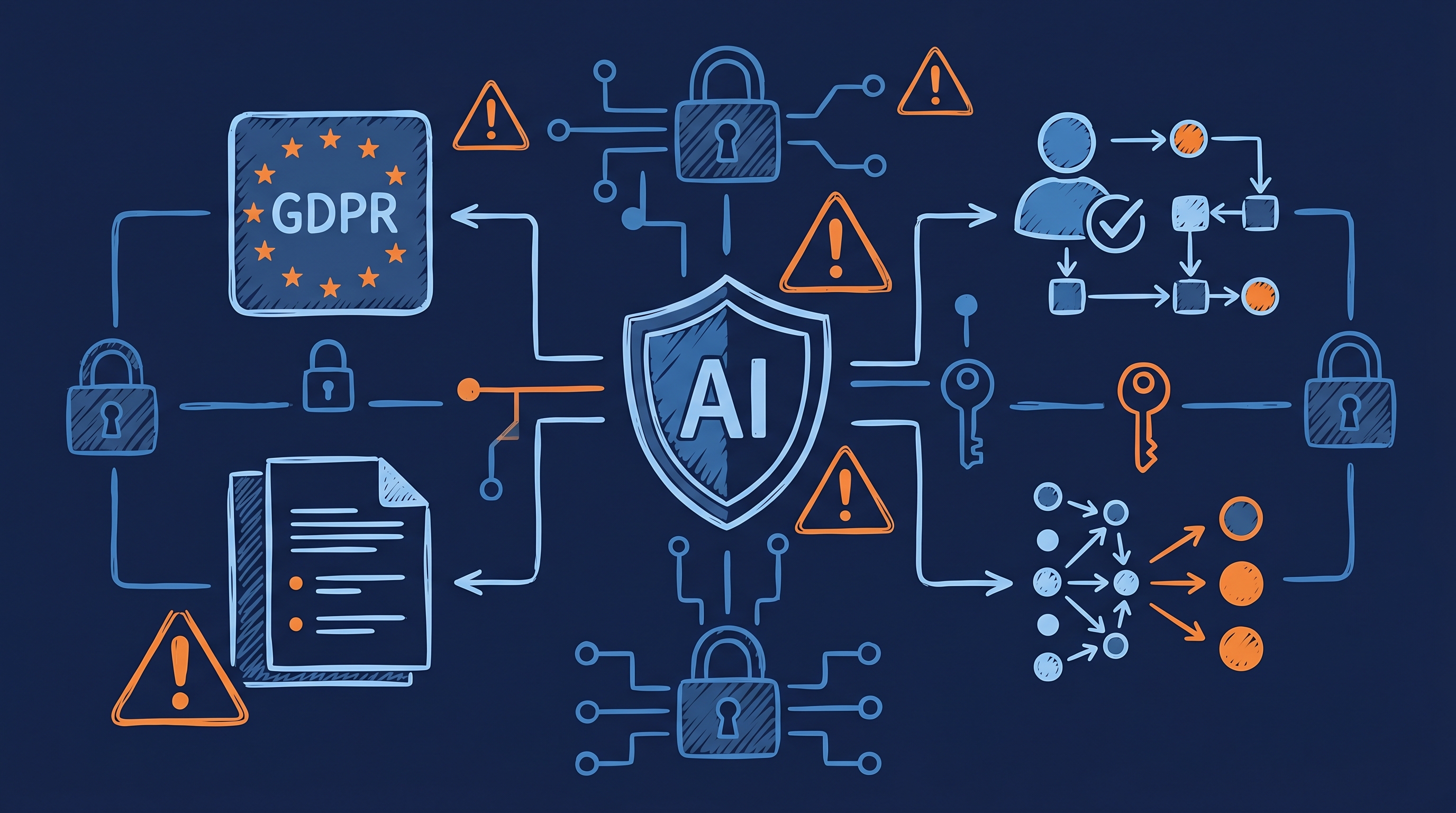
Here is the elephant in the room: most AI implementations ignore compliance. Teams use ChatGPT with customer data, paste confidential information into prompt windows, and let agents access data without documenting what happens to it.
For European companies, that is not an option. The GDPR places clear requirements on the use of AI agents:
- Data Minimization: An agent may only access the data it needs for its specific task — not everything.
- Purpose Limitation: Data collected for customer service must not automatically be available to marketing agents.
- Explainability: When an AI agent makes a decision that affects customers, it must be possible to trace how that decision was reached.
- Human-in-the-Loop: For certain decisions — such as rejecting an application — a human must give final approval.
An enterprise AI governance framework therefore defines clear rules: who authorizes which agent actions? Which data may be processed? Where are audit trails? When does a human intervene?
European companies hold an often-underestimated advantage here: those who factor in compliance from the start build more robust systems. Privacy-compliant AI is not a barrier — it is a feature. Customers trust companies that handle AI responsibly. And the EU AI Act will further strengthen this advantage in the years ahead.
For corporate events and executive retreats: The talk “AI Agents in the Enterprise” shows how to build AIOS infrastructure in a GDPR-compliant way — with a concrete roadmap for leaders. Request a talk
4 Use Cases: AIOS in the Enterprise
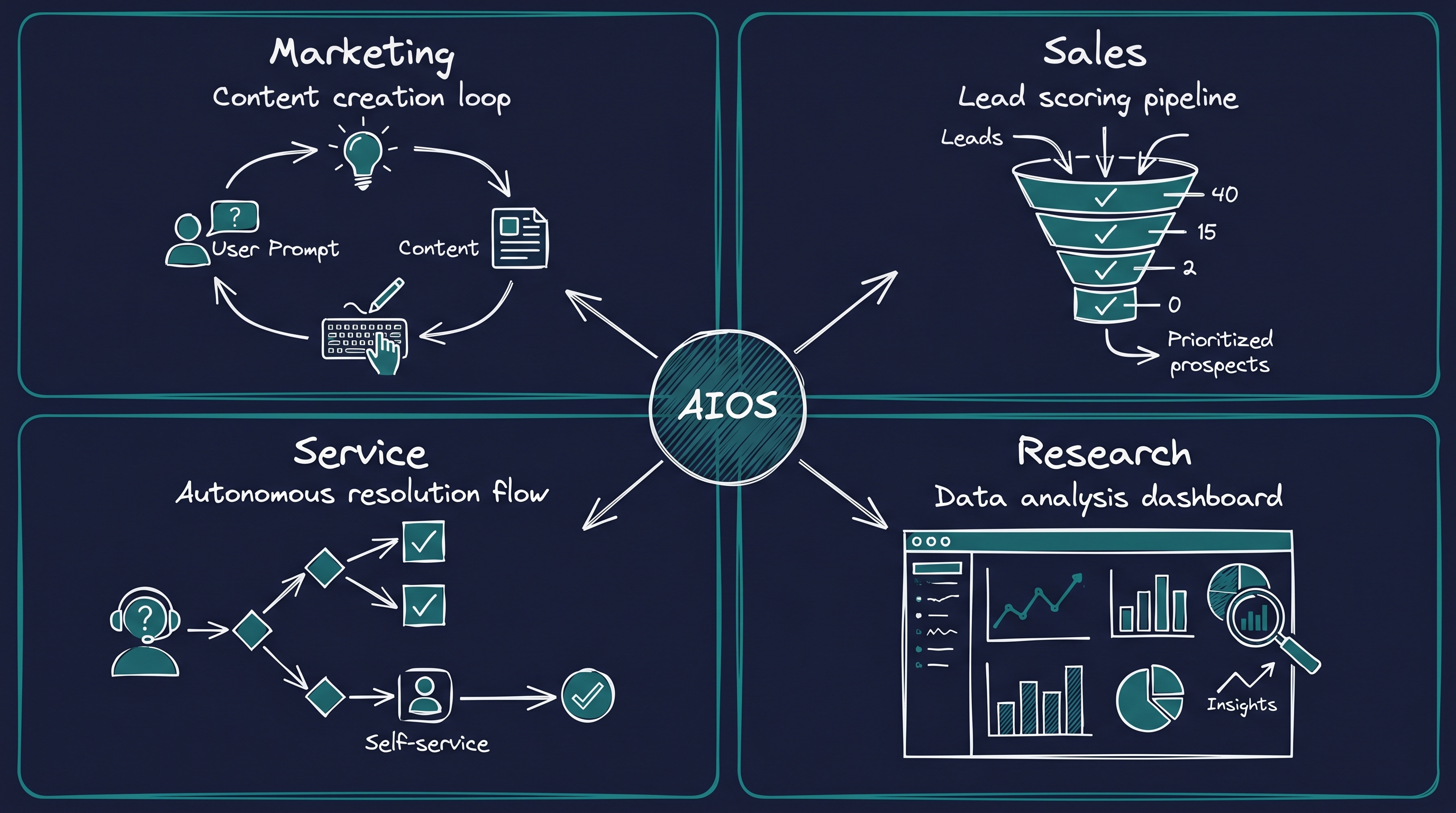
1. Marketing: The Autonomous Content Loop
Instead of creating individual pieces of content manually, an AIOS orchestrates the entire content process: a research agent analyzes search trends and competitors. A content agent produces drafts — tailored to brand voice and target audience. A validation agent tests the content with digital twins of the target audience before publication. A performance agent measures results after publication and feeds the insights back to the content agent — which learns from them and optimizes future output. The result: a closed loop that improves with every cycle. Fully automated, fully coordinated, fully documented.
2. Sales: Intelligent Lead Scoring and Personalized Outreach
An AIOS in sales goes far beyond traditional lead scoring. An analytics agent evaluates leads based on dozens of signals — website behavior, firmographic data, industry trends. A research agent enriches each lead with publicly available information. An outreach agent crafts personalized messages based on the lead’s specific pain points — not generic templates. The result: higher reply rates, shorter sales cycles.
3. Customer Service: From Script to Autonomous Resolution
Most customer-service chatbots follow decision trees: if question X, then answer Y. An AIOS-based customer service understands context: the agent knows the customer’s history, identifies the underlying problem (not just the stated question), and can independently implement solutions — process returns, issue credits, schedule appointments. In complex cases, it automatically escalates to the right team member — with full context.
4. Research: Automated Market Analysis and Competitive Intelligence
An AIOS can automate the entire research process: competitor monitoring, patent analysis, trend tracking, customer-feedback evaluation. Instead of taking weeks to produce a market report, an orchestrated system of specialized agents delivers up-to-date competitive intelligence — complete with source citations and confidence scores.
The Path to AIOS: 5 Steps to Get Started
Step 1: Audit Current AI Tools
Most companies already use five to ten AI tools — often without realizing it. ChatGPT accounts, AI features embedded in existing software, standalone automations. The first step: a complete inventory. Which tools are being used? By whom? With which data? The results are often surprising.
Step 2: Define the Agent Architecture
Before buying technology, define the agent architecture: which tasks should be automated? Which tools do the agents need? Which data must they access? How do they communicate with each other? These architectural decisions determine the success of an AIOS more than any technology choice.
Step 3: Governance First
Build the governance layer before rolling out agents. Define approval workflows, audit trails, and GDPR checks. Which agents may perform which actions without human approval? Where are the boundaries? This step is often skipped — and later becomes expensive to retrofit. More on the foundational principles for AI agents.
Step 4: Start with One Department and Prove ROI
Do not roll out the AIOS company-wide. Start with one department — ideally one with clear, measurable processes. Marketing content creation, sales qualification, or customer service triage are good pilot candidates. Measure ROI rigorously: time savings, quality improvement, cost reduction. Those numbers are needed for the next step.
Step 5: Scale with Shared Memory and Cross-Agent Orchestration
Once the pilot works, begin scaling. The key: shared memory. What the marketing agent learns about customers must be available to the sales agent. What the research agent discovers about competitors must feed into the content strategy. This interconnection is what separates an AIOS from a collection of individual agents. A structured AI onboarding strategy helps manage this transition systematically.
Does the team need AI expertise? In addition to keynotes, Dr. Jonathan Mall offers interactive workshops on prompt engineering, AI onboarding, and AIOS architecture for enterprises. Inquire now
Sources & Further Reading
External Sources
- Gartner: What Is an Intelligent Agent in AI? — Overview of the current state of autonomous AI agents in enterprise settings
- McKinsey: Superagency in the Workplace — How companies can unlock the potential of AI agents
- EU AI Act — The European regulatory framework for artificial intelligence
- GDPR — The General Data Protection Regulation of the European Union
- Wikipedia: AI Agent — Foundations and taxonomy of autonomous AI systems
Further Articles on jonathanmall.com
- 27 Principles for AI Agents — Core rules for deploying AI agents safely and effectively
- AI Onboarding: 10 Steps — How companies introduce AI systematically
- Digital Twin as a File System — AI-independent knowledge architectures for enterprises
- Recommended or Invisible — How AI search is changing brand visibility
Conclusion: The Question Is Not If, But When
AI Operating Systems are neither science fiction nor a buzzword — they are the logical next stage of enterprise AI adoption. The path from chatbot to AIOS requires no revolution, just systematic evolution: audit, architecture, governance, pilot, scale.
Companies that start now will hold a lead in two to three years that latecomers will find nearly impossible to close. Because an AIOS gets better with every task — the shared knowledge, optimized workflows, and trained agents accumulate an advantage that grows exponentially. The earlier this process begins, the larger the head start.
The technology is mature. The regulation is clear. The tools are available. The only limiting factor is the decision to start today.
About the Author: Dr. Jonathan T. Mall is a cognitive psychologist, CIO, and co-founder of neuroflash. With over 20 years of experience at the intersection of neuroscience and AI, his talks show companies how to make the leap from chatbot to AI Operating System — securely, GDPR-compliant, and with measurable results. Contact: jonathanmall.com · LinkedIn.
Frequently Asked Questions
What is the difference between a chatbot and an AI Operating System?
A chatbot reacts to single questions without memory or business context. An AI Operating System coordinates multiple agents that share knowledge, access tools and run autonomous workflows. The agent stage sits in between, completing individual tasks with tool access.
What components does an AI Operating System need?
Five core parts: an agent registry that lists capabilities, shared context and memory, standardized tool access to enterprise systems, a governance layer for approvals and permissions, and an audit trail logging every action. Together they make multi-agent orchestration safe and traceable.
Why does GDPR compliance matter for an AIOS?
Because an AIOS touches real business data across many systems, you need permissions, approval workflows and full audit logging built in. This keeps the system aligned with GDPR and the EU AI Act, turning compliance into infrastructure rather than a bolt-on.