Why AI's Top Startups Stopped Publishing Research (and What It Costs Everyone Buying AI)
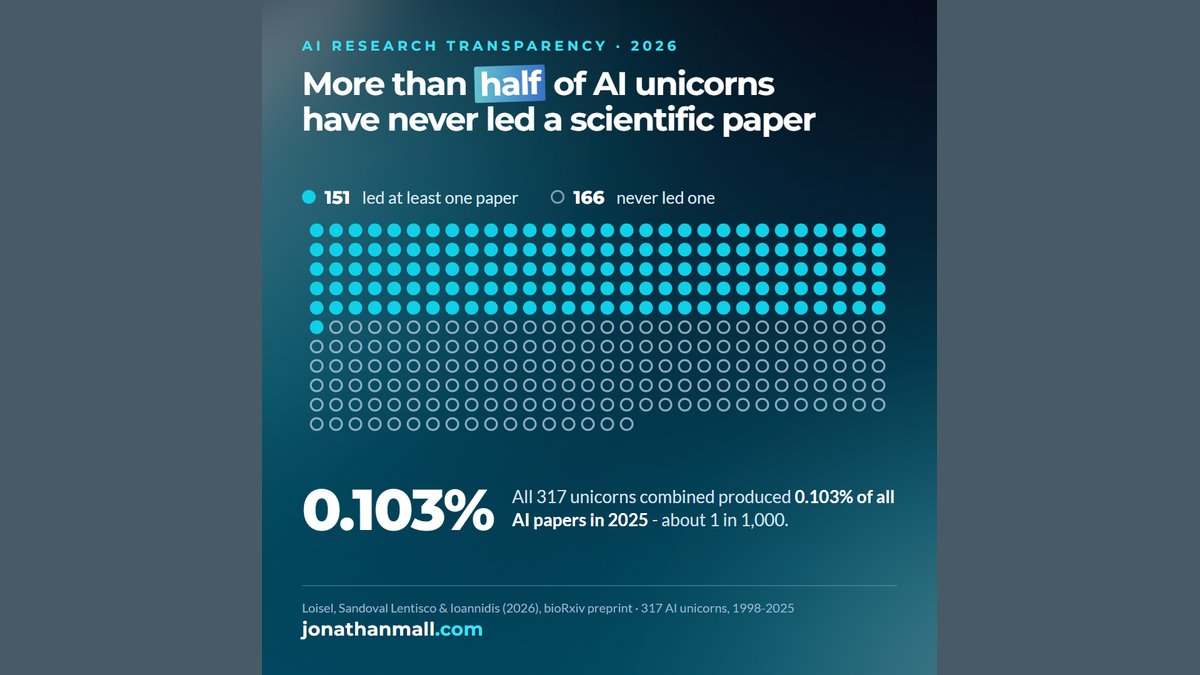
A new bioRxiv preprint by Loisel, Sandoval Lentisco and Ioannidis, covered by Science on July 28, measured how much the world's most valuable AI companies actually publish. The finding: barely anything. Of 317 AI unicorns, 166 have never had an employee lead a single scientific paper, and together this group produced roughly 1 in 1,000 of all AI papers published in 2025. I run a digital-twin research company that sells AI to marketers, so this is my own industry being measured, and I read the paper twice before deciding what I think of it.
The Silence Is Real, and It Is Rational
Start with the numbers, because they are more extreme than the headline suggests. More than half of the 317 unicorns in the dataset, companies that between them represent most of the AI industry's valuation, have never had a single researcher lead a peer-reviewed or preprinted paper.
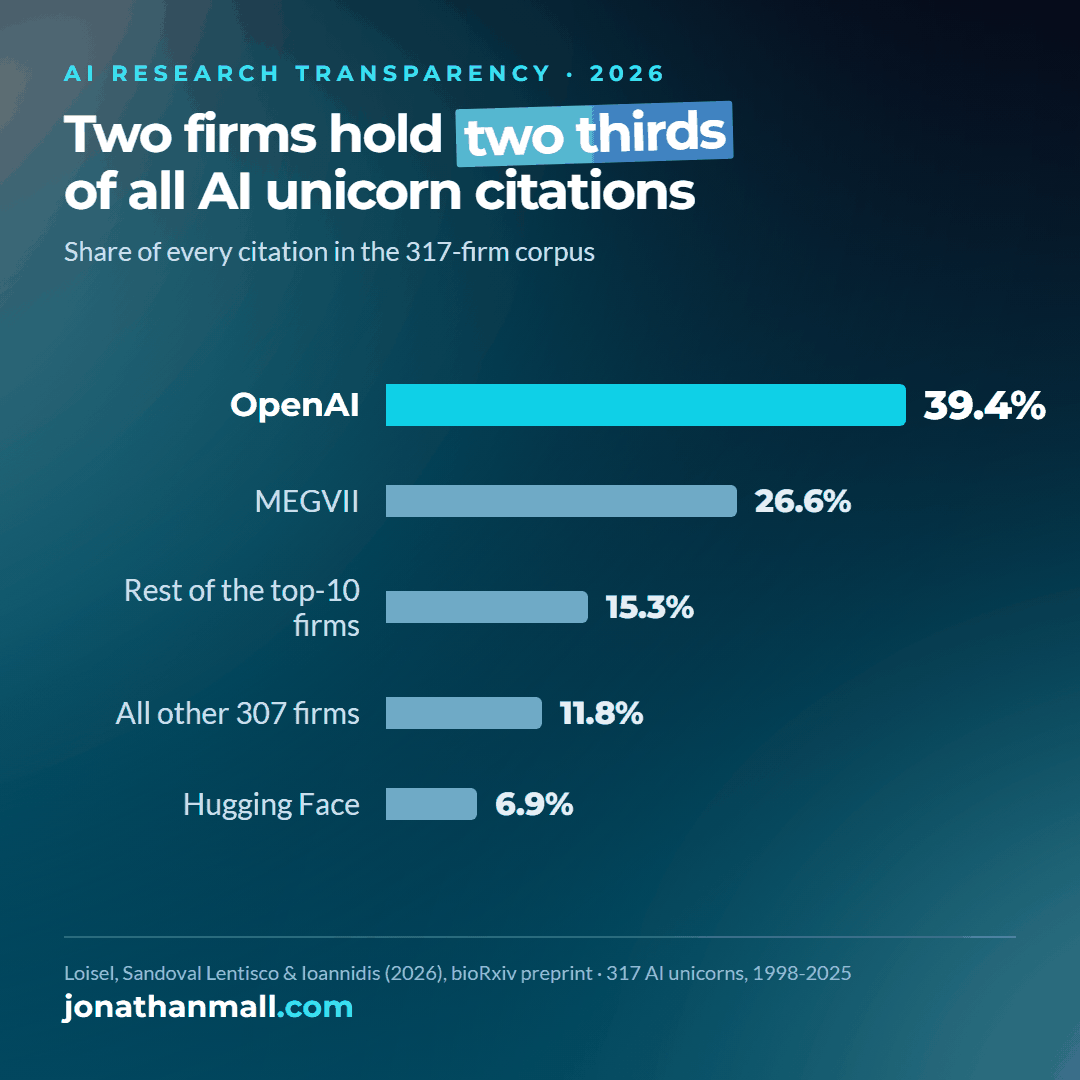
Citations are even more concentrated than headcount. OpenAI holds 39.4% of all citations in the dataset. Number two, at 26.6%, is not the name most marketers would guess: Megvii, the Beijing computer-vision firm behind Face++. The top 5% of firms hold 92.0% of all citations. Inside OpenAI itself, a company of roughly 4,500 people, only 8 authors have 5 or more eligible publications.
I agree with the paper's economic reading, and I do not think it needs moral outrage attached to it. Pharmaceutical companies publish because a patent protects what disclosure gives away; the paper functions as marketing, not as a leak. AI companies have no equivalent protection. A published method is a gift to every competitor with API access and a free weekend, so the rational move is to stop publishing and let the product speak instead. Naming the incentive matters more than condemning the behavior, because it tells you the trend will not reverse until the economics do.
The trend also runs top-down, not bottom-up. This month DeepMind dismantled its own Nobel-winning AlphaFold team, and John Jumper left along with several co-authors for Anthropic, according to The Decoder. The community noticed immediately: a r/singularity thread asking whether DeepMind would "remain a research-first lab" collected 603 upvotes within days. When the team that won a Nobel Prize for open structural biology gets folded up, the silence the preprint documents is not a startup-stage habit. It is becoming policy at the top of the market.
What the Paper Underplays: The Cost Lands on Buyers
What the preprint measures well and interprets thinly is who pays for the silence. As a neuropsychologist, my first instinct with any evidence gap is that people do not stop forming beliefs when the evidence disappears. They fill the gap with whatever signal is loudest and most emotionally charged, regardless of how reliable it is.
You can watch that substitution happen this month. The Science analysis of the unicorn dataset generated a sober 505-point discussion on Hacker News, the kind of forum that actually reads methodology sections. In the same window, the single most-viewed AI-trust artifact anywhere was not a paper. It was a TikTok, 1.47 million views, of a former OpenAI researcher's extinction forecast, its top comment reading simply "decade? DECADE????" with 86,832 likes. That is the vacuum the preprint documents, filled with the loudest available signal rather than the most reliable one.
The distrust itself is not new, it has only lost its counterweight. A CACM opinion piece was already titled "I don't really trust papers out of Top AI Labs anymore" back in 2022, years before the current pullback. An essay circulating this month, from semiodept, argues the labs now have no working mechanism left to earn trust once the papers stop: no independent audit, no comparable disclosure, nothing but the claim itself. For marketers, this is not an abstract media-literacy problem. Every vendor deck in my industry quotes a benchmark nobody outside the vendor can reproduce. Buy AI tooling on the strength of that slide and you are buying testimony, not evidence, and testimony is exactly what fills a vacuum best.
Where I Disagree: Publishing Is Not Only for Academia
The preprint's implicit conclusion, that verifiable publishing is a luxury only academia can still afford, is where I part ways with it. This month my own team, a market-research software company rather than a research university, published a study of 8,352 startups with Stripe-verified revenue via TrustMRR, alongside two experiments whose thresholds and kill clauses were frozen before the first AI call went out. One of those experiments failed by our own frozen standard: our Digital Twin panels predicted which of two startups would survive at 54.0% accuracy, against a 50% coin flip. We published that null result at the same prominence as everything that worked, in the full study.
The same experiments also validated something real: twin panels ranked which sales channel buyers trust in the market's own order, a trusted creator recommendation at 5.13 out of 10 against a cold ad at 3.02, matching the hierarchy that showed up independently in the revenue data itself. The point is not that our method is flawless, the failed prediction proves it is not. The point is costly signaling: a published failure is more credible than any landing-page benchmark precisely because it was expensive to admit. If a small commercial team can commit in advance to publishing a result that embarrasses its own product category, a company valued in the billions can too.
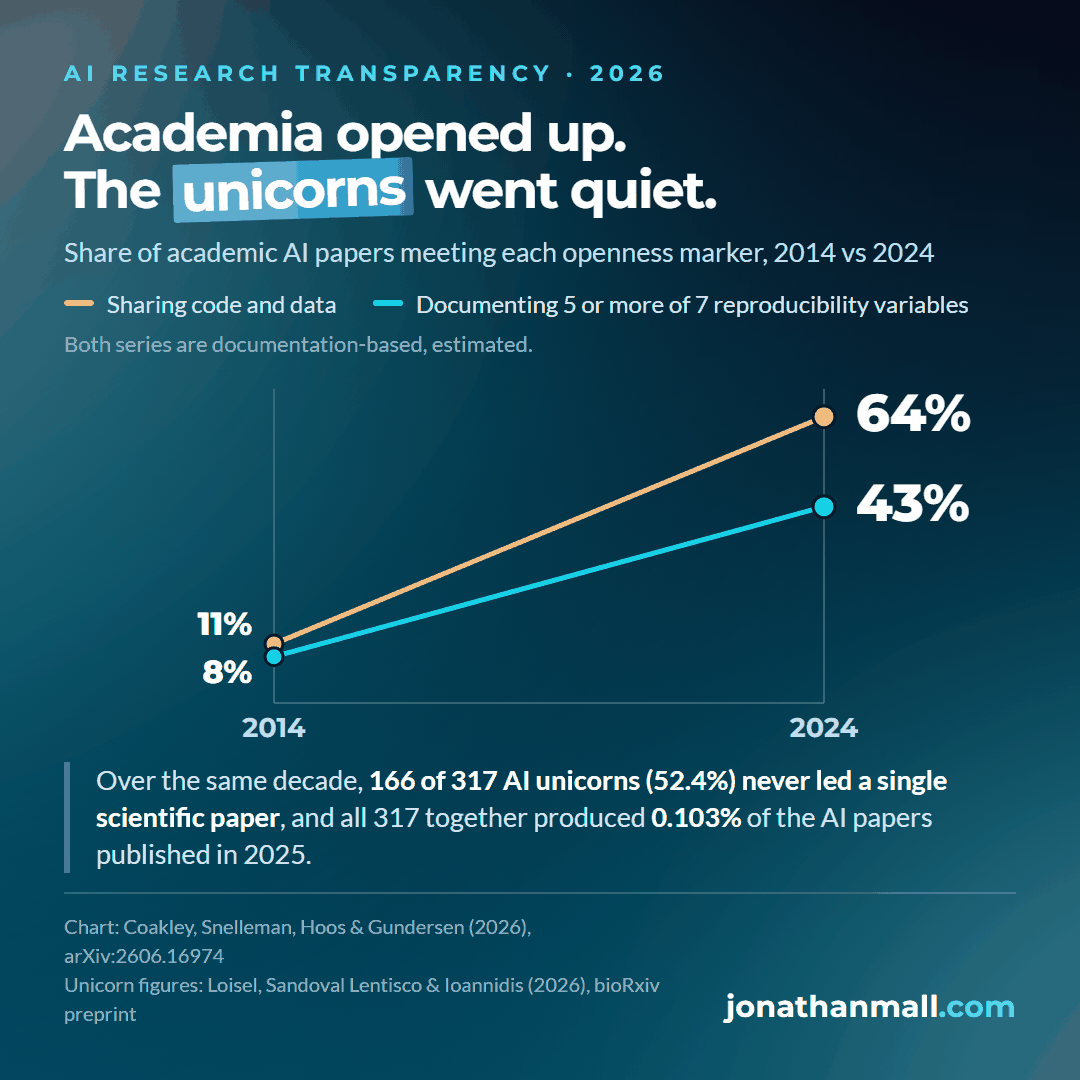
Academia's own record backs this up: an arXiv survey found that the share of AI papers documenting reproducibility variables rose from 8% in 2014 to 43% in 2024. The same survey notes the improvement is stalling wherever the underlying datasets stay closed, which is exactly the condition the unicorns are choosing. Openness did not disappear from AI research. It retreated to the part of the field with the weakest incentive to hide it.
Planning an event on AI, consumer psychology, or market research? Book Jonathan Mall as a keynote speaker: this story, live on stage, with the evidence to back it.
Openness Is Becoming the Challenger's Strategy
The silence is also not universal, and where it breaks, it breaks in a specific direction. On July 15, Mira Murati's Thinking Machines released Inkling, a 975-billion-parameter open-weight model under an Apache 2.0 license, monetized through fine-tuning tooling rather than API tolls, according to TechCrunch. This is not charity so much as a wedge: a company without a hundred-billion-dollar head start choosing verifiability, because it cannot compete on opacity against firms that got there first.
My prediction, watching from the buyer's side of the market: as the giants go quiet, verifiable evidence becomes a moat for everyone who is not already the incumbent, and buyers will slowly learn to price the difference. Until they do, here is the checklist I hand any marketer evaluating an AI vendor, whether the product is a foundation model or a research panel like the one I sell, expanded further in our buyer's guide to digital-twin software:
- Ask for one study the vendor could have failed, and see whether they show you the failure.
- Ask what the product explicitly cannot do; a vendor with no known limitation has not looked hard enough.
- Ask whether their validation numbers come from a revealed outcome, money, survival, an actual choice, or from a survey that only measures agreement with itself.
Openness is optional right now precisely because so few companies have chosen it. That will not last. The moment enough buyers in a market start asking these three questions and rewarding vendors who answer them, silence stops being a rational strategy and starts being a competitive disadvantage.
Want research you can actually check? Read the full 8,352-startup study including our published null result, or book a conversation with Jonathan.
Sources
- Science (2026-07-28): "AI's top startups are barely publishing their research" (science.org)
- Loisel, Sandoval Lentisco & Ioannidis (July 2026), bioRxiv preprint (biorxiv.org)
- Hacker News discussion, 505 points (news.ycombinator.com)
- The Decoder: "DeepMind dismantles its AlphaFold team as key authors leave for Anthropic" (the-decoder.com)
- r/singularity thread, 603 upvotes (reddit.com)
- CACM (2022): "I don't really trust papers out of Top AI Labs anymore" (cacm.acm.org)
- semiodept: "AI labs don't know how to make you trust them" (semiodept.com)
- TikTok, @spencewuah, 1.47M views (tiktok.com)
- arXiv reproducibility survey (arxiv.org)
- TechCrunch (2026-07-15): "Thinking Machines amps up its bet against one-size-fits-all AI with its first open model, Inkling" (techcrunch.com)
- Science on X, @NewsfromScience (x.com)
About the author: Dr. Jonathan Mall is a cognitive neuropsychologist, co-founder of neuroflash, and keynote speaker on AI and consumer psychology. Contact: jonathanmall.com · LinkedIn.