The Anchoring Effect, Twin-Tested: A Strikethrough Price Lifts Purchases by 83%
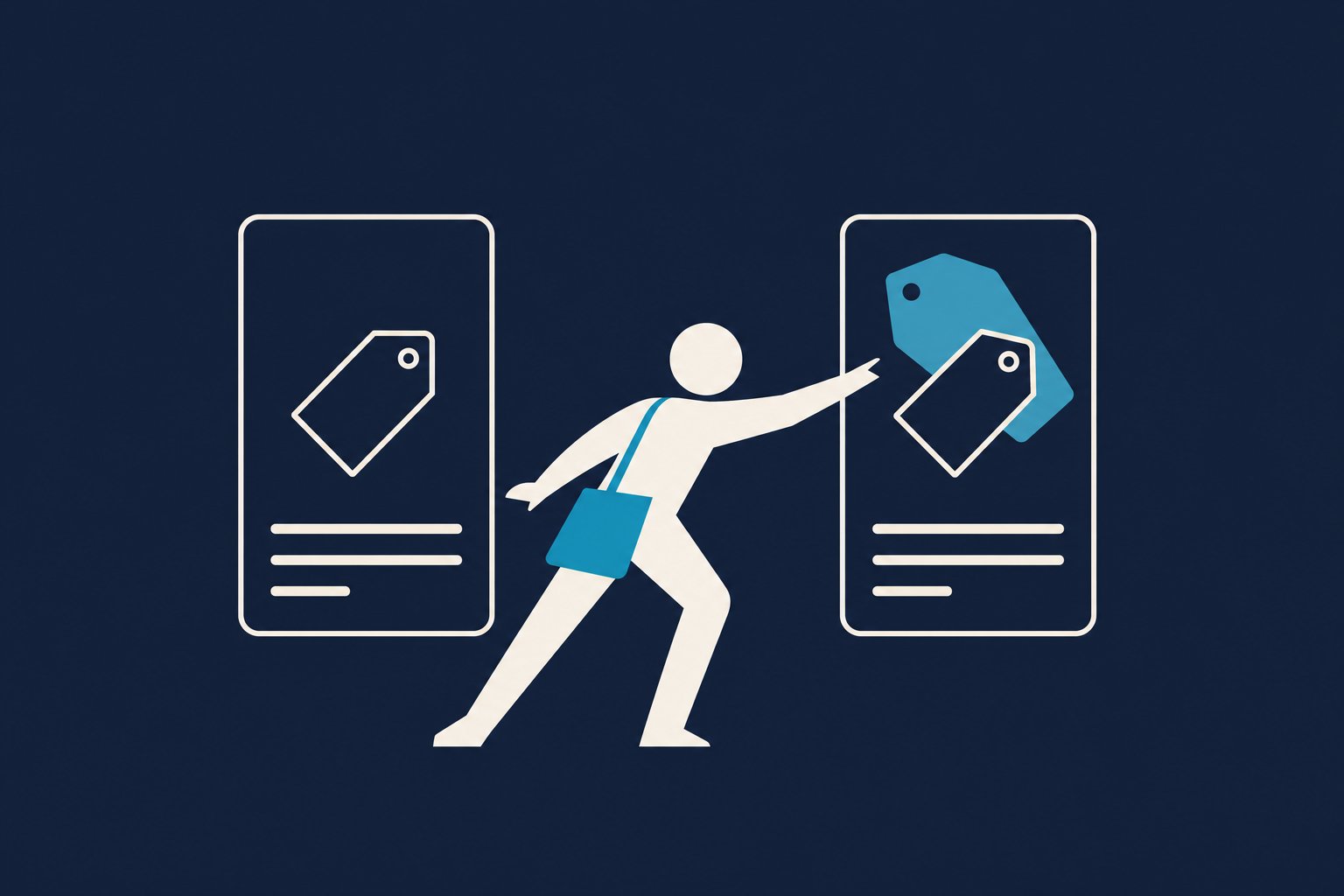
Proof, not claims: classic persuasion triggers, re-tested live with digital twins. → See all 23 purchase triggers at a glance.
Tversky, Kahneman, Ariely and colleagues describe a trigger, the anchoring effect, we re-tested it with digital twins.
What is the anchoring effect in strikethrough pricing?
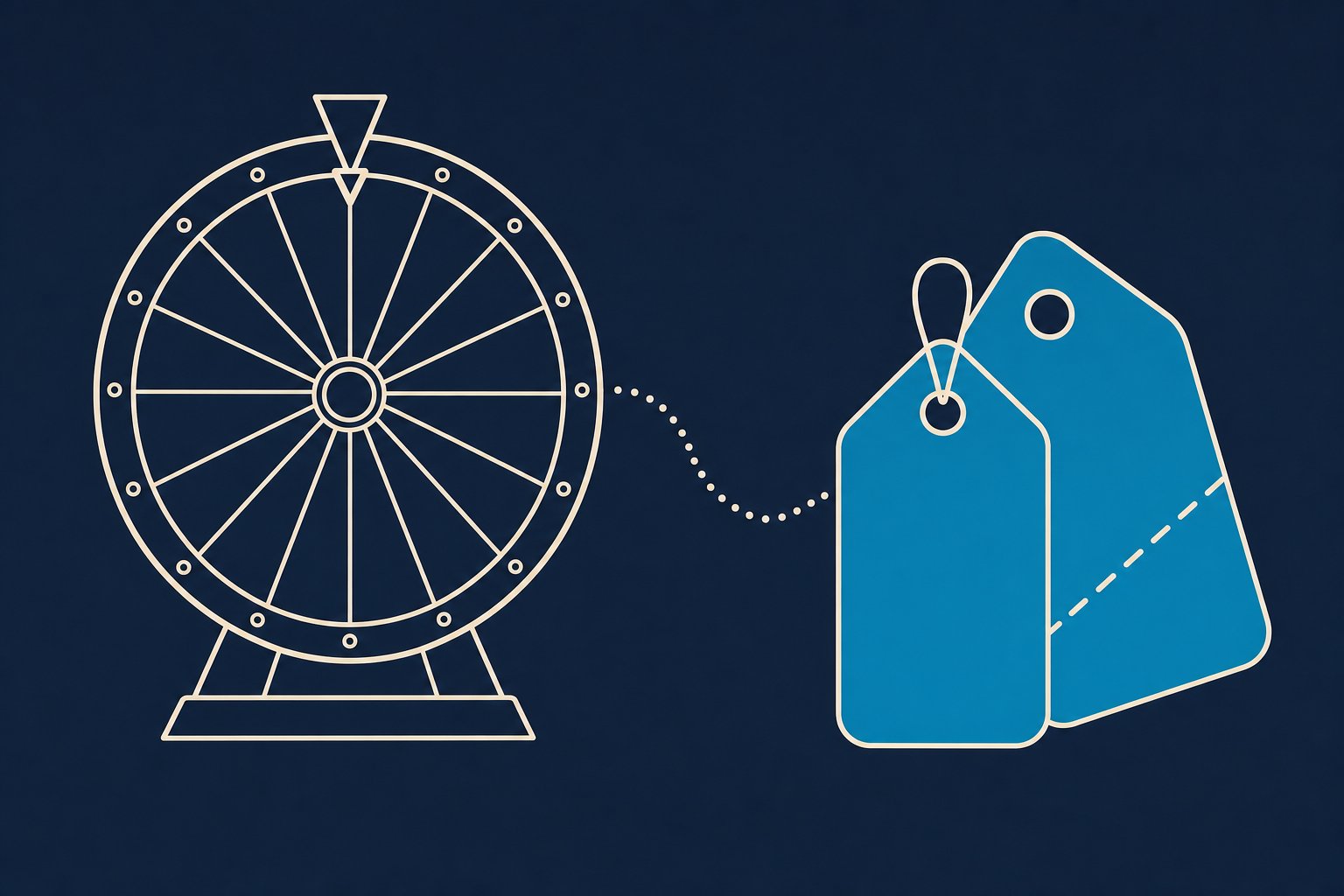
Everyone knows the picture from an online shop: a crossed-out price, next to it the supposedly reduced number. The idea behind it is one of the best-known findings in decision psychology, the anchoring effect. Amos Tversky and Daniel Kahneman showed in Science in 1974 that a completely arbitrary starting number systematically distorts subsequent estimates: participants watched a wheel of fortune spin out a number between 0 and 100, then estimated the percentage of African countries in the United Nations. Groups that saw a low wheel value (10) estimated a median of 25 percent, groups that saw a high wheel value (65) estimated 45 percent, even though everyone knew the number was random.
Ariely, Loewenstein and Prelec built on this in a widely cited 2003 study: MBA students first indicated whether they'd buy six products at a price derived from the last two digits of their social security number, then stated their maximum willingness to pay in a real auction. Those with a high random digit were willing to pay 57 to 107 percent more than those with a low digit, for identical products. The authors call this "coherent arbitrariness": the anchor is arbitrary, but once it's set, the relative price ordering stays stable.
In retail, the same principle shows up as a strikethrough price: a higher "was" price next to the actual offer. We wanted to know whether digital twins respond to such a strikethrough price the same way, even though the final price stays exactly the same in both cases.
How did we test the strikethrough-price effect?
The Method: n = 10 digital twins (DACH consumer panel, ages 25–60) per condition, between-subject. Each twin saw only ONE price presentation per run, never both side by side, because otherwise the comparison itself would have become the topic instead of the anchor working unnoticed. Across two counter-balanced runs the panel halves swapped conditions, so that by the end every twin had seen both price presentations exactly once, pooled into two independent n=10 samples (10 twins × 2 counter-balanced runs, not independent observations in the strict sense). The question wasn't "would you buy: yes/no" but an allocation: "Out of 10 opportunities, how many would you take?", which produces a realistic distribution instead of an all-or-nothing result. The panel responded in German; quotes are translated.
The effect holds up independently across both runs (5.8 vs. 3.2 and 5.2 vs. 2.8), so twin identity and order can't explain the difference. We tested a retailer-style strikethrough price, not a replication of the arbitrary random anchors (wheel of fortune, social security number) used by Tversky & Kahneman or Ariely et al.. Only the anchoring PRINCIPLE is being carried over to the retail case. What we measured was stated purchase intent from synthetic twins across ten hypothetical repeats, not conversion tracking. Only two assignment orders (instead of the intended three) were possible with this 2×2 between-subject design, a structural, documented limitation.
 Beate Hofmann, 58
Project manager twin* · Stuttgart · University degree
“I'm Beate Hofmann, a project manager from Stuttgart. Since my divorce I've found new stability with a new partner, and even though I'm living with chronic back pain and an active cancer diagnosis, I stay active with daily exercise and feel deeply satisfied with my life.”
What makes this twin distinct: I hold strong private religious beliefs without attending church, I'm deeply skeptical of politics and the economic situation, and I guard my data so carefully that I'll pass up a discount rather than share it.
* Digital twin: an AI simulation based on a real person’s profile: 68+ survey items, a full psychographic profile (values, demographics, behavior). Not a real person.
 Sabine Wagner, 56
Nurse twin* · Leipzig · Upper secondary education
“I'm Sabine Wagner, a nurse at a hospital in Leipzig. I'm married and live with my husband, but between 40-hour shift work and running the household, I have almost no time left for myself.”
What makes this twin distinct: My faith isn't just tradition. It's an active source of strength for a demanding job, I place strong trust in the police and the justice system, and despite my packed hospital schedule I still volunteer for charitable causes.
* Digital twin: an AI simulation based on a real person’s profile: 68+ survey items, a full psychographic profile (values, demographics, behavior). Not a real person.
 Kathrin Baumann, 32
Teacher twin* · Munich · Postgraduate degree
“I'm Kathrin Baumann, a primary school teacher from Munich. I'm married with two young children, and life right now is turbulent between school and a young family. Exercise has taken a back seat.”
What makes this twin distinct: I trust people deeply and tend to look for the good in them, I lean politically left and feel close to the Greens, and I consistently boycott products for sustainability reasons even though politics otherwise takes a back seat in my daily life.
* Digital twin: an AI simulation based on a real person’s profile: 68+ survey items, a full psychographic profile (values, demographics, behavior). Not a real person.
 Melanie Schubert, 33
Bank clerk twin* · near Frankfurt · Advanced vocational education
“I'm Melanie Schubert, a bank clerk at a large company near Frankfurt. I'm married and live with my husband, though occasional back and neck issues slow me down a bit in daily life.”
What makes this twin distinct: I'm considerably more risk-averse than most people around me, I avoid leadership roles and deliberately limit my own time online even though I'm perfectly capable with technology. Order and reliability matter more to me than trying new things.
* Digital twin: an AI simulation based on a real person’s profile: 68+ survey items, a full psychographic profile (values, demographics, behavior). Not a real person.
 Lukas Sander, 33
Retail twin* · Dortmund · Postgraduate degree
“I'm Lukas Sander, a retail employee with team-lead responsibility in Dortmund. I'm married with three children aged two, four, and seven, between a 40-hour work week and a full family life, I feel very satisfied and firmly in control.”
What makes this twin distinct: Even though I'm security-oriented and risk-averse, I strongly support minority rights, including LGBTQ rights, and want a strong, socially active government, and my postgraduate degree gives me an unusual outside perspective on my retail job.
* Digital twin: an AI simulation based on a real person’s profile: 68+ survey items, a full psychographic profile (values, demographics, behavior). Not a real person.
 Anke Schumann, 48
HR twin* · Hamburg · University degree
“I'm Anke Schumann, an HR officer at a mid-size company in Hamburg. I'm married, have two sons, and feel deeply fulfilled and settled in my life.”
What makes this twin distinct: I place strong trust in parliament and the justice system even though the economic situation leaves me dissatisfied, I champion income equality and minority rights, and yet I also see obedience and respect for authority as core parenting values, a contradiction I notice in myself.
* Digital twin: an AI simulation based on a real person’s profile: 68+ survey items, a full psychographic profile (values, demographics, behavior). Not a real person.
 Sören Lindner, 30
IT twin* · Cologne · Advanced vocational education
“I'm Sören Lindner, an IT administrator at a large company in Cologne. I'm not married and live with my partner. My childhood was shaped by financial hardship and family conflict, which made me more risk-tolerant and determined as an adult.”
What makes this twin distinct: I'm unusually risk-tolerant and drawn to leadership, I protest and donate for causes I believe in, I guard my data strictly despite my strong tech affinity, and I actively oppose workplace inequality for women.
* Digital twin: an AI simulation based on a real person’s profile: 68+ survey items, a full psychographic profile (values, demographics, behavior). Not a real person.
 Tobias Hübner, 35
Mechatronics twin* · Essen (Ruhr area) · Upper secondary education
“I'm Tobias Hübner, a mechatronics technician at a mid-size electronics manufacturer in Essen, in the Ruhr area. I'm not married and live in a large six-person household with my parents and younger relatives, chaotic, but a strong source of security for me.”
What makes this twin distinct: I put several hours a week into caring for relatives and neighbors rather than outward-facing social activities, I consistently reject tracking cookies, and I still vote regularly even though I feel my vote carries little real weight.
* Digital twin: an AI simulation based on a real person’s profile: 68+ survey items, a full psychographic profile (values, demographics, behavior). Not a real person.
 Dennis Altmann, 41
Sales twin* · Düsseldorf · University degree
“I'm Dennis Altmann, a sales rep at a mid-size wholesale company in Düsseldorf, and I travel frequently for work. I'm married with three children. My own childhood was marked by financial strain and conflict, which is why I want a more stable, harmonious home for my own kids.”
What makes this twin distinct: Unlike Düsseldorf's generally liberal environment, I place high value on clear rules, order, and traditional parenting values like obedience and respect for authority, I meet strangers with healthy skepticism; my father originally came from Turkey.
* Digital twin: an AI simulation based on a real person’s profile: 68+ survey items, a full psychographic profile (values, demographics, behavior). Not a real person.
 Jürgen Krause, 59
Accountant twin* · Berlin · Upper secondary education
“I'm Jürgen Krause, an accountant nearing retirement in Berlin. I've never married and live with two older relatives I care for about 15 hours a week, while dealing with back and joint pain and occasional severe headaches.”
What makes this twin distinct: I'm socially and culturally conservative, value tradition and respect for authority, and feel little connection to the European idea despite living in a cosmopolitan city, yet I still vote SPD because social and income justice matter to me.
* Digital twin: an AI simulation based on a real person’s profile: 68+ survey items, a full psychographic profile (values, demographics, behavior). Not a real person.
* Digital twins are AI simulations based on real person profiles, not real people. Click a twin to see what it is based on.
What we tested
Strikethrough price (anchor) Winner · 5.5 of 10
“The product page shows: €129 €89.”
Flat price (no anchor) · 3.0 of 10
“The product page shows: €89.”
Why does a crossed-out price work even when the final price stays the same?
€129 vs. €89, the same coffee-machine final price, once with a visible strikethrough price, once without. With the anchor, the twins reached for the product on average 5.5 out of 10 occasions, without the anchor only 3.0 out of 10, a gain of 83 percent, even though the product, the final price, and every other sentence in the stimulus stayed identical. Only the line "€129 €89" instead of "€89" distinguished the two conditions.
The effect isn't a one-off artifact of a single measurement: both counter-balanced runs show the same pattern (5.8 vs. 3.2 in the first, 5.2 vs. 2.8 in the second), regardless of which panel half saw which condition when.
Seven out of ten strikethrough-condition responses explicitly named the €129 comparison price or the savings as the reason for reaching for the product, not as a marketing trick, but as a genuine, positive purchase signal. "A price of €89 for a coffee machine that used to cost €129 is a good deal to me, because I pay close attention to fair value for money and compare a lot before I buy," says twin "Sabine" (digital twin, DACH consumer panel) in the strikethrough-price condition. Notably, that same Sabine answers quite differently in the flat-price run. "I would probably only take it 1 out of 10 times, since €89 is just an average price and I'd be hoping for a better deal … a real bargain would need to be well below this price for me," says twin "Sabine" without the anchor, the same twin, the same final price, the opposite condition.
Jürgen Krause, the accountant twin, also makes the reference price an explicit argument: "The reduced price of €89 is then the deciding argument to finally go for it, because as an accountant I naturally pay attention to good value for money," says twin "Jürgen."
Is the anchoring effect equally strong across all twins?
No, and that's exactly what makes the result more credible than a clean, unanimous picture. Seven out of ten twins reached for the product more often with the strikethrough price than without; three moved slightly in the opposite direction (each −1 point: Lukas Sander, Anke Schumann, Sören Lindner). The 2.5-point average gap is carried mainly by four twins with large deltas (+6, +6, +4, +7), a descriptive panel result with visible spread, not a significance claim.
Lukas Sander is the most interesting case: he deliberately puts an "offer" in scare quotes and explicitly re-normalizes the price. "To me, €89 is just a normal price," says twin "Lukas." He's functionally anchor-resistant and also one of the three twins with a negative delta between conditions. Notably, none of the ten twins explicitly called the strikethrough price a marketing trick. Several were anchor-aware, but not anchor-resistant in the sense of openly rejecting the tactic. Real consumers might react more skeptically here, which would tend to dampen the effect in the field rather than amplify it.
A second measure: how cheap the €89 price feels subjectively, on a scale from 1 to 10, points in the same direction (8.33 with the anchor versus 4.5 without), but rests on only three and two cases respectively that actually answered with a number. That's directionally suggestive, not a robust metric. We're showing it here explicitly with this small base, not as a second headline number.
Classic study
Tversky & Kahneman (1974): An arbitrary starting number (wheel of fortune) shifts subsequent estimates substantially, median 25 vs. 45 depending on the anchor.
Digital twins (2026)
+83% more purchase willingness (5.5 vs. 3.0 of 10) from the visible strikethrough price alone, at the identical final price.
Same principle, measured fresh: in minutes instead of weeks of fieldwork.
Does this replicate the anchoring effect from Tversky & Kahneman and Ariely?
Only in principle, not in procedure. Neither the wheel-of-fortune experiment nor the social-security-number study can be rebuilt one-to-one with a text-based twin panel. There's no real wheel of fortune, and digital twins have no persistent social security number across sessions. Instead, we tested the real retail variant of the anchor: a retailer-set strikethrough price, the kind found in practically every online shop. That's a domain shift, from an anchor the participant knows to be arbitrary, to an anchor that plausibly looks informative. So the twin finding shouldn't be described as a "replication of the wheel-of-fortune experiment" or a "replication of the SSN-digit study," but as a test of whether the same anchoring principle also shifts stated purchase intent with a plausible, not obviously random reference price, and that's exactly what happens in our data.
What does this mean for your price communication?
The practical takeaway from this one test: a strikethrough price is not a minor detail on the product page. In our panel it influenced stated purchase willingness more strongly than any other price variable we normally track, at exactly the same final price. At the same time, the spread within the panel shows that a strikethrough price doesn't automatically convince everyone: three out of ten twins reacted slightly against the grain, and one anchor-resistant case deliberately re-normalized the price. Before you roll out a strikethrough price broadly, it's worth running your own small test with your target audience: product category, price level, and the credibility of the reference price are likely to determine whether the effect is just as large for you.
Want to know if a strikethrough price works with your own target audience? Book my keynote "Why Consumers Buy Weird": including a live demo of how digital twins test pricing decisions in minutes.
This experiment is part of The Trigger Lab series, in which we re-test classic findings from consumer psychology with digital twins. Read the full overview of all re-tests in the flagship article "Brainfluence Retested."
Further reading
- Loss Aversion & Framing in the Twin Test
- The Endowment Effect: Why a Free Trial Outweighs the Price
- Digital Twins in Market Research: The Complete Guide 2026
Frequently asked questions
How much does a strikethrough price increase purchase willingness in the twin test?
With a visible strikethrough price (€129 crossed out, €89 current price), the digital twins reached for the product on average 5.5 out of 10 occasions; without the strikethrough price at the identical final price of €89, only 3.0 out of 10, an increase of 83 percent from the anchor alone.
Is this a replication of Tversky & Kahneman's anchoring experiment?
Only in principle. Tversky & Kahneman (1974) and Ariely, Loewenstein & Prelec (2003) worked with arbitrary random anchors (wheel of fortune, social security number) that participants knew to be meaningless. We instead tested a retailer-set strikethrough price that plausibly looks informative, a real retail variant of the same anchoring principle, not a direct replication of the original procedures.
Does the strikethrough price work the same way for every digital twin?
No. Seven out of ten twins reached for the product more often with the strikethrough price; three moved slightly in the opposite direction. One twin deliberately re-normalized the price and showed functional anchor resistance. The average effect is carried mainly by four twins with large swings, a descriptive panel result, not a significance claim.
How was this test with digital twins conducted?
Digital twins from a DACH consumer panel (ages 25–60) each saw only ONE price presentation of the same coffee machine, either with a strikethrough price or as a plain flat price, and stated how many out of 10 opportunities they would take. Across two counter-balanced runs the panel halves swapped conditions, resulting in two independent samples of ten per condition.
Glossary: The Trigger Lab vocabulary
Digital twins: AI personas built on real survey profiles that respond to text stimuli with forced-choice decisions and ratings: a market-research panel that answers in minutes instead of weeks. → More on this: Digital Twins in Market Research: The Complete Guide
The Trigger Lab: the article series in which classic findings from consumer psychology are re-tested live with digital twins from a DACH consumer panel. → See the experiment: Brainfluence Retested
Anchoring effect: a first-mentioned number, such as a crossed-out original price, distorts the evaluation of every price that follows, even when the anchor is arbitrary or recognizably so (Tversky & Kahneman, 1974; Ariely, Loewenstein & Prelec, 2003).
Trust words: fixed trust phrases placed under the buy button, such as money-back guarantee, customer reviews, or a safety certification, that, per Dooley (Brainfluence, 2011), increase perceived trust and purchase willingness. → See the experiment: Trust Words in the Twin Test
Loss aversion & framing: losses weigh psychologically heavier than equally sized gains, which is why loss-framed messages ("don't miss out…") are expected to work more strongly than gain-framed ones ("secure yours…") (Tversky & Kahneman, 1981). → See the experiment: Loss Aversion & Framing in the Twin Test
Endowment effect: once someone already owns or uses a product, it becomes subjectively more valuable and harder to give up than at the point of first purchase (Kahneman, Knetsch & Thaler, 1990). → See the experiment: The Endowment Effect in the Twin Test
Pick share (forced choice): the share of twins who choose a given option in a forced-choice question with no "don't know" option, averaged across two counter-balanced orderings.
Allocation measurement: a question technique in which twins state how many out of 10 purchases or situations they would choose a given option, producing a realistic distribution instead of a single unanimous yes/no picture.
Sources & further reading
- Tversky, A. & Kahneman, D. (1974). Judgment under Uncertainty: Heuristics and Biases. Science, 185(4157), 1124–1131. ("Adjustment and Anchoring" section)
- Ariely, D., Loewenstein, G. & Prelec, D. (2003). "Coherent Arbitrariness": Stable Demand Curves Without Stable Preferences. The Quarterly Journal of Economics, 118(1), 73–105.
- Trigger Lab Experiment G1 (Anchoring Effect, Strikethrough Price), 2026, n = 10 digital twins (neuroflash).
Get the same scientific power for your marketing: Use the digital twins from this experiment yourself: via the neuroflash Digital Twins MCP directly inside Claude or Cursor, or in your browser at neuroflash.com. Your stimuli, the same panel principle, results in minutes.
Dr. Jonathan T. Mall
Cognitive neuropsychologist, AI entrepreneur, and Chief Innovation Officer at neuroflash. Jonathan combines 20+ years of experience in neuroscience and AI to predict how people decide. His signature keynote "Why Consumers Buy Weird" explains why we buy irrationally, and how digital twins can predict it. Want to experience these insights live? Book an AI keynote with live demos. LinkedIn · Request a keynote