B2B Buying-Committee Psychology: Why 6-10 Decision-Makers Rarely Agree

B2B decision psychology, tested live with digital twins: proof instead of assertion.
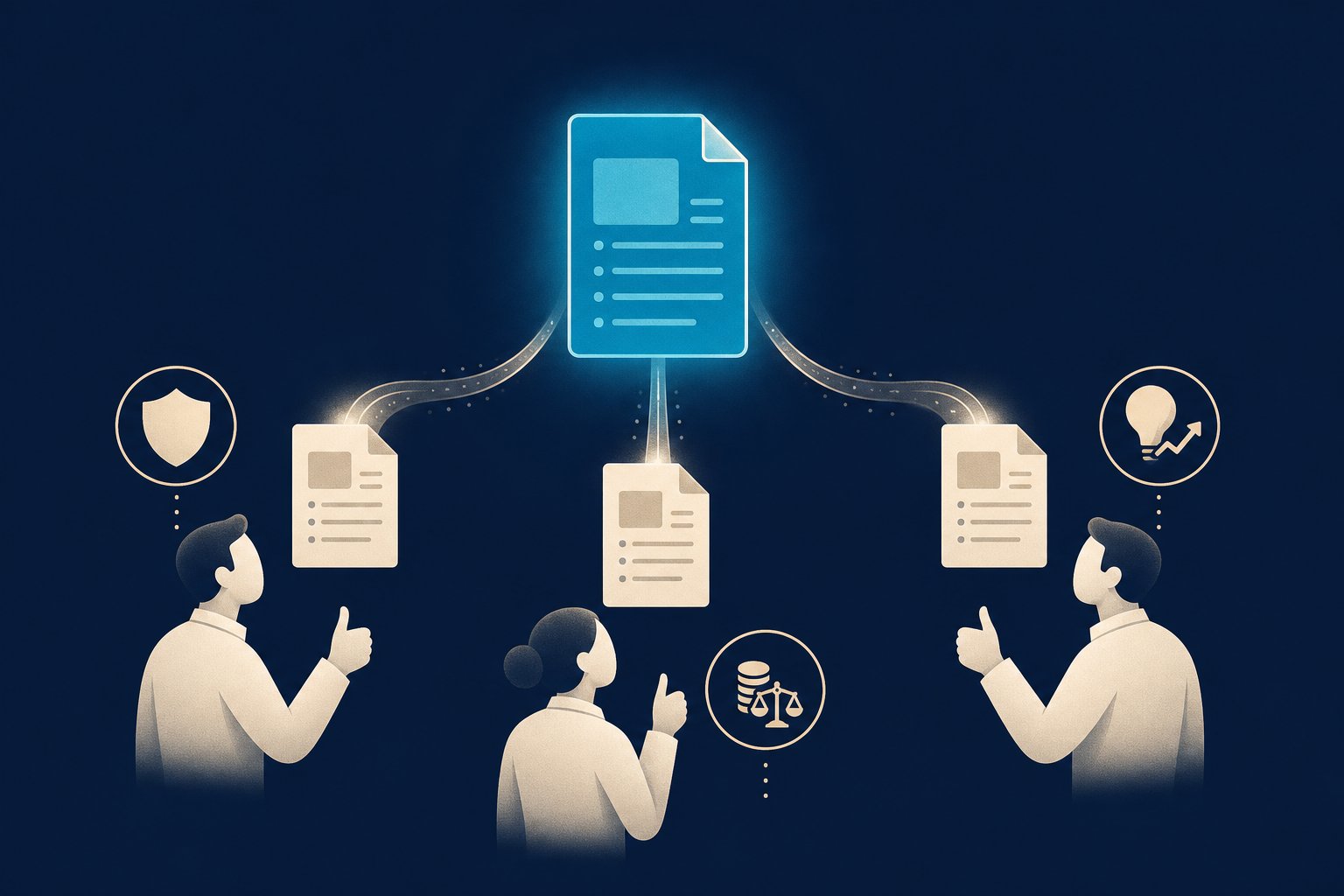
“On average, 6 to 10 people are involved in a B2B purchase decision”, this finding from CEB’s (now Gartner’s) sales research, popularized in The Challenger Customer (Adamson, Dixon, Toman & Spenner, 2015), explains why B2B deals drag on: what needs convincing is an entire panel with conflicting priorities, not a single person. We wanted to see whether and how this consensus conflict could be made visible with digital twins, and whether the same message lands differently depending on role.
Why do 6 to 10 decision-makers rarely agree?
The classic explanation is structural: a buying committee bundles people whose success is measured against different metrics. The Finance role is judged on avoided bad investments, the IT role on data security and system stability, the Strategy role on growth and innovation edge. The same software is a risk to be hedged for one person and a lever to be pulled for another. Daniel Kahneman’s work on loss aversion (Kahneman & Tversky, 1979) supplies the psychological foundation: for many roles, a possible loss weighs more heavily than an equally sized possible gain, especially where someone is held accountable for mistakes.
Rather than just citing that thesis, we measured it. We built three twin panels, Finance/Procurement, IT leadership (CIO/CTO), Strategy & Innovation, and presented each with the same fictional software offer in three text versions. Same product, same price, same six facts. The only thing that varied was what the text opened with and where it put its emphasis.
What we tested
Variant S · Risk focus Winner · 59 %
“No risk to your data landscape: GDPR-compliant, EU hosting, cancellable after twelve months: no lock-in …”
Variant F · Capability focus 24 %
“From week six, your team sees which customers are about to churn before they do …”
Variant R · ROI focus 17 %
“Pays for itself from month nine: measurably lowers effort, full cost transparency …”
Which framing wins the purchasing meeting?
Across all three roles combined, the risk focus prevailed: it won 59 % of the choices, capability focus 24 %, ROI focus 17 %. In an environment where decision-makers are on the hook for mistakes, “you take on no risk” beats the promise of “you gain more”, exactly the pattern loss aversion predicts.
But the average conceals where the committee split, and that is exactly the point. Broken down by role:
- Finance & Procurement: the most clearly risk-driven. Risk focus took the majority, with ROI focus ahead of capability focus. Numbers and exit clauses convince here more than feature promises.
- IT leadership (CIO/CTO): also risk-dominated, but the argument runs through data sovereignty, GDPR and avoiding shadow IT rather than budget.
- Strategy & Innovation: the only role where capability focus held its own. “Spot churn before it happens” speaks directly to their mandate. ROI focus fell flat here almost entirely.
In other words: whoever sends only one version of their message wins one role at best and loses the rest. The committee splits along its own metrics.
The method:
Three panels of 10 digital twins each (neuroflash), built on B2B decision-maker profiles in the DACH region: Finance/Procurement, IT leadership, Strategy & Innovation. Each panel was shown the same offer in three text variants, in groups of five and in alternating order (R-S-F, F-S-R, and S-F-R as a control). The primary measure is the forced choice (which variant would have to win the purchasing meeting), with a secondary points allocation across ten fictional purchase scenarios. 75 choice responses were usable for analysis. Limits: digital twins replicate a panel, not a real committee with group dynamics; the points-allocation data fell below the threshold for a robust standalone figure (under 15 usable per role) and serves only as a secondary signal; freshly created twins tended toward role monologues without an actual judgment on the first pass. Those runs were discarded and repeated. All raw responses are logged per twin.
The real finding: order beats framing
Had we measured only once, the story would be “risk focus wins”, clean and plausible. But because we tested each role across several argument orders, a second effect emerged that was larger than expected: the position of an argument in the list influenced the choice more than its content did.
The middle position took 55 % of all votes: regardless of which variant sat there. It is even clearer within the same twins: one Strategy panel chose capability focus by majority in one order and flipped to risk focus by majority when the order was reversed. An IT panel that had first chosen risk focus unanimously switched almost entirely to ROI focus once we moved the risk text to the front and the ROI text to the end. Same decision-makers, same texts, different order, different majority. This matches the “center-stage effect” (Rodway, Schepman & Lambert, 2012): what sits in the middle reads as the obvious choice.
Add to that a third, uncomfortable finding: in 28 % of the responses, the twins justified their choice with attributes that did not appear anywhere in the chosen text. One role praised “risk minimization” in the ROI text, another commended the “graphic presentation” of what was pure running text. Position steered the choice; role supplied the justification afterward. That is exactly the pattern described by “choice blindness” research (Johansson et al., 2005), tracing back to Nisbett & Wilson (1977): people, and, apparently, their digital counterparts too, confidently explain decisions whose real cause is not accessible to them.

Classic view
Challenger Customer (2015): 6 to 10 decision-makers with conflicting priorities have to reach consensus, which slows B2B deals down.
Digital Twins (2026)
59 % risk focus, but each role runs on its own logic, and argument order tips the majority.
The same panel, simulated in minutes instead of coordinated over weeks.
What does this mean for your B2B communication?
Three concrete consequences for anyone selling to committees:
- Role-specific, not one-size-fits-all. One message for everyone wins one role and loses the rest. Anyone who wants to convince Finance, IT and Strategy in the same deal needs three cuts of the same facts: risk language for Finance and IT, capability language for Strategy.
- Order is a lever, not an accident. If the middle position is systematically favored, the strongest role-specific argument belongs there, not at the start, where it gets skimmed over, and not at the end, where it reads as an afterthought.
- Justifications are unreliable. If decision-makers back their choice with invented attributes, after-the-fact feedback (“why didn’t you go with that one?”) is a weak data source. It is more reliable to test the choice itself under controlled conditions before the text goes out.
The real value lies in speed: coordinating a real buying committee for an A/B test of offer language is practically impossible. A twin panel delivers the same role friction in minutes, early enough to sharpen the message before it reaches the real committee. For how reliably twins track reality, see our guide to digital twins in market research; for how they compare to classic focus groups, see the method comparison.
How differently the roles ticked shows in their own words. “Data protection and hosting aren’t nice-to-haves for us. They’re the baseline requirement just to make the shortlist,” says twin ‘Beate’ (Head of Strategy). A Finance role weighs it differently: “I always look at the numbers first. ‘Pays for itself from month nine’ speaks directly to my planning needs,” says twin ‘Antje’. And an IT role puts the priority plainly: “Before I think about features or ROI, data sovereignty has to be settled. That’s the door-opener for any innovation.” (All statements come from digital twins, not real people.)
This exact experiment runs live on stage in my keynotes: the audience calls out the variants, the digital twins decide in real time, science you can watch happen, rather than a talk read off slides. If you are looking for a speaker on AI and decision psychology who brings the room in: request an AI keynote with live demos → Fee (mid four-figure range) and availability are laid out transparently on the booking page.
Related articles
- How AI Is Changing Neuromarketing, why even rational B2B purchases are decided in the emotional system.
- Digital Twins in Market Research. The Complete Guide 2026
- Digital Twins vs. Focus Groups. The Method Comparison
Frequently asked questions
How many decision-makers are involved in a B2B purchase decision?
According to CEB/Gartner sales research, popularized in The Challenger Customer (2015), an average of 6 to 10 people are involved in a B2B purchase decision. These roles are measured against different metrics, which is why they evaluate the same solution differently.
Which argument is most likely to convince a B2B buying committee?
In our twin test, the risk focus (“no lock-in, GDPR, EU hosting, cancellable”) won 59 % of the choices, ahead of capability focus (24 %) and ROI focus (17 %). Finance and IT responded most strongly to risk minimization, while Strategy was the only role to respond clearly to concrete capability.
Does the order of arguments affect the decision?
Strongly, in our test: the variant placed in the middle took 55 % of all votes, and the same panels switched their majority purely through a changed order. The strongest role-specific argument therefore belongs in the middle of the message, not at the start or the end.
Can a buying committee be simulated with digital twins?
Partly. Role-specific twins convincingly replicate the typical priorities of Finance, IT and Strategy and make the friction within the committee visible in minutes. They do not replace real group dynamics and should be validated against a real panel before a campaign launches.
Sources & further reading
- Adamson, B., Dixon, M., Toman, N. & Spenner, P. (2015). The Challenger Customer: Selling to the Hidden Influencer Who Can Multiply Your Results. Portfolio/Penguin. (CEB/Gartner finding: 6–10 decision-makers per B2B purchase.)
- Kahneman, D. & Tversky, A. (1979). Prospect Theory: An Analysis of Decision under Risk. Econometrica, 47(2), 263–291.
- Rodway, P., Schepman, A. & Lambert, J. (2012). Preferring the One in the Middle: Further Evidence for the Centre-stage Effect. Applied Cognitive Psychology, 26(2), 215–222.
- Johansson, P., Hall, L., Sikström, S. & Olsson, A. (2005). Failure to Detect Mismatches Between Intention and Outcome in a Simple Decision Task. Science, 310(5745), 116–119.
- Nisbett, R. E. & Wilson, T. D. (1977). Telling More Than We Can Know: Verbal Reports on Mental Processes. Psychological Review, 84(3), 231–259.
- neuroflash Digital-Twins experiment P2-1, 2026, 3 role panels of 10 digital twins each (DACH B2B decision-makers), 75 usable choice responses.
Test your own offer language on a buying committee: Use role-specific digital twins yourself: via the neuroflash Digital Twins MCP directly inside Claude or Cursor, or in the browser at neuroflash.com. Your variants, the same panel principle, results in minutes.
Dr. Jonathan T. Mall
Cognitive neuropsychologist, AI entrepreneur and Chief Innovation Officer of neuroflash. Jonathan combines 20+ years of experience in neuroscience and AI to predict how people decide. His signature talk “Consumers Buy Weird” explains why we buy irrationally, and how digital twins predict it. Anyone who wants to experience these insights live can book an AI keynote with live demos. LinkedIn · Request a keynote