Can Digital Twins Replace Focus Groups? The Honest Method Comparison 2026
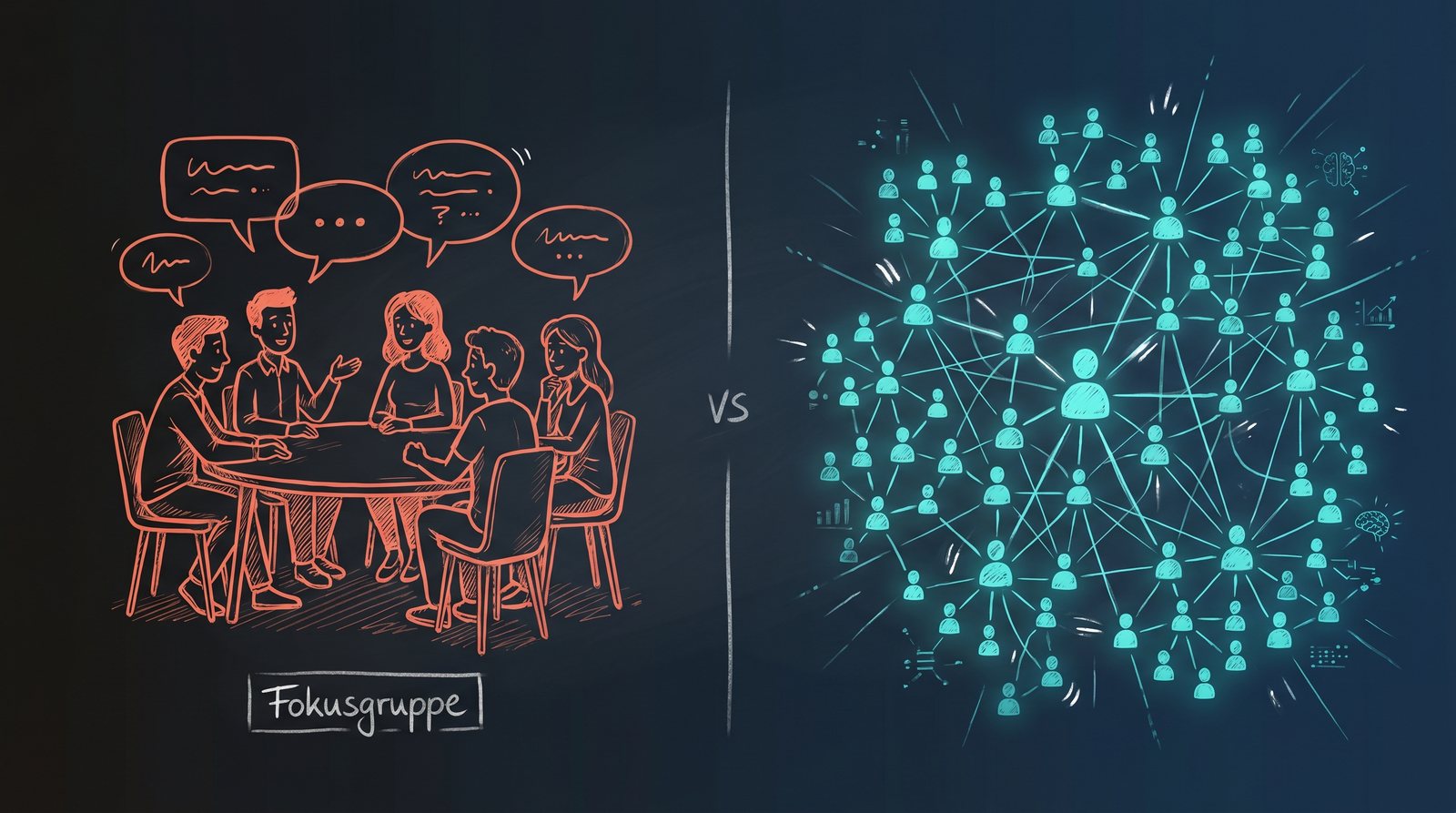
Why the most honest answers never surface in a focus group
Back in 2003, Harvard professor Gerald Zaltman put a number on the table that market research still hasn’t fully digested: 95 percent of all purchase decisions are made subconsciously. Yet most companies still rely on a method built on exactly the opposite assumption: put people in a room, ask them questions, and hope their conscious answers reflect their unconscious motives.
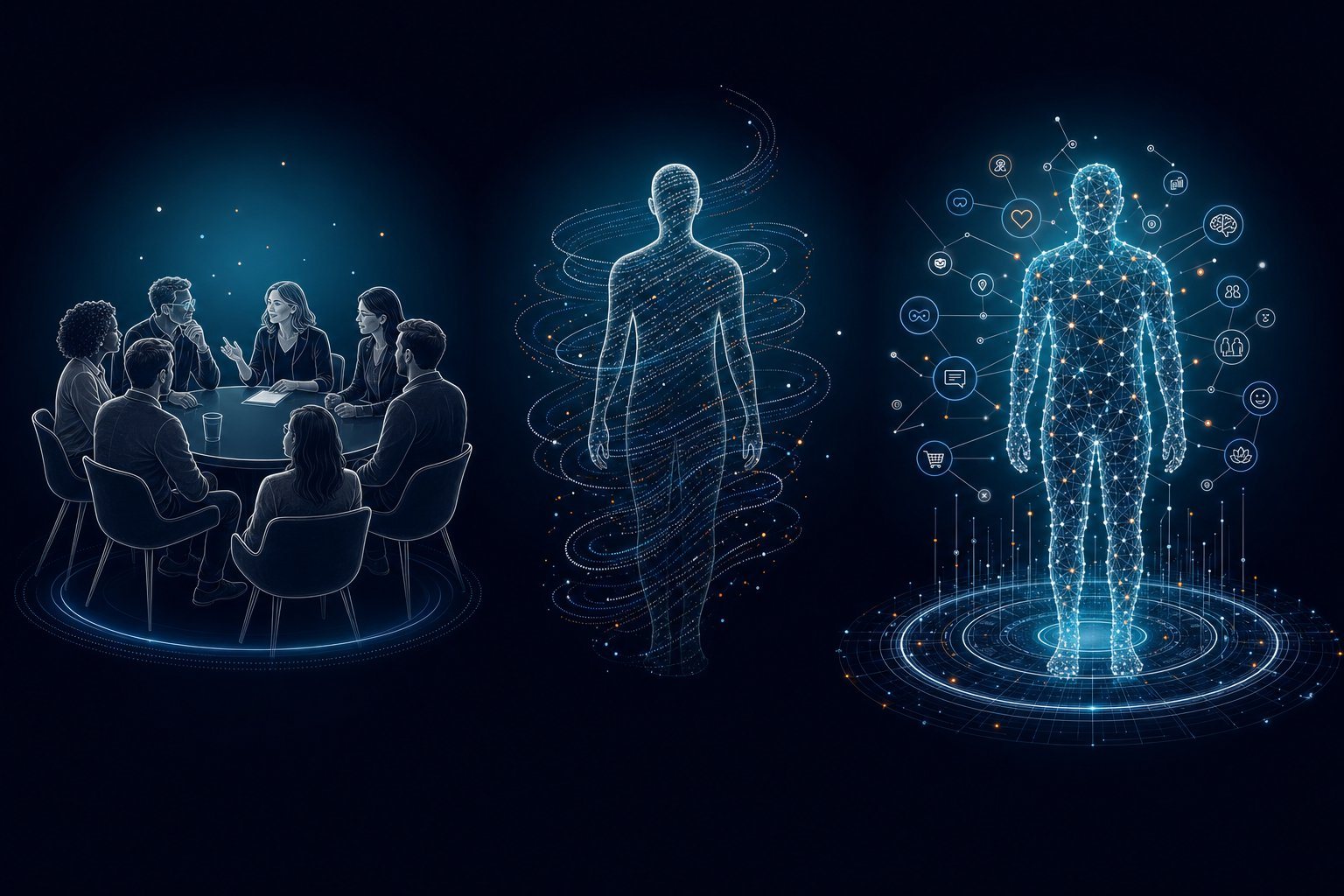
As a cognitive neuropsychologist, I’ve spent years researching the gap between what people say and what they actually do. In 2026, you have three methods to choose from for that question: the classic focus group, the new industry umbrella term Synthetic Respondents, and their data-grounded evolution, Digital Twins. This article compares all three, honestly, and shows when each one makes the decisive difference.
Disclosure: I’m the co-founder of a digital-twin provider. You’ll find the full disclosure, including our own numbers, in the transparency section at the end of this article.
The three methods, one paragraph each
Focus groups
Focus groups are the classic moderated group discussion: one moderator and 6 to 10 participants talking live about a topic. Since the 1940s, when sociologist Robert K. Merton first used them systematically, they have stood as the gold standard for exploratory depth, if you’re exploring a completely new topic and don’t even know which questions to ask, a good focus group delivers insights no other method can, because people tell stories, contradict themselves, and build on ideas live. Their weaknesses are just as well documented: social desirability suppresses honest answers. Nobody says in the group “I’m buying this bag for the status,” instead you hear “the craftsmanship won me over.” Dominance effects pull the discussion toward the loudest opinion, because the first position voiced becomes the anchor for every judgment that follows. And the timeline, typically several weeks from recruitment to final report, makes focus groups unsuitable for fast iteration.
Synthetic Respondents
Synthetic Respondents are LLM-based personas generated from a prompt, without an individual data foundation for the specific simulated person. A language model receives a role description like “respond as a 35-year-old mother from Munich” and generates plausible-sounding answers from it. The advantage: they answer in minutes instead of weeks and scale infinitely. You can test hundreds of variants at once. The term has become the industry’s umbrella label for synthetic survey participants, but quality varies widely: without an anchored data foundation and rigorous methodology, validity depends heavily on which metric you’re measuring, more on that in the validation evidence section below.
Digital Twins
Digital Twins are an evolution of synthetic respondents: instead of generating purely from a prompt, each simulated person is grounded in a real individual profile, at data-driven providers, built from 68 to 250 psychographic data points per profile drawn from real survey answers. The difference from a generic AI persona matters: where a pure prompt reproduces cultural stereotypes, a Digital Twin draws on empirically verified behavioral data from real people, complete with their cognitive biases, contradictions, and irrational preferences. Neuropsychologist Hans-Georg Häusel describes in Brain View three emotional core systems that govern our buying behavior, the dominance system (power, status, control), the stimulation system (curiosity, reward, adventure), and the balance system (safety, stability, habit), and every person has an individual profile on this “Limbic Map” (Häusel, 2012, ch. 3). A data-grounded Digital Twin reflects these individual motivational structures instead of guessing at them from a prompt. That makes Digital Twins more reproducible and, with a solid data foundation, more valid than pure Synthetic Respondents, with the caveat that accuracy drops once a target audience is underrepresented in the underlying database.
Planning an event on market research and AI? Book Jonathan Mall as a keynote speaker: talks on Digital Twins, neuromarketing, and the future of consumer insights.
The comparison: 8 dimensions
| Criterion | Focus groups | Synthetic Respondents | Digital Twins |
|---|---|---|---|
| Speed | 4–8 weeks | Minutes to hours | Minutes to hours |
| Cost (order of magnitude) | High: recruitment, moderation, analysis (EUR 8,000–25,000 per group) | Very low | Low to moderate (project/subscription models) |
| Validity | Gold standard for depth/exploration, but group-dynamics bias | r = 0.64–0.81 depending on metric (Kantar 2025) | Documented up to 98% panel agreement (Essity); 92% (Oetinger); r = 0.83 (Mannheim) |
| Sample | 6–10 per group | Infinitely scalable | Scalable within the profile database |
| Ethical risk | Participant consent & data privacy | Bias reproduction from training data | Same as Synthetic Respondents; data foundation anonymized |
| Scalability | Low | Very high | Very high |
| Replicability | Low (each group is unique) | Moderate (prompt-dependent) | High (same profiles, same questions, same results) |
| B2B suitability | Strong for deep exploration | Limited for niche audiences | Strong when the audience is represented in the data foundation |
At a glance: focus groups win on exploratory depth, Synthetic Respondents win on speed and cost, Digital Twins win on combining speed with documented validity, as long as the audience is represented in the data.
What the validation studies really show
Numbers without context invite false confidence. Here are the concrete studies and cases behind the figures above:
| Study/Case | Year | Method | Result |
|---|---|---|---|
| Kantar Validation Study | 2025 | Synthetic Respondents, ad research | r = 0.81 (Ad Breakthrough), r = 0.72 (Brand Linkage), r = 0.64 (Purchase Intent) |
| University of Mannheim | 2024 | Digital Twins, German automotive brands | r = 0.83 vs. real consumer judgments |
| Procter & Gamble | : | Synthetic Respondents, go/no-go campaign testing | 85% agreement with real panels; ~USD 12 million saved per year |
| neuroflash × Essity | : | Digital Twins, claim ranking | 98% accuracy vs. real panel |
| neuroflash × Oetinger | 2026 | Digital Twins, product testing before print | 92% agreement with classical market research, 80% less research time |
The Kantar numbers show a range, not a single truth: r = 0.81 for Ad Breakthrough is a solid correlation; r = 0.64 for purchase intent is noticeably weaker. In practice, that means Synthetic Respondents are well suited to fast screening, but not equally reliable across every metric. Kantar itself draws a clear conclusion: the method is valid for screening purposes, but not as the sole basis for final, high-risk decisions such as a multi-million-dollar product launch.
The University of Mannheim’s r = 0.83 for German automotive brands is one of the strongest documented values for Digital Twins, a sign that a broader, individually anchored data foundation per profile can improve validity over pure prompt-based personas. Procter & Gamble confirms, with 85% agreement and roughly USD 12 million saved per year, that the approach pays off operationally too, again under the premise that it’s used as a screening tool, not a replacement for final validation.
In short: the more individual data grounding per profile, the more stable the validity across different metrics. But no provider, not even a data-driven one, replaces final validation for high-risk decisions.

Can digital twins replace focus groups?
For fast screening of claims, concepts, or messaging variants, Digital Twins can replace a focus group today: they answer in minutes instead of the typical 4–8 weeks, at low to moderate cost instead of EUR 8,000–25,000 per group, and documented cases show up to 98% panel agreement (Essity), 92% agreement with classical market research (Oetinger), and r = 0.83 against real consumer judgments (University of Mannheim).
A live focus group still wins for completely new, exploratory topics with no prior knowledge, for niche B2B audiences the underlying data doesn’t cover, and for high-risk launch decisions, where the documented best practice stays hybrid: Digital Twins or Synthetic Respondents for screening, a real panel or focus group for final validation.
Which method, when? (Decision tree)
Instead of a blanket recommendation, here’s the logic you can use to decide project by project:
- Completely new, exploratory topic with no prior knowledge?
→ Focus group: possibly supplemented by Digital Twins to prepare the discussion guide. - Fast screening of many variants (claims, concepts, messaging)?
→ Digital Twins or Synthetic Respondents; data-grounded twins when validity matters. - High-risk launch decision?
→ Hybrid: twins for screening, a real panel or focus group for final validation. - Niche B2B audience the data doesn’t cover?
→ Classic interviews or focus groups; twins only as a supplement. - Minimal budget or time?
→ Synthetic Respondents, with awareness of the validity limits from the table above.
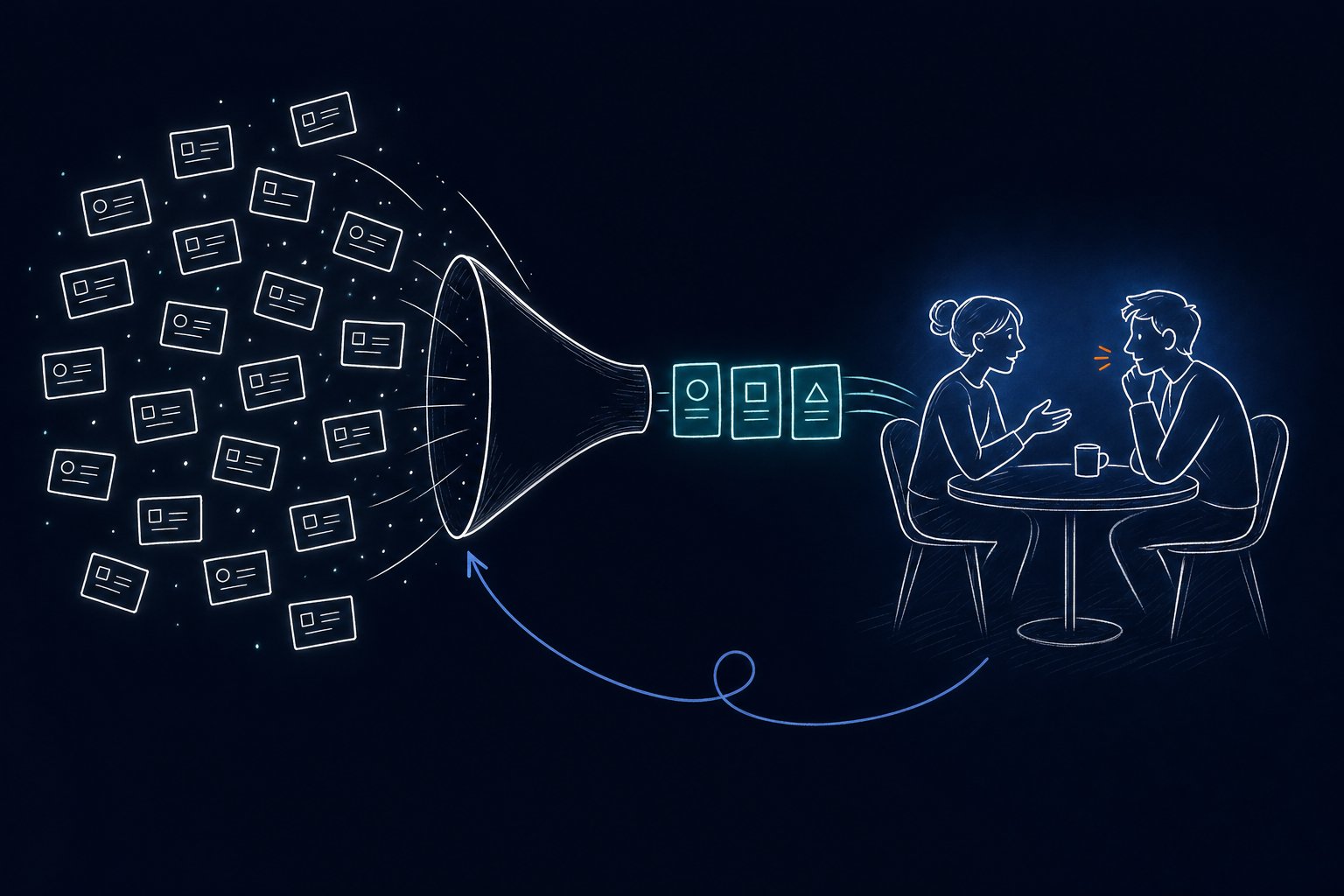
The smartest answer is usually a sequence: screen broadly and cheaply first, then go deep where it matters. A proven pattern is three steps: screen with Digital Twins or Synthetic Respondents (narrow 10–20 concepts down to 2–3 candidates in minutes), deepen with a focus group (the “why” behind the numbers, the emotional narratives no algorithm invents), and finally re-validate the optimized version against a broader synthetic sample. In practice, this saves 70 to 80 percent of the budget compared with a purely classical approach, at comparable or even higher result quality, because the upstream selection focuses the group discussion on the questions that actually matter. Kahneman documented in Noise (2021) how strongly expert judgment, market researchers included, is distorted by unsystematic variability: two focus groups on the same topic with identical screening criteria produce surprisingly different results. Synthetic methods deliver consistent results for an identical question, which eliminates that noise, but doesn’t replace the narrative depth only a real conversation provides (Kahneman et al., 2021, ch. 1).
What psychology tells us about the limits of all three methods
Cialdini describes six principles of persuasion in Influence. At least three of them systematically distort focus groups:
- Social proof: participants orient toward the group’s opinion, especially when they’re uncertain.
- Authority: a confident moderator or a dominant participant becomes an authority figure others align themselves with.
- Liking: we agree with people we like: even when their opinion contradicts our own.
Synthetic methods, Synthetic Respondents and Digital Twins alike, don’t carry these social biases: no group pressure, no moderator, no social ego. But they carry other limits: they can only extrapolate from patterns present in their data foundation. That risk is greatest for pure prompt-based personas, because the model draws on general training data rather than anchored audience data. When an audience is underrepresented or a cultural context is missing, precision drops for both synthetic variants. A synthetic method is only ever as good as the data it’s built on. Ariely demonstrated in his well-known silk-stocking experiment how strongly even human participants are guided by pure position effects, then justify their choice afterward with invented reasons like “better material” (Ariely, 2008, ch. 2), a reminder that none of the three methods is inherently objective; each carries its own documented source of error, a point also relevant when weighing how AI is changing neuromarketing research more broadly.
As The Neuro-Consumer puts it: “The majority of purchase decisions are irrational and driven by unconscious mechanisms in the brain. Traditional marketing analysis is based on the 15 percent that remains conscious” (Roullet & Droulers, 2020). Focus groups capture that 15 percent, often distorted by exactly the social effects above. Synthetic methods model the other 85, but only as accurately as their data foundation allows.
Transparency: our own implementation at neuroflash
Here’s where I lay my cards on the table: I’m co-founder and Chief Innovation Officer of neuroflash, which is why this section comes deliberately after the neutral comparison, not before it.
neuroflash has been building a data foundation since 2017 that now spans 1 million real profiles, each with 68 to 250 psychological data points, including Big Five personality traits. Two validations from real projects, as shown in the table above: in claim ranking for Essity, the Digital Twins reached 98% accuracy against a real panel. At Oetinger Verlag, agreement with classical market research came in at 92%, at 80% less research time. Read the full Oetinger case study here.
Those are the numbers we work with: no more, no less. Whether Digital Twins are the right choice for your use case depends primarily on whether your audience is represented in the data foundation. Reach out for a talk or workshop on Digital Twins in market research: including a live demo with your own real questions.
Frequently asked questions
What’s the difference between Digital Twins and Synthetic Respondents?
Synthetic Respondents are AI answers generated from a prompt without an individual data foundation per person. Digital Twins are grounded in a real individual profile with 68 to 250 psychological data points. In short: a Digital Twin is a data-grounded model, while a Synthetic Respondent, in the narrow sense, is the pure prompt-based answer without an anchored data foundation.
How valid are synthetic respondents really?
The 2025 Kantar validation study measures r = 0.81 for Ad Breakthrough, r = 0.72 for Brand Linkage, and r = 0.64 for Purchase Intent. That’s enough for fast screening, but according to Kantar’s own conclusion, not as the sole basis for final, high-risk decisions.
Are focus groups still worth it in 2026?
Yes. For completely new, exploratory topics with no prior knowledge, for niche audiences the data doesn’t cover, and for deep emotional research, the focus group remains unmatched. Honestly, no synthetic method wins here.
Can Digital Twins completely replace focus groups?
No. The documented best practice is hybrid: Digital Twins or Synthetic Respondents for screening, a real panel or focus group for final validation, exactly the conclusion the Kantar study reaches too.
What does market research with Digital Twins cost compared to focus groups?
A classic focus group costs EUR 8,000 to 25,000 per group and takes 4 to 8 weeks. Synthetic Respondents and Digital Twins deliver results in minutes to hours, at very low to moderate cost. For methodology details, see the complete guide to Digital Twins in market research 2026.
Further reading
- Digital Twins in Market Research: The Complete Guide 2026
- What Are Digital Twins? The Complete Guide for Marketers
- How AI Is Changing Neuromarketing
- The 7 Best AI Keynote Speakers 2026: An Honest Comparison
- Meta AI Personas vs. Digital Twins: The Technology Comparison 2026
Sources & further reading
- Kahneman, D. (2011). Thinking, Fast and Slow. Farrar, Straus and Giroux.
- Kahneman, D., Sibony, O. & Sunstein, C. R. (2021). Noise: A Flaw in Human Judgment. Little, Brown Spark.
- Ariely, D. (2008). Predictably Irrational: The Hidden Forces That Shape Our Decisions. Harper Collins.
- Cialdini, R. B. (2006). Influence: The Psychology of Persuasion. Harper Business.
- Häusel, H.-G. (2012). Brain View: Warum Kunden kaufen. Haufe Verlag.
- Roullet, A. & Droulers, O. (2020). The Neuro-Consumer. Routledge.
- Zaltman, G. (2003). How Customers Think: Essential Insights into the Mind of the Market. Harvard Business School Press.
- Argyle, L. P. et al. (2023). Out of One, Many: Using Language Models to Simulate Human Samples. Political Analysis. arxiv.org/abs/2306.15895
- ESOMAR: Code & Guidelines for ethical market research
- Kantar (2025). Validation Study. Synthetic Respondents in Advertising Research.
- University of Mannheim (2024). Validation Study on German Automotive Brand Perception.
- Procter & Gamble (internal validation). 85% agreement, approx. USD 12 million saved per year.
Dr. Jonathan T. Mall
Cognitive neuropsychologist, AI entrepreneur and Chief Innovation Officer of neuroflash. Jonathan combines 20+ years of experience in neuroscience and AI to predict how people decide. His signature talk “Consumers Buy Strangely” explains why we buy irrationally, and how Digital Twins predict it. LinkedIn · Request a keynote