Consumer Psychology Keynote Speaker: A Cognitive Neuropsychologist on the 95 Percent Nobody Checks
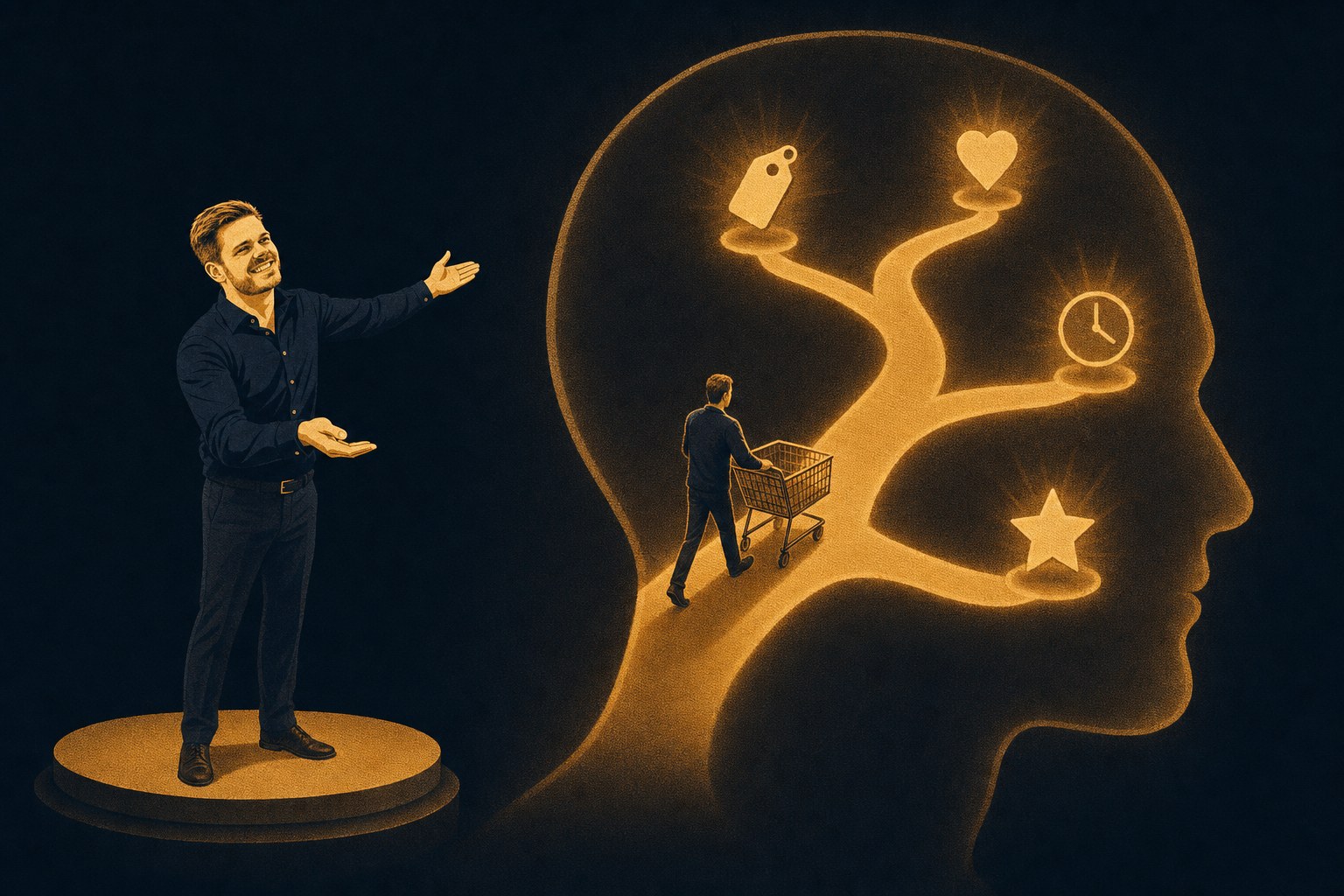
A consumer psychology keynote speaker turns the science of buying decisions, meaning neuroscience, behavioural economics and persuasion research, into choices a business audience can change on Monday. The talks worth a slot rest on three things: named primary studies, commercial numbers that survive a fact check, and a working answer to what AI has done to the field since 2023.
Disclosure before anything else: I sell this service. The other speakers named below are real competitors of mine, and for the right brief I would recommend several of them. So the criteria in this article are written to be checked against any shortlist, mine included. Status 2026, reviewed yearly.
Why do people buy? What the brain scans actually show
You can watch a purchase decision form before the buyer can report it.
In 2007, Brian Knutson's team at Stanford put people in an fMRI scanner, showed them products and prices, and let them buy with real money. Activity in the nucleus accumbens, a reward region, rose for products people went on to buy. Activity in the insula, which tracks aversion, rose when a price felt excessive. From those two signals the researchers predicted purchases before participants pressed the button, published in Neuron [1].
Price does more than steer the choice. It changes the experience. Hilke Plassmann's team at Caltech served people the same wine labelled at 10 dollars and at 90 dollars. The expensive label produced higher activity in the medial orbitofrontal cortex, the region that encodes experienced pleasantness, reported in PNAS [2]. The marketing placebo effect is measurable, not metaphorical.
Does brand knowledge beat the product in the buyer's head?
In blind tests it does not. Once the label is visible, it usually does.
In the Coke and Pepsi scanner study, blind tasters' preferences followed the taste. Show the same people the Coke logo and reward circuitry plus memory regions responded, and brand knowledge overrode the sensory signal [3]. The label is part of what the brain registers as the product, on the same footing as the taste.
Antonio Damasio's patient work pushes the point further: people with damage to emotional circuitry do not turn into perfectly rational shoppers, they lose the ability to decide at all [6]. Emotion does the deciding work; strip it out and the deciding stops.
One finding matters for anyone with a media budget. Emily Falk's neural focus group studies at Penn found that brain responses in a small sample predicted population-level campaign success better than the same people's self-reports, published in Psychological Science [4]. What an audience says about an ad and what their brains do with it are two different datasets.
Is it true that 95 percent of purchase decisions are subconscious?
Directionally yes, numerically no. The 95 percent figure is not a research result.
It traces to Gerald Zaltman of Harvard Business School, who wrote that most cognition runs below conscious awareness [8]. That is a considered expert estimate about thinking in general, and Zaltman framed it as one. No study produced the number, and no study ever measured purchase decisions that way. Most neuromarketing keynotes repeat it as hard data regardless.
The honest version still lands. Daniel Kahneman's dual-process account, fast automatic System 1 against slow deliberate System 2, rests on decades of experiments showing that everyday choices run on the fast system while conscious reasoning arrives afterwards to write the justification [5]. The prediction studies above [1][4] show the same thing with hardware: the decision signal precedes the verbal report.
How a speaker handles this one claim is a useful credibility test. A slide that shows "95%" without a caveat tells you which kind of talk you booked.
What does a consumer psychology keynote actually cover?
Three layers, and most talks only deliver the first.
The mechanism. System 1 dominance, reward prediction, and the biases that follow from both: anchoring, loss aversion, social proof, choice overload. Each one tied to a named study rather than an anecdote.
The commercial stakes. Two numbers carry this part. Les Binet and Peter Field's analysis of the IPA effectiveness databank found very large profit effects in 31 percent of emotionally led campaigns against 16 percent of rational ones [7]. And despite everything the field knows, Nielsen's Breakthrough Innovation research across 12,000 European launches found that more than three quarters of new FMCG products fail in their first year [9]. That is the sourced version of the "nine out of ten products fail" line that circulates unattributed on speaker pages.
The application. Pre-testing, message framing, pricing psychology, choice architecture. This layer goes thin fastest, because it needs someone who has run the tests. Mine are public: the Trigger Lab series re-runs classic persuasion effects with synthetic consumers and publishes the null results alongside the wins.
This material as a keynote: I speak on why people buy, with live demos instead of stock slides, in English or German. Your audience watches digital twins react to your own campaigns in real time. Book an intro call directly →
How do you choose a consumer psychology keynote speaker?
Ask four questions, and listen for the answer a summariser cannot give.
| What to ask | A strong answer | A thin answer |
|---|---|---|
| Which primary studies does the talk cite? | Named authors, years, journals, including post-2020 work | The 1990s canon plus an uncited percentage |
| Have you run research yourself? | Own datasets, methods and published limitations | Summaries of other people's studies |
| What changed in the talk since generative AI? | A concrete new section with 2024 to 2026 evidence | One AI slide added to a 2019 deck |
| Can the audience see it work live? | A demo run on the client's own material on stage | Screenshots of a demo |
The table sorts speakers by what they can produce on request: sources, data, and a demo that runs on your material rather than theirs.
The best-known English-language names in this niche are Roger Dooley, Martin Lindstrom, Patrick Renvoisé and Matt Johnson, and each is a strong communicator. The second row is the one that sorts a shortlist. Ask every name on it, mine included, for one accuracy number measured against a real human panel, and compare what comes back. Two head-to-head comparisons go through the detail, Roger Dooley or Jonathan Mall and Martin Lindstrom or Jonathan Mall. My own fee sits in the mid four-figure range (net); the market bands are broken down in AI Keynote Speaker Pricing 2026.
What has AI changed about consumer psychology research?
Prediction no longer needs a scanner.
The fMRI work proved that buying decisions are predictable from data people cannot self-report. Digital twins, meaning AI personas built from real survey data, now simulate how a defined target group responds to ads, prices and packaging in minutes rather than weeks. The twins behind my talks rest on over 1 million survey responses with 68 to 250 psychographic data points per profile [10].
The part no incumbent speaker can match is the validation, because it is ours. When the publisher Oetinger pre-tested a new product, the twins' verdict matched the human panel at 92 percent agreement, documented in the Oetinger Digital Twins Case Study 2026. In work with Essity, agreement reached up to 98 percent [10].
The caveat belongs in the same breath, every time: twins measure stated purchase intent of synthetic respondents, not real transactions. Where the method holds and where it does not is laid out in Can Digital Twins Replace Focus Groups? A keynote that stops in 2019 leaves an audience knowing why people buy. One that continues into synthetic consumers leaves them with something to test this quarter.
A great consumer psychology speaker cites the studies; the rare ones ran some
The neuroscience of buying is one of the best-evidenced fields a keynote can draw on. Purchase prediction from brain activity [1], price reshaping the experience itself [2], emotionally led campaigns roughly doubling the odds of very large profit effects [7]. Most stages still get a secondhand version of it with an invented statistic on slide three.
So the sorting question for your shortlist is short. Ask which dataset is theirs. A speaker who cannot name one is a science journalist on stage, which can be exactly right for your audience, as long as you know that is what you booked.
Keynote for your 2026 event: the studies, my own validation data and live digital-twin demos, as a keynote (30 to 60 min.) or a workshop, in English or German. Pick a slot for an intro call →
Sources
- Knutson, B., Rick, S., Wimmer, G. E., Prelec, D. & Loewenstein, G. (2007). Neural predictors of purchases. Neuron, 53(1), 147 to 156. doi.org/10.1016/j.neuron.2006.11.010
- Plassmann, H., O'Doherty, J., Shiv, B. & Rangel, A. (2008). Marketing actions can modulate neural representations of experienced pleasantness. PNAS, 105(3), 1050 to 1054. doi.org/10.1073/pnas.0706929105
- McClure, S. M., Li, J., Tomlin, D., Cypert, K. S., Montague, L. M. & Montague, P. R. (2004). Neural correlates of behavioral preference for culturally familiar drinks. Neuron, 44(2), 379 to 387. doi.org/10.1016/j.neuron.2004.09.019
- Falk, E. B., Berkman, E. T. & Lieberman, M. D. (2012). From neural responses to population behavior: neural focus group predicts population-level media effects. Psychological Science, 23(5), 439 to 445. doi.org/10.1177/0956797611434964
- Kahneman, D. (2011). Thinking, Fast and Slow. Farrar, Straus and Giroux. us.macmillan.com
- Damasio, A. (1994). Descartes' Error: Emotion, Reason, and the Human Brain. Putnam. Antonio Damasio, Wikipedia
- Binet, L. & Field, P. (2013). The Long and the Short of It: Balancing Short and Long-Term Marketing Strategies. IPA. ipa.co.uk
- Zaltman, G. (2003). How Customers Think: Essential Insights into the Mind of the Market. Harvard Business School Press. Gerald Zaltman, Wikipedia
- Nielsen, Breakthrough Innovation Report (European edition), as reported by Harpers Wine & Spirit Trade News: over three quarters of new FMCG launches fail in their first year, from 12,000 European launches analysed since 2011. harpers.co.uk
- Mall, J. / neuroflash (2026). Digital-twin validations Oetinger (92 percent) and Essity (up to 98 percent); data base over 1 million survey responses, 68 to 250 data points per profile. Method: Oetinger Digital Twins Case Study 2026
About the author: Dr. Jonathan Mall is a cognitive neuropsychologist (PhD, University of Groningen, 2013), Chief Innovation Officer and co-founder of neuroflash. He keynotes on consumer psychology, AI and digital twins with live demos, in English and German, for corporates, associations and conferences across the DACH region. More: Jonathan Mall: Facts, Q&A and Press Kit · What organisers say · LinkedIn
Frequently asked questions about consumer psychology keynote speakers
What does a consumer psychology keynote speaker talk about?
Decision science, applied to buying: how fast automatic processing drives purchases, which brain signals predict a sale, and how biases such as anchoring, loss aversion and choice overload show up in pricing, packaging and advertising. A good talk translates work like Knutson's 2007 purchase-prediction study into decisions a team can change the week after the event. Since 2023 the strongest talks also cover synthetic consumers and how AI search reshapes buying journeys.
Is the claim that 95 percent of purchase decisions are subconscious true?
The direction is well supported, the number is not. It comes from Gerald Zaltman at Harvard Business School as an expert estimate about cognition in general, and no experiment ever measured it for purchase decisions. Brain-imaging studies do show that the decision signal precedes the verbal report. Treat the 95 percent as an illustration, and treat a speaker who presents it as measured data with caution.
What should I ask a consumer psychology speaker before booking?
Four things. Which primary studies does the talk cite, and is any of it post-2020? Have you personally run research, and can you name the dataset? What changed in your talk since generative AI arrived? And can the audience watch the method work live on our own material? A speaker who cannot answer the second question summarises other people's work, which can still be the right choice for a general audience.
How much does a consumer psychology keynote speaker cost?
Format, audience size and preparation drive the price more than stage fame does. A 30 to 60 minute keynote is calculated differently from a half-day workshop with live demos on the client's own material. My own fee sits in the mid four-figure range (net). The market bands and what moves them are broken down in AI Keynote Speaker Pricing 2026.
Does a consumer psychology keynote work for a B2B or non-marketing audience?
Yes, because the underlying decision psychology does not change by sector. B2B buying committees run on the same biases as consumers, sharpened by risk aversion: avoiding a visible mistake outranks picking the best option. Healthcare, finance, SaaS and retail need different examples, not different science, and the surprise effect is usually largest in the rooms that expected the topic to be about shoppers.
How reliable are digital twins for testing consumer reactions?
In the validated cases, agreement with real surveys reached 92 percent at Oetinger and up to 98 percent at Essity, built on over 1 million survey responses with 68 to 250 data points per profile. The boundary matters as much as the number: what twins report is the stated purchase intent of synthetic respondents. Observed transactions stay outside the method, so twins sort weak options out early and never replace a final real-world check.