Digital Twins Case Study 2026: How Oetinger Tested Its New Game Before Going to Print
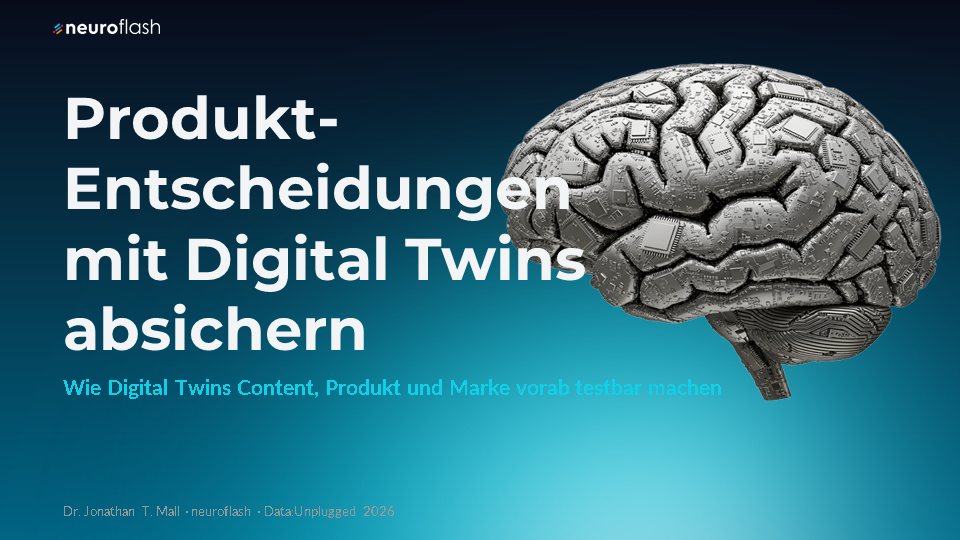
Experienced publishing professionals know what a good game cover looks like, or so the common assumption goes. The practical test at Oetinger shows how often that experience misses the mark: the subtitle everyone internally loved would have placed the product on the wrong shelf. In the keynote for the Behavioral Science Akademie (Data:Unplugged 2026), Thorsten Höge (Head of Digital & Audio Strategy, Verlagsgruppe Oetinger) and I laid out the full case, including the moments where the Digital Twins contradicted our gut feeling.
The full talk (23 min., German): why gut feeling and classic market research fail, and how Oetinger reached 92% market-research agreement with over 1M simulated profiles.
Why Gut Feeling Fails: Three Examples from the Talk
A hospital raises patient satisfaction by more than 50 percent, not with more beds or doctors, but with easier access to the parking lot. The last experience of a stay tips the overall judgment. For model Toni Garrn, the cozy coffee post correlates most strongly with engagement, while the performance shot even correlates negatively. Her followers see her as a friend, and you have coffee with a friend. And Nokia, with a 50% market share, launches a smartphone that has everything on paper, and flops against the iPhone, because purchase decisions play out in the experiencing self, in split seconds, shaped by context and emotion.
The takeaway from 20 years at the intersection of brand and cognitive research: it is damn hard to take the perspective of your own target audience, even if you spend your entire career trying. How strongly emotions drive purchase decisions is well researched; what was missing was a method to test those reactions in advance: individually, validly, and in context.
The Method: Over 1 Million Real Profiles, Built Since 2017
neuroflash’s Digital Twins are built on survey data from over one million real people, 68 to 250 psychological data points per person, ranging from Big Five personality traits to values and fundamental needs. When a target-audience description comes in, specific individuals are drawn from the pool in embedding space and surveyed individually. Before a twin answers, the system simulates its inner thought process in the given context. We call this Psychological Scaffolding. What fundamentally sets Digital Twins apart from focus groups is covered in the complete Digital Twins guide.
The Case: Klingt wie Kindheit, A Legacy Publisher Tests Before Print
Oetinger, the Hamburg publisher that brought Pippi Longstocking to Germany, is launching a new game series: Klingt wie Kindheit (“Sounds Like Childhood”), a nostalgia quiz with 250 cards on Pippi, Momo, Walkman, and 56k modems (2–10 players, ages 14+, RRP €22, first release 09/11/2026). Thorsten’s question in the talk: “We quickly found out that people really enjoy playing this. But how do we sell it?”
Three Twin Insights That Changed the Product
1. “Adults” instead of “big kids.” The planned subtitle “The Nostalgia Quiz for Big Kids” failed with the twins. Adults want to be addressed as equals. Changing it to “for Adults” also moves the game in bookstores out of the children’s corner and into the right shelf.
2. An identity claim instead of a product label. “Edition Heroes of Your Childhood” became “Einmalhelden, Immerhelden” (roughly: “Once a Hero, Always a Hero”). The claim now speaks to the person playing, not to the cards.
3. The ALF swap. Twin Sabrina recognized Pippi and Lassie instantly; nobody noticed the black heart on the cover. So it was swapped for ALF via image editing directly in the interface, two thumbs up from the simulated audience.
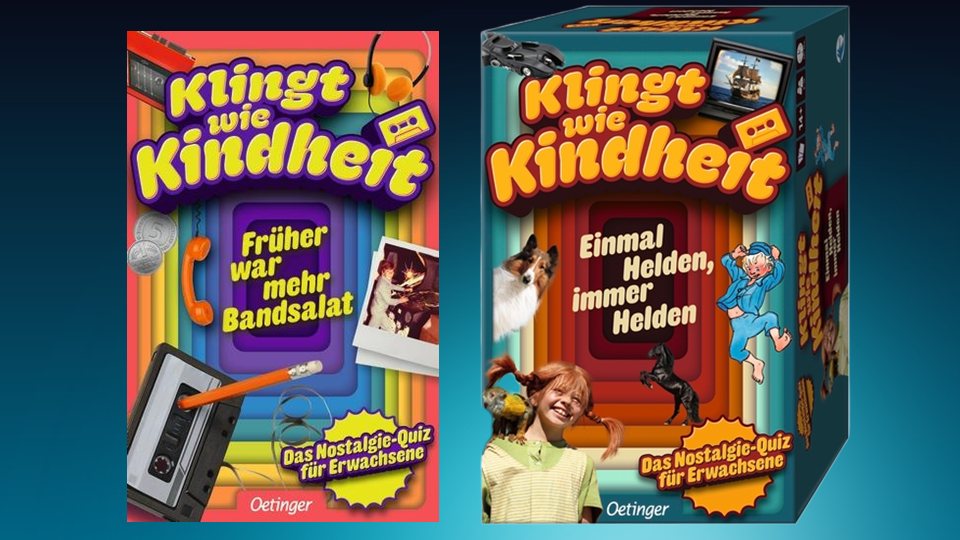
The cover iterations compared: the winning version uses higher contrast, the identity claim ‘Einmalhelden, Immerhelden,’ and ALF as a recognition figure.
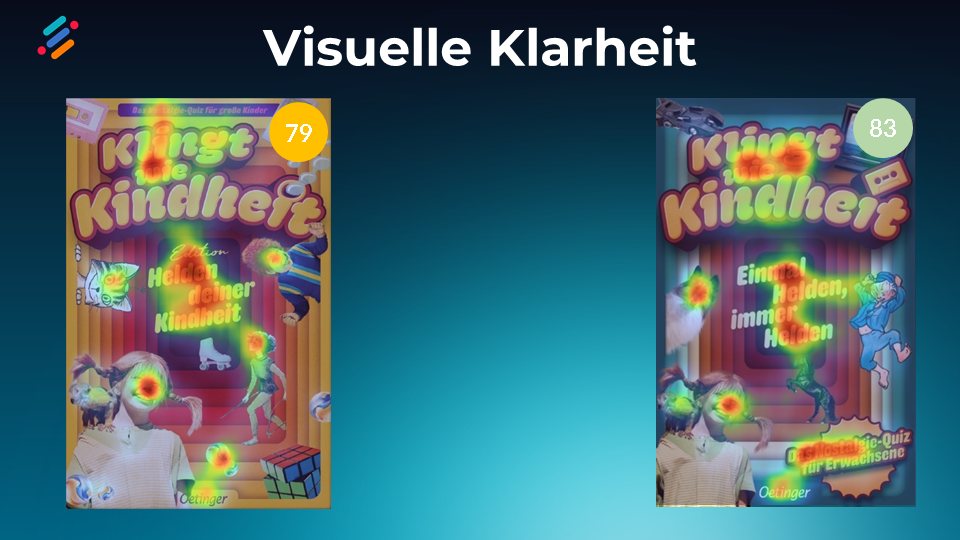
The heatmap comparison of the 2 cover versions shows scattered attention on the losing design and clear hotspots on the winning version.
From Cover to the Thalia Shelf
The final step in the talk: virtually placing the finished cover on the Thalia bookstore shelf via photo and running the analysis again. The result, according to Thorsten: a large attention hotspot right on Klingt wie Kindheit, “all the work paid off.” Oetinger now uses the tool daily and has rebuilt its internal testing department around these loops: fewer classic tests, more rapid iteration.
The Validation: 92%, 98%, and 80% Less Research Time
Three numbers carry the case. The twin predictions for Oetinger matched Oetinger’s in-house market research 92% of the time. At Essity, the twins’ claim ranking reached 98% accuracy against an expensive human panel, 22 claims, B2B target audience of facility managers. And because test loops run in hours instead of weeks, research time drops by roughly 80%. A B2B customer in medical technology also spent real LinkedIn ad budget to find out which ad would perform worst. The twin scores had correctly predicted it beforehand. Important: these figures apply to contextual surveys. Asking without a situation only measures the remembering self. You’ll find the methodological comparison in the article Digital Twins vs. Focus Groups.
Three Takeaways for Your Next Product
Choose a concrete decision. An upcoming cover, a claim, an ad. The method is built for binary and ranked comparisons, not abstract strategy questions. Check your persona descriptions. In FMCG workshops, the described persona often resembles the project team more than the real target audience. Up to 80% of the description comes from gut feeling. Plan for context questions. Train station, supermarket checkout, Thalia shelf: the same person judges differently depending on the situation, and that’s exactly where purchase decisions happen.
Frequently Asked Questions
What are Digital Twins in market research?
AI personas based on real survey data from real people: at neuroflash, over 1 million profiles with 68 to 250 psychological data points per person, built since 2017. They answer questions about products and advertising the way the real target audience would.
How accurate are Digital Twins’ predictions?
In the Oetinger case, agreement with the in-house market research was 92 percent. At Essity, the twins’ ranking of 22 claims reached 98 percent accuracy against a human panel.
How do you start a first test with Digital Twins?
With a concrete decision: a cover, a claim, or an ad in an A/B comparison. The method is tailored to binary and ranked comparisons, a valid result is ready within hours instead of weeks.
Want to experience this case live on your stage?
The talk works as a keynote with a live demo: your audience asks questions, and the Digital Twins answer in real time, in German, English, or Dutch.
Sources
- Talk handout, all 58 slides, figures, and sources (DE/EN)
- Video of the keynote talk (23 min., Behavioral Science Akademie, April 28, 2026)
- Verlagsgruppe Oetinger. Klingt wie Kindheit releases September 11, 2026
Further reading: Digital Twins in Market Research: The Complete Guide · Digital Twins vs. Focus Groups · Digital Twin Audience Software: The Buyer’s Guide
About the author: Dr. Jonathan T. Mall, cognitive neuropsychologist, AI entrepreneur, and Chief Innovation Officer of neuroflash. Jonathan delivers keynotes on Digital Twins, neuromarketing, and AI agents at conferences including d3con, KVD Service Congress, and automatica. LinkedIn.