GEO and AEO Explained Through Data: What AI Search Engines Actually Cite

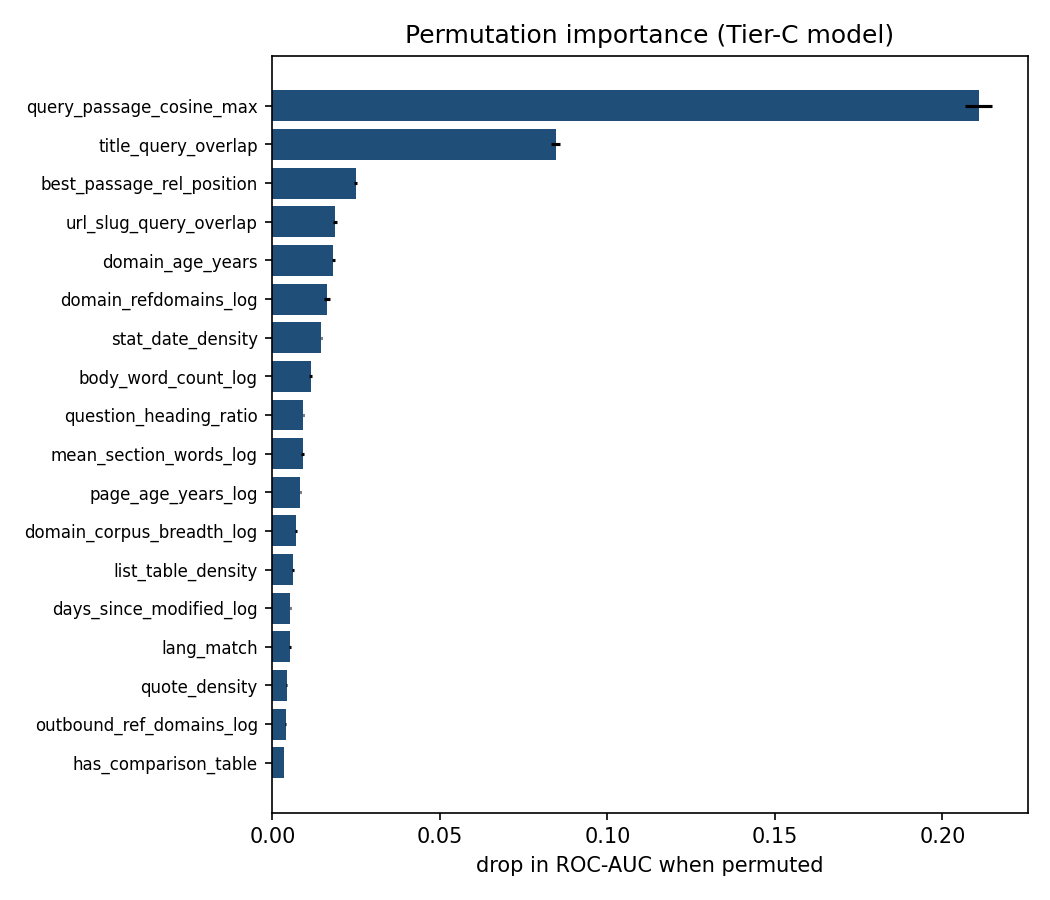
GEO (Generative Engine Optimization) and AEO (Answer Engine Optimization) both mean the same practical thing in 2026: getting a page quoted inside an AI-generated answer instead of merely ranked in a list of links. Our own study of 52,821 AI citations shows the strongest lever by far is semantic relevance to the query, not backlinks, not keyword-stuffed headings, and not article length.
Most GEO and AEO advice online is recycled SEO folklore with "AI" pasted on top. We tested it instead of repeating it: a pre-registered ranking-factor model over ChatGPT and Google AI Overview citations, run against 20 candidate variables from the published GEO literature, letting the data throw out what does not survive contact with reality.
What do GEO and AEO actually mean today?
Generative Engine Optimization is the discipline of getting cited inside an AI-generated answer. Answer Engine Optimization is the older, broader term covering any answer engine, including Google's classic featured snippets. Both are converging on the same test in 2026: does the model quote your page, not where does your page rank.
The distinction still matters for search volume. "AEO" gets roughly 27,100 monthly US searches, ten times the volume of "GEO SEO" at 2,900, so buyers are searching under the older label even as the newer term describes the current practice more precisely. Either term routes to the same work: write the answer the way a model needs to lift it, not the way a human skims a results page.

What did we study to define GEO and AEO by data, not opinion?
A pre-registered ranking-factor model on our own Rankscale citation panel: 1,362 queries, tracked across ChatGPT and Google AI Overviews over three snapshots in July 2026, yielding 52,821 citations across 847 fetched pages and 587 enriched domains. Twenty variables drawn from the published GEO and SEO literature, scored with risk-set conditional models plus gradient boosting, discriminate cited from non-cited pages at an AUC of 0.86.
That is a testable claim, not a marketing number, and the model stays correlational at its core. For the step by step version of applying these findings to one real site, including the weekly measurement loop that produced this same citation panel, see how I got ChatGPT to recommend me.
Why does relevance beat every other AI SEO factor?
Being the best-matching passage for a query outweighs every authority, formatting, and freshness signal we tested, combined. Semantic query-passage similarity carried a standardized odds ratio of 3.06 and title-query word overlap carried 2.18, meaning a one-standard-deviation gain in either variable more than doubles citation odds on its own.
That second number contradicts a common SEO claim. Semrush's 600,000-keyword study found title-tag keyword match correlates weakly with classic Google rankings and called it an entry ticket, not a driver. Our AI-citation data shows the opposite: title-query overlap is a top-two driver. Put the query's literal words in the title.
Want this data on stage? I run the GEO and AEO experiments behind every claim in this article myself, then speak on what the results mean for marketing and content teams. Book a 15-minute intro call →
Do backlinks still matter for answer engine optimization?
Not independently, once page content enters the model. Domain-level referring domains and page-level backlinks both lost statistical significance (p=.89 and p=.94) as soon as relevance variables were controlled for. That directly contradicts Backlinko's classic 11.8M-page finding that referring domains correlate more strongly with rankings than any other factor tested, in a different sport: classic organic search.
Our authority measures are imperfect proxies, with no brand-mention data and no internal link graph, so the honest reading is no independent effect within the AI-visible pool we measured, not links never matter anywhere. Between running a backlink campaign and rewriting a page for relevance, our data says rewrite. Anyone weighing a real GEO budget against a pricing decision can compare against the going rate for AI keynote speakers in 2026, where the same rewrite-first logic applies to spend.
Does FAQ schema actually lift AI citations?
Yes, and it is one of the few formatting choices in our model that produced a real, statistically significant effect. FAQPage, QAPage, and HowTo structured data lifted citation odds by 43% (p<.05). Question-form headings without the matching schema markup showed no effect at all.
That split matters on a content budget. Rewriting headings into questions feels like AEO work, but our data says it does nothing on its own. Adding the JSON-LD schema block, the code a model's retrieval layer can parse directly, is what moves the number. Every article on jonathanmall.com now ships that schema block as a default.
| Factor | Effect on citation odds |
|---|---|
| Query to passage semantic match | 3.06x per SD |
| Title contains the query's own words | 2.18x per SD |
| FAQPage or HowTo schema present | +43% |
| Domain or page backlinks | no effect (p=.89, p=.94) |
| List and table density | 0.90x per SD |
Why does ChatGPT reward different pages than Google AI Overviews?
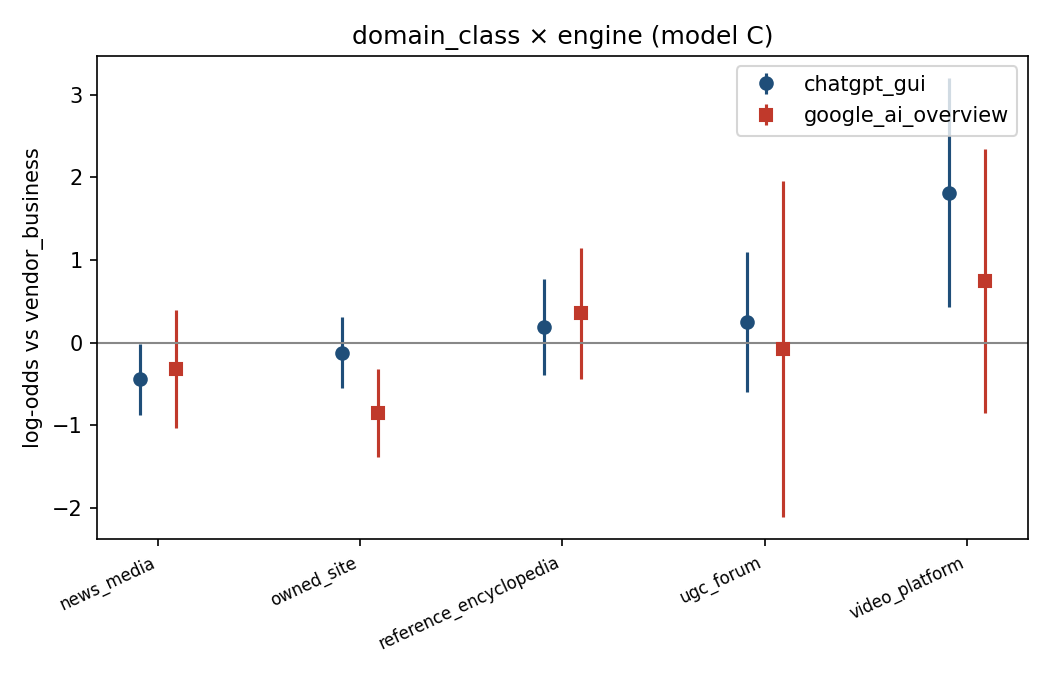
Because they run two different scoring rules on the same page. ChatGPT favors video platforms and treats owned brand pages fairly. Google AI Overviews cancels that pattern and specifically penalizes owned sites (std-OR 0.48, p=7e-06), leaning instead on earned placements such as press coverage, directories, and YouTube.
The practical split: jonathanmall.com's own pages compete far better inside ChatGPT than inside Google AI Overviews. For AIO visibility, a YouTube upload of the same content or a placement in trade press outperforms polishing the owned page further. For ChatGPT visibility, the owned page plus a linked YouTube presence is the stronger combination. One AI search optimization plan cannot serve both engines identically, a distinction that also shapes how a speaker's own reference material and case studies should be distributed across owned and earned channels.
Do listicles and longer articles perform better in generative engine optimization?
No, on both counts. List and table density carried a mildly negative effect on citation odds (std-OR 0.90) even on commercial-intent queries, and there is no 500 to 1,500 word sweet spot: citation odds move in one direction only, and it is not toward longer.
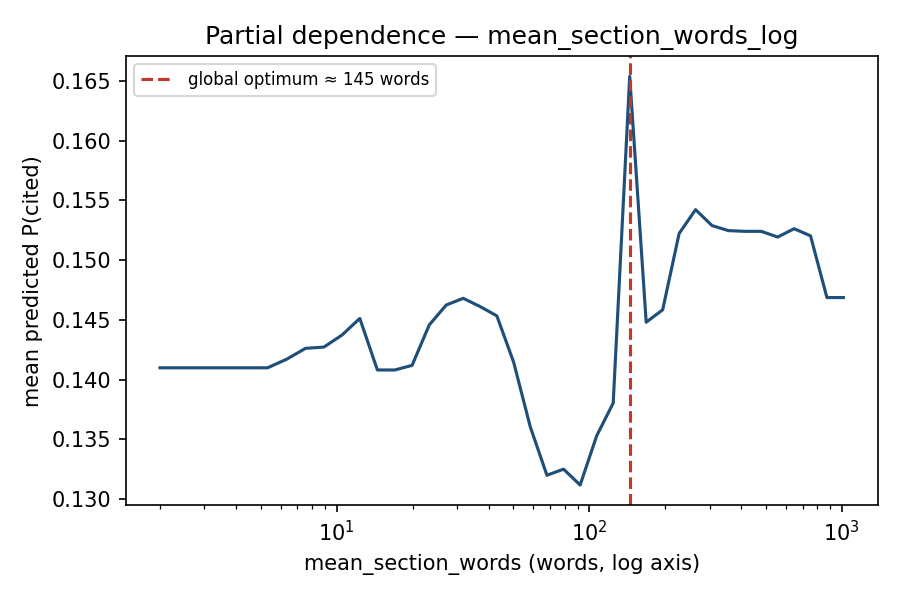
This replicates the independent C-SEO Bench academic benchmark and contradicts a widely cited industry claim that comparative listicles capture roughly a third of all AI citations. It also matches jonathanmall.com's own policy against self-ranking listicles, adopted after a site-wide visibility drop tied to that exact format, one reason the AI keynote speaker landscape overview uses criteria and scenario framing instead of a ranked list. Chunking still helps: median section length peaked around 145 words, inside the 120 to 180 word range GEO practitioners recommend, but padding a section past that point buys nothing.
The GEO and AEO myth scoreboard
Six recycled claims, checked against the same 52,821 citations, so you can see which ones survived contact with real data.
| Common AI SEO claim | What our data found |
|---|---|
| Title keyword match is just an entry ticket | Wrong. Top-2 driver, std-OR 2.18 |
| FAQ schema lifts AI citations around 30% | Holds, our number is +43% |
| Listicles win AI citations | Reversed, about 10% lower per SD |
| Backlinks are a top AI citation driver | No independent effect once content is controlled |
| A 500 to 1,500 word sweet spot exists | No, shorter, focused pages cited more |
| Chunk content into 120 to 180 word sections | Holds, optimum measured at 145 words |
What does this mean for a GEO and AEO budget?
Rewrite for relevance first: the query's literal words in the title, the direct answer in the first screen. Everything else follows from that.
After relevance, in order of payoff: add FAQPage schema to every page that answers real questions, split content into roughly 145-word self-contained sections, and decide per page whether you are optimizing for ChatGPT (own the page, add video) or Google AI Overviews (chase earned placements instead). Skip the backlink campaign and do not pad word count chasing an imaginary sweet spot. The practitioner's version of this loop, including how the query set itself gets built, sits in the companion how-to piece linked above rather than repeated here.
None of this is guesswork dressed up as a framework. It is what happened when we measured 52,821 real citations instead of repeating what everyone else assumed, on a panel documented alongside the digital twins methodology that also grounds our audience research.
Talking to a team about AI visibility? I turn this exact GEO and AEO study into a keynote or workshop, English or German, with the live model and the myth scoreboard on screen. Schedule your intro call →
Questions people ask about GEO and AEO
Short, direct answers to the questions that came up most while we were building the model above.
What is the difference between GEO and AEO?
Generative Engine Optimization (GEO) is the practice of getting a page cited inside an AI-generated answer, on ChatGPT, Google AI Overviews, Perplexity and similar tools. Answer Engine Optimization (AEO) is the older, broader term for structuring content so any answer engine, including classic featured snippets, can lift a direct answer from it. In practice the two overlap almost completely today: both reward an answer-first structure, and both are measured by whether a page gets quoted, not whether it ranks.
Is AI search optimization actually measurable, or is it guesswork?
It is measurable. Our pre-registered model over 52,821 AI citations across 1,362 queries (ChatGPT and Google AI Overviews, July 2026) reached an AUC of 0.86, meaning the on-page factors we tracked predict citation with real accuracy. Passage relevance and title-query overlap explain most of that signal; formatting tricks explain almost none of it.
Do backlinks move the needle for generative engine optimization?
Not independently, once page content is in the model. Domain referring-domains and page-level backlinks both lose statistical significance (p=.89 and p=.94) as soon as relevance variables are controlled. Our authority measures are imperfect proxies, so read this as no independent effect within the AI-visible pool, not as links never mattering anywhere.
Is FAQ schema worth adding for AI citations?
Yes, and it is one of the few formatting choices that showed a real, statistically significant effect: FAQPage, QAPage and HowTo JSON-LD markup lifted citation odds by 43% (p<.05) in our data. Phrasing headings as questions without the schema markup showed no effect at all, so the code matters more than the wording.
Why does content get cited in ChatGPT but not in Google AI Overviews?
Because the two engines run different logic. ChatGPT rewards video platforms and owned brand pages. Google AI Overviews penalizes owned sites (std-OR 0.48, p=7e-06) and leans on earned placements such as press coverage and YouTube instead. Treat them as two separate optimization targets, not one.
Do listicles perform better in AI search results?
No. List and table density had a mildly negative effect on citation odds in our data (std-OR 0.90), which contradicts a widely cited claim that comparative listicles make up a third of all AI citations. It matches an independent academic benchmark, C-SEO Bench, and jonathanmall.com's own no-self-ranking-listicle policy.
Sources and further reading
- Aggarwal, S., Murahari, V., Rajpurohit, T., Kalyan, A., Narasimhan, K., & Deshpande, A. (2024). GEO: Generative Engine Optimization. Proceedings of KDD 2024, arXiv:2311.09735. arxiv.org/abs/2311.09735
- Puerto et al. C-SEO Bench, cited in: Optimizing Visibility in Generative Engines: A Critical Survey of GEO (2023 to 2026). arXiv:2607.14035. arxiv.org/abs/2607.14035
- Ahrefs (2024). Only 12% of AI Cited URLs Rank in Google's Top 10. ahrefs.com
- Semrush. Ranking Factors Study. semrush.com
- Ziptie (2024). FAQ Schema for AI Answers. ziptie.dev
- Backlinko. Search Engine Ranking Factors (11.8M-page study). backlinko.com
- Google Search Central (2014). HTTPS as a Ranking Signal. developers.google.com
About the author: Dr. Jonathan Mall is a cognitive psychologist (PhD, University of Groningen, 2013), CIO and co-founder of neuroflash, and a keynote speaker on AI visibility, GEO, and consumer psychology. He runs the ranking-factor experiments behind this article himself on jonathanmall.com's own Rankscale citation panel, and speaks on the results in English and German across the DACH keynote circuit. Facts, Q&A and press kit · LinkedIn