The Peak-End Rule, Twin-Tested: No Effect — but a Lesson About List Order
Proof, not claims: classic persuasion triggers, re-tested live with digital twins. → See all 23 purchase triggers at a glance.
Roger Dooley and Daniel Kahneman describe a trigger; we re-tested it with digital twins.
What does the peak-end rule actually say?
The peak-end rule traces back to a series of studies led by Daniel Kahneman. In the best-known one (Redelmeier & Kahneman, 1996, Pain), patients undergoing a colonoscopy or lithotripsy gave continuous real-time pain ratings, and afterward, ONE retrospective overall rating. That overall rating was best predicted by two values: the peak pain and the pain at the end, not by duration or the average. A second study from the same group (Kahneman, Fredrickson, Schreiber & Redelmeier, 1993, Psychological Science) had participants go through two cold-water trials, one short, and one long trial in which the temperature was raised slightly toward the end so the pain eased off. The majority voluntarily chose to repeat the longer, overall more painful trial, because it ended better. For checkout and onboarding flows, countless UX and marketing guides turn this into a rule of thumb: the last step of an experience counts disproportionately for what people remember.
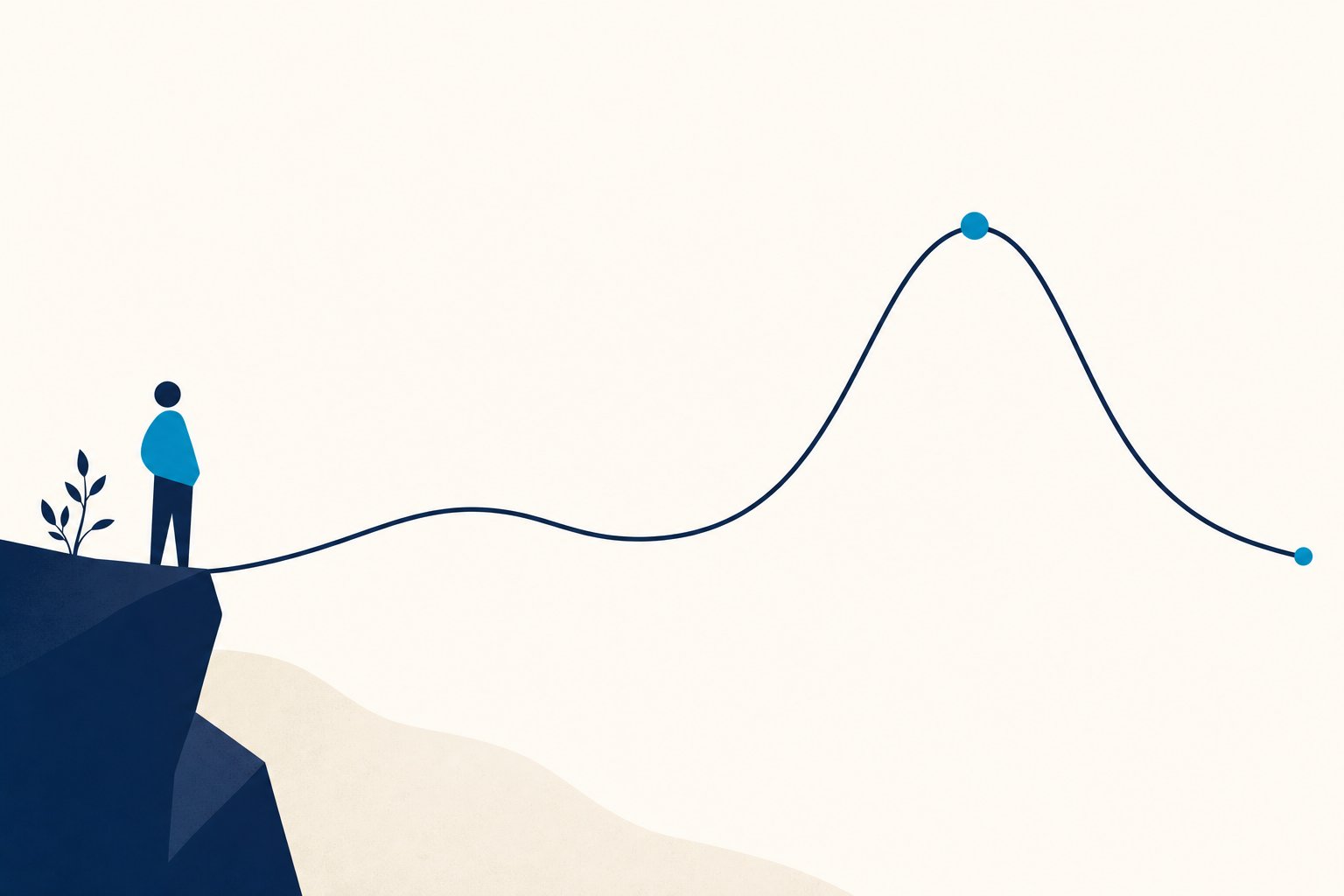
We wanted to know whether the same rule holds when you transfer it to a very different context: an online ordering process. So we built two delivery flows with exactly the same five steps and the same surprise gift. Only the position of the gift differs.
How did we test this?
The Method: n = 10 digital twins (DACH consumer panel, ages 25–60) read two order flows for a €79 product: Variant E (surprise gift in the last of five steps) and Variant S (the same gift in the first step). Both variants were explicitly described to the twins as identical in content ("the exact same gift and the same 5 steps"). Instead of a binary choice, the twins answered an allocation question: "Out of 10 similar orders, how many would you choose Variant E for, and how many Variant S?" Each twin ran the test twice, with the order of variant mentions reversed, to surface list-position effects rather than hide them (10 twins × 2 counter-run passes, not independent observations). The panel responded in German; quotes are translated.
Important context: the twins read a described sequence and judge it prospectively. They don't live through it in real time the way participants in the original studies did. The memory-construction mechanism that Redelmeier and Kahneman studied may have no real foothold in a purely text-based format. On top of that, we made the content-equivalence of both variants explicit, a step the original studies never verbally disclosed to participants. That's a deliberately conservative test design.
 Beate Hofmann, 58
Project manager twin* · Stuttgart · University degree
“I'm Beate Hofmann, a project manager from Stuttgart. Since my divorce I've found new stability with a new partner, and even though I'm living with chronic back pain and an active cancer diagnosis, I stay active with daily exercise and feel deeply satisfied with my life.”
What makes this twin distinct: I hold strong private religious beliefs without attending church, I'm deeply skeptical of politics and the economic situation, and I guard my data so carefully that I'll pass up a discount rather than share it.
* Digital twin: an AI simulation based on a real person’s profile: 68+ survey items, a full psychographic profile (values, demographics, behavior). Not a real person.
 Sabine Wagner, 56
Nurse twin* · Leipzig · Upper secondary education
“I'm Sabine Wagner, a nurse at a hospital in Leipzig. I'm married and live with my husband, but between 40-hour shift work and running the household, I have almost no time left for myself.”
What makes this twin distinct: My faith isn't just tradition. It's an active source of strength for a demanding job, I place strong trust in the police and the justice system, and despite my packed hospital schedule I still volunteer for charitable causes.
* Digital twin: an AI simulation based on a real person’s profile: 68+ survey items, a full psychographic profile (values, demographics, behavior). Not a real person.
 Kathrin Baumann, 32
Teacher twin* · Munich · Postgraduate degree
“I'm Kathrin Baumann, a primary school teacher from Munich. I'm married with two young children, and life right now is turbulent between school and a young family. Exercise has taken a back seat.”
What makes this twin distinct: I trust people deeply and tend to look for the good in them, I lean politically left and feel close to the Greens, and I consistently boycott products for sustainability reasons even though politics otherwise takes a back seat in my daily life.
* Digital twin: an AI simulation based on a real person’s profile: 68+ survey items, a full psychographic profile (values, demographics, behavior). Not a real person.
 Melanie Schubert, 33
Bank clerk twin* · near Frankfurt · Advanced vocational education
“I'm Melanie Schubert, a bank clerk at a large company near Frankfurt. I'm married and live with my husband, though occasional back and neck issues slow me down a bit in daily life.”
What makes this twin distinct: I'm considerably more risk-averse than most people around me, I avoid leadership roles and deliberately limit my own time online even though I'm perfectly capable with technology. Order and reliability matter more to me than trying new things.
* Digital twin: an AI simulation based on a real person’s profile: 68+ survey items, a full psychographic profile (values, demographics, behavior). Not a real person.
 Lukas Sander, 33
Retail twin* · Dortmund · Postgraduate degree
“I'm Lukas Sander, a retail employee with team-lead responsibility in Dortmund. I'm married with three children aged two, four, and seven, between a 40-hour work week and a full family life, I feel very satisfied and firmly in control.”
What makes this twin distinct: Even though I'm security-oriented and risk-averse, I strongly support minority rights, including LGBTQ rights, and want a strong, socially active government, and my postgraduate degree gives me an unusual outside perspective on my retail job.
* Digital twin: an AI simulation based on a real person’s profile: 68+ survey items, a full psychographic profile (values, demographics, behavior). Not a real person.
 Anke Schumann, 48
HR twin* · Hamburg · University degree
“I'm Anke Schumann, an HR officer at a mid-size company in Hamburg. I'm married, have two sons, and feel deeply fulfilled and settled in my life.”
What makes this twin distinct: I place strong trust in parliament and the justice system even though the economic situation leaves me dissatisfied, I champion income equality and minority rights, and yet I also see obedience and respect for authority as core parenting values, a contradiction I notice in myself.
* Digital twin: an AI simulation based on a real person’s profile: 68+ survey items, a full psychographic profile (values, demographics, behavior). Not a real person.
 Sören Lindner, 30
IT twin* · Cologne · Advanced vocational education
“I'm Sören Lindner, an IT administrator at a large company in Cologne. I'm not married and live with my partner. My childhood was shaped by financial hardship and family conflict, which made me more risk-tolerant and determined as an adult.”
What makes this twin distinct: I'm unusually risk-tolerant and drawn to leadership, I protest and donate for causes I believe in, I guard my data strictly despite my strong tech affinity, and I actively oppose workplace inequality for women.
* Digital twin: an AI simulation based on a real person’s profile: 68+ survey items, a full psychographic profile (values, demographics, behavior). Not a real person.
 Tobias Hübner, 35
Mechatronics twin* · Essen (Ruhr area) · Upper secondary education
“I'm Tobias Hübner, a mechatronics technician at a mid-size electronics manufacturer in Essen, in the Ruhr area. I'm not married and live in a large six-person household with my parents and younger relatives, chaotic, but a strong source of security for me.”
What makes this twin distinct: I put several hours a week into caring for relatives and neighbors rather than outward-facing social activities, I consistently reject tracking cookies, and I still vote regularly even though I feel my vote carries little real weight.
* Digital twin: an AI simulation based on a real person’s profile: 68+ survey items, a full psychographic profile (values, demographics, behavior). Not a real person.
 Dennis Altmann, 41
Sales twin* · Düsseldorf · University degree
“I'm Dennis Altmann, a sales rep at a mid-size wholesale company in Düsseldorf, and I travel frequently for work. I'm married with three children. My own childhood was marked by financial strain and conflict, which is why I want a more stable, harmonious home for my own kids.”
What makes this twin distinct: Unlike Düsseldorf's generally liberal environment, I place high value on clear rules, order, and traditional parenting values like obedience and respect for authority, I meet strangers with healthy skepticism; my father originally came from Turkey.
* Digital twin: an AI simulation based on a real person’s profile: 68+ survey items, a full psychographic profile (values, demographics, behavior). Not a real person.
 Jürgen Krause, 59
Accountant twin* · Berlin · Upper secondary education
“I'm Jürgen Krause, an accountant nearing retirement in Berlin. I've never married and live with two older relatives I care for about 15 hours a week, while dealing with back and joint pain and occasional severe headaches.”
What makes this twin distinct: I'm socially and culturally conservative, value tradition and respect for authority, and feel little connection to the European idea despite living in a cosmopolitan city, yet I still vote SPD because social and income justice matter to me.
* Digital twin: an AI simulation based on a real person’s profile: 68+ survey items, a full psychographic profile (values, demographics, behavior). Not a real person.
* Digital twins are AI simulations based on real person profiles, not real people. Click a twin to see what it is based on.
What we tested
Variant E · Gift at the end · 5.0 out of 10 (pooled)
“… Step 5: right at the bottom of the package is an unexpected small gift with a personal card.” (German original: „Schritt 5: ganz unten im Paket liegt ein unerwartetes kleines Geschenk mit einer persönlichen Karte.“)
Variant S · Gift at the start · 5.0 out of 10 (pooled)
“Step 1: order confirmation, an unexpected small gift is already included with the package …” (German original: „Schritt 1: Bestellbestätigung, dem Paket liegt sofort ein unerwartetes kleines Geschenk bei …“)
Which wins: the gift at the end, or at the start?
At first glance, this looked like a clear peak-end win. In every single pass, the variant mentioned first received noticeably more allocation points than the second: 5.7 out of 10 versus 4.3 out of 10. The problem: this pattern showed up exactly as strongly regardless of whether Variant E or Variant S was mentioned first.
Once you pool both counter-run passes (n=20), the apparent lead disappears completely: Variant E and Variant S land at exactly 5.0 out of 10 allocation points, a perfect tie. What initially read as a solid peak-end effect turned out to be a list-position effect: whichever variant is mentioned first wins, regardless of whether the gift sits at the beginning or the end of the flow.
Kathrin, one of the digital twins, illustrates the pattern well. In the first pass (Variant E mentioned first), she allocated 8 out of 10 to Variant E: "Something unexpected at the end is a small reward for the patience, it tends to stick in memory more," says twin "Kathrin" (digital twin, DACH consumer panel). In the second pass, where Variant S was mentioned first, she shifted to 6 out of 10 for S. Her reasoning stayed plausible, but the number followed the new order.
Does the peak-end effect show up at least in individual twins?
A look at the panel composition shows a mixed picture. Four twins (Baumann, Schubert, Sander, Wagner) consistently followed list position across both passes. They simply preferred whichever was mentioned first. One twin (Hofmann) was a borderline case: once she followed position, in the second pass she split exactly 5/5. Five twins, by contrast, held a stable preference for one particular variant, independent of mention order: two consistently preferred Variant E (gift at the end). Tobias Hübner and Sören Lindner. Three consistently preferred Variant S (gift at the start), Jürgen Krause, Anke Schumann, and Dennis Altmann.
Tobias Hübner explains his E preference exactly in the spirit of the classic rule: "A surprise at the end is like a little dessert after the meal that rounds off the whole experience on a positive note," says twin "Tobias." Melanie Schubert, on the other hand, chose differently depending on the pass. In the second pass, when Variant S was mentioned first, she flipped: "I'm just impatient and don't want to wait until the very end. If the enjoyment comes right at the start, that's much better for me and I like remembering it that way," says twin "Melanie."
Important: the two stable E preferences shouldn't be cherry-picked here as "the twins that show the real peak-end effect". The three stable S preferences are numerically the majority and pull in exactly the opposite direction. At the panel level, these two stable groups nearly cancel each other out, which contributes to the exact 5.0/5.0 symmetry, so the symmetry is partly a composition coincidence, not a uniform mechanism across all ten twins.
Classic study
Kahneman, Fredrickson, Schreiber & Redelmeier (1993): Across two experienced pain trials, the majority voluntarily chose to repeat the longer, overall more painful trial, because it ended better.
Digital twins (2026)
5.0 to 5.0, for a described order sequence, once you control for list position, no peak-end advantage remains.
Same principle, measured fresh: in minutes instead of weeks of fieldwork.
Does this result contradict Kahneman and Redelmeier?
No, and that's the real lesson of this test. Redelmeier and Kahneman studied how people remember and rate an experience they had just lived through in real time. Our digital twins, by contrast, read a described five-step sequence and judge it prospectively. They don't live through anything, they have no moments to selectively remember. The memory-construction mechanism the original studies documented may have no real foothold at all in a purely text-based format. Our null result doesn't contradict the classic work, then. It shows that the widespread rule of thumb "the ending counts most" doesn't automatically transfer to a prospectively judged, text-described customer journey.
There's also a deliberate design choice worth noting: we explicitly told both variants that they were identical in content, a step the original studies never disclosed to participants (who had to judge duration and content themselves, and many judged wrong). This transparency makes "both are equivalent" the most obvious answer, a conservative test, not a lax one. On top of that, in Variant E the peak and the ending sit at the same point (step 5 is both at once), so a pure peak effect can't be separated from a pure end effect. Our test only speaks to the combined claim, as it's also phrased on the hub page.
A second metric: how well the twins would "remember" each variant, on a 1–10 scale, also delivers no reliable difference: pooled, both variants land close together, and the direction flips depending on whether you include or exclude a single value that isn't unambiguously documented. No finding can be drawn from this memory scale, therefore.
What does this mean for your checkout or onboarding flow?
The practical lesson from this test lies less in the peak-end result itself than in the methodology behind it: if you test a described flow with an AI panel and present only ONE order of the options, you'll very likely end up declaring a winner, and that winner, at 5.7 to 4.3, is exactly the one mentioned first, regardless of the actual content. So before you draw a decision from a single AI-tested comparison, whether a surprise works better at the start or the end of your ordering process, it's worth running a second pass with the order swapped. For the question "when should I place my best element?" itself, this test offers no lever: with identical content and an explicit statement of equivalence, our twins simply don't care, for described flows, whether the gift sits at the start or the end.
Want to know how your own customer journey performs with a real target-audience panel? Book my keynote "Why Consumers Buy Weird", including a live demo of how digital twins test buying decisions in minutes.
This test is part of The Trigger Lab series, in which we re-test classic consumer psychology findings with digital twins. Read the full overview of all the re-tests in the flagship article "Brainfluence Retested."
Further reading
- Loss Aversion & Framing in the Twin Test
- Storytelling in Product Descriptions: Twin Test
- Digital Twins vs. Focus Groups: Method Comparison 2026
Frequently asked questions
What does the peak-end rule say?
The peak-end rule holds that people, in retrospect, judge an experience mainly by its emotional peak and its ending, not by the average across its full duration (Redelmeier & Kahneman, 1996; Kahneman et al., 1993). For checkout and onboarding flows, this is often turned into the rule of thumb that the last step of an experience sticks especially strongly in memory.
Does the peak-end rule show up in the twin test?
In our test, with two counter-ordered passes, the variant with the gift at the end and the variant with the gift at the start landed, pooled, at exactly the same 5.0 out of 10 allocation points. The apparent 5.7-to-4.3 lead of whichever variant was mentioned first in each individual measurement followed list position, not gift position, a list-position effect, not a peak-end effect.
Does this test disprove Kahneman's peak-end rule?
No. The original studies examined how people remember a genuinely lived experience after the fact. Our digital twins, by contrast, judge a described sequence prospectively without living through it. The memory mechanism the original studies document may not even be engaged in this text-based format. The null result shows a limit to how this transfers to described customer journeys, not a contradiction of the original research.
What's the most important practical lesson from this test?
If you test two variants of a flow with an AI panel and present only one order, you risk a list-position effect worth roughly a 5.7-to-4.3 bonus for whichever option is mentioned first, regardless of the actual content. A second pass with the order swapped makes this effect visible and separable from the actual content effect.
Glossary: The Trigger Lab vocabulary
Digital twins: AI personas built on real survey profiles that respond to text stimuli with forced-choice decisions and ratings: a market research panel that answers in minutes instead of weeks. → More on this: Digital Twins in Market Research: The Complete Guide
The Trigger Lab: the article series in which classic consumer psychology findings are re-tested live with digital twins from a DACH consumer panel.
Peak-end rule: the principle that a retrospective rating of an experience is shaped mainly by its emotional peak and its ending, not by the average of all its moments (Redelmeier & Kahneman, 1996; Kahneman, Fredrickson, Schreiber & Redelmeier, 1993).
First impression (50 milliseconds): the finding that visitors form a design judgment about a website in roughly 50 milliseconds, with visual simplicity beating dense design (Lindgaard et al., 2006; Tuch et al., 2012). → See the experiment: The First 50 Milliseconds
Anchoring effect: a price or value mentioned first shifts the subsequent evaluation of an offer toward it, even when the anchor is obviously arbitrary (Tversky & Kahneman, 1974). → See the experiment: Anchoring Effect: Strikethrough Price in the Twin Test
Scarcity: the principle that limited availability or limited time makes an action feel more urgent and raises the perceived value of an offer (Cialdini, 1984). → See the experiment: Scarcity in the Twin Test
Loss aversion & framing: the same option feels differently attractive depending on whether it's framed as a possible loss or a possible gain, because losses weigh psychologically heavier than equally sized gains (Tversky & Kahneman, 1981). → See the experiment: Loss Aversion & Framing in the Twin Test
Reciprocity: people feel obligated to return a favor they've received, which makes a gift given upfront or a free offer a powerful purchase trigger (Regan, 1971). → See the experiment: Reciprocity in the Twin Test
Endowment effect: people value something they already own or are currently using more highly than if they still had to acquire that same object (Kahneman, Knetsch & Thaler, 1990). → See the experiment: Endowment Effect in the Twin Test
Storytelling (narrative transportation): consumers who become "immersed" in a story process the message less critically and are more likely to adopt story-consistent beliefs (Green & Brock, 2000). → See the experiment: Storytelling in Product Descriptions: Twin Test
Pick share (forced choice): the share of twins who, in a forced-choice question with no "don't know" option, choose a particular variant, averaged across two counter-ordered passes.
Allocation measurement: a question technique in which twins state, for each variant, how many out of 10 purchases or situations they would choose it for, producing a realistic distribution instead of a single-verdict yes/no picture.
Sources & further reading
- Redelmeier, D. A., & Kahneman, D. (1996). Patients' memories of painful medical treatments: real-time and retrospective evaluations of two minimally invasive procedures. Pain, 66(1), 3–8.
- Kahneman, D., Fredrickson, B. L., Schreiber, C. A., & Redelmeier, D. A. (1993). When more pain is preferred to less: adding a better end. Psychological Science, 4(6), 401–405.
- Do, A. M., Rupert, A. V., & Wolford, G. (2008). Evaluations of pleasurable experiences: the peak-end rule. Psychonomic Bulletin & Review, 15(1), 96–98.
- Trigger Lab Experiment G7 (peak-end rule), 2026, n = 10 digital twins (neuroflash).
Get the same scientific power for your own marketing: use the digital twins from this experiment yourself: via the neuroflash Digital Twins MCP directly inside Claude or Cursor, or in your browser at neuroflash.com. Your stimuli, the same panel principle, results in minutes.
Dr. Jonathan T. Mall
Cognitive neuropsychologist, AI entrepreneur, and Chief Innovation Officer at neuroflash. Jonathan combines 20+ years of experience in neuroscience and AI to predict how people decide. His signature keynote "Why Consumers Buy Weird" explains why we buy irrationally, and how digital twins can predict it. If you'd like to see these insights live, you can book an AI keynote with live demos. LinkedIn · Request a keynote