Storytelling, Twin-Tested: The Fact List Beats the Founder Story
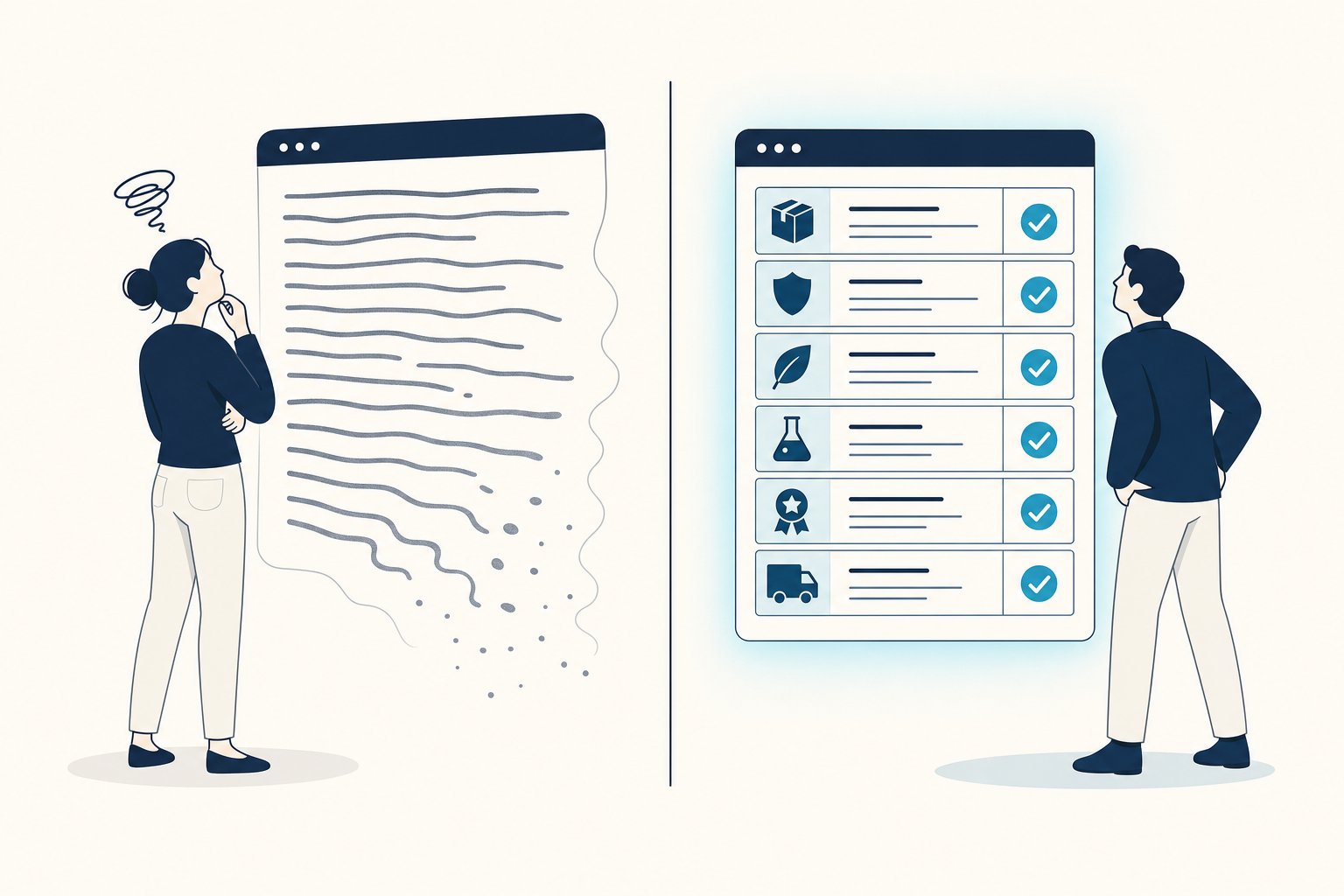
Proof, not claims: classic persuasion triggers, re-tested live with digital twins. → See all 23 purchase triggers at a glance.
Green & Brock describe narrative transportation based on a study from 2000; Escalas applies the principle to advertising copy in 2004. We re-tested the “story vs. facts” contrast with digital twins.
Does a founder story really sell better than a fact list?
“Tell a story, not a spec sheet” is one of the most repeated rules in content marketing. The psychological basis is called narrative transportation: Green & Brock (2000, Journal of Personality and Social Psychology 79(5), 701–721) showed across four experiments that readers who become “transported” into a narrative adopt story-consistent beliefs and rate characters more positively, and this effect holds robustly even when the same story is labeled as fact or as fiction. Escalas (2004, Journal of Advertising 33(2), 37–48) applies the idea to advertising: consumers who mentally transport themselves into using a product while reading an ad narrative develop more positive brand attitudes than with a purely argumentative ad.

That has hardened into a marketing rule of thumb: founder stories, origin myths, and customer anecdotes are supposed to sell better than plain product data. We wanted to know whether that still holds in 2026 for a completely ordinary everyday object, so we tested the same backpack (€89, 30 l, water-repellent, padded laptop compartment) in three description variants: a pure founder story about a broken zipper and thirty sewing prototypes, a pure fact list with warranty and material details, and a hybrid version combining both.
How did we test this?
The Method: Because narrative transportation, by theory, works specifically when a reader commits to ONE story rather than comparing it against an alternative, we did not, as in other Trigger Lab tests, show all twins every variant side by side. Instead, each of the 10 digital twins (DACH consumer panel, ages 25–60) read exactly ONE description per pass across two waves, and stated how many of 10 purchases they would choose this vendor for and how well they expected to recall a detail a week later (1–10 scale). Assignment rotated across two waves so each response is a first encounter with that description, giving n = 7 responses for story, n = 7 for facts, and n = 6 for hybrid (n = 5 on the recall scale; one value came back without a concrete number and was not substituted). The panel responded in German; quotes are translated.
Because the three conditions share twins (each condition draws on two of three panel sub-groups), the samples are partially paired, not fully independent. The numbers below are a descriptive, directional result for this run, not a statistically confirmed finding. We also measured stated purchase intent and self-PREDICTED recall, not an actual purchase and not an actual memory test. Green & Brock used a validated 18-item recall test; and people asked directly whether a story persuaded them tend toward an “I'm not influenced” reflex. Green & Brock also never compared story text against a fact list. They varied labels and reading instructions on the same nine-page narrative; our story-vs-facts contrast follows the Escalas logic more closely, and Escalas 2004 is verified here only at the abstract level (the full text is paywalled).
 Beate Hofmann, 58
Project manager twin* · Stuttgart · University degree
“I'm Beate Hofmann, a project manager from Stuttgart. Since my divorce I've found new stability with a new partner, and even though I'm living with chronic back pain and an active cancer diagnosis, I stay active with daily exercise and feel deeply satisfied with my life.”
What makes this twin distinct: I hold strong private religious beliefs without attending church, I'm deeply skeptical of politics and the economic situation, and I guard my data so carefully that I'll pass up a discount rather than share it.
* Digital twin: an AI simulation based on a real person’s profile: 68+ survey items, a full psychographic profile (values, demographics, behavior). Not a real person.
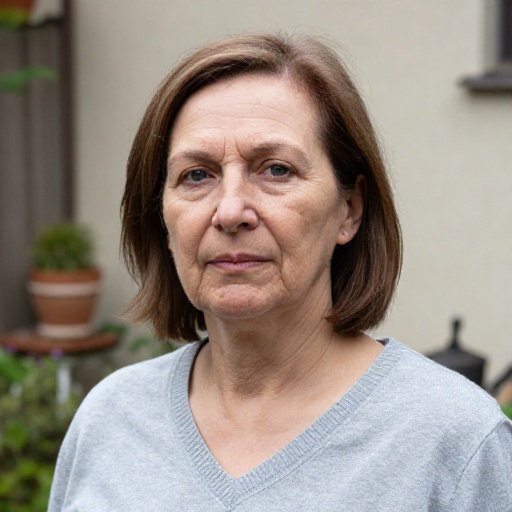 Sabine Wagner, 56
Nurse twin* · Leipzig · Upper secondary education
“I'm Sabine Wagner, a nurse at a hospital in Leipzig. I'm married and live with my husband, but between 40-hour shift work and running the household, I have almost no time left for myself.”
What makes this twin distinct: My faith isn't just tradition. It's an active source of strength for a demanding job, I place strong trust in the police and the justice system, and despite my packed hospital schedule I still volunteer for charitable causes.
* Digital twin: an AI simulation based on a real person’s profile: 68+ survey items, a full psychographic profile (values, demographics, behavior). Not a real person.
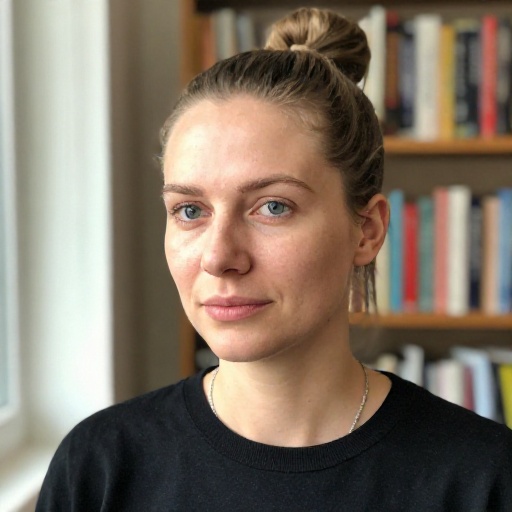 Kathrin Baumann, 32
Teacher twin* · Munich · Postgraduate degree
“I'm Kathrin Baumann, a primary school teacher from Munich. I'm married with two young children, and life right now is turbulent between school and a young family. Exercise has taken a back seat.”
What makes this twin distinct: I trust people deeply and tend to look for the good in them, I lean politically left and feel close to the Greens, and I consistently boycott products for sustainability reasons even though politics otherwise takes a back seat in my daily life.
* Digital twin: an AI simulation based on a real person’s profile: 68+ survey items, a full psychographic profile (values, demographics, behavior). Not a real person.
 Melanie Schubert, 33
Bank clerk twin* · near Frankfurt · Advanced vocational education
“I'm Melanie Schubert, a bank clerk at a large company near Frankfurt. I'm married and live with my husband, though occasional back and neck issues slow me down a bit in daily life.”
What makes this twin distinct: I'm considerably more risk-averse than most people around me, I avoid leadership roles and deliberately limit my own time online even though I'm perfectly capable with technology. Order and reliability matter more to me than trying new things.
* Digital twin: an AI simulation based on a real person’s profile: 68+ survey items, a full psychographic profile (values, demographics, behavior). Not a real person.
 Lukas Sander, 33
Retail twin* · Dortmund · Postgraduate degree
“I'm Lukas Sander, a retail employee with team-lead responsibility in Dortmund. I'm married with three children aged two, four, and seven, between a 40-hour work week and a full family life, I feel very satisfied and firmly in control.”
What makes this twin distinct: Even though I'm security-oriented and risk-averse, I strongly support minority rights, including LGBTQ rights, and want a strong, socially active government, and my postgraduate degree gives me an unusual outside perspective on my retail job.
* Digital twin: an AI simulation based on a real person’s profile: 68+ survey items, a full psychographic profile (values, demographics, behavior). Not a real person.
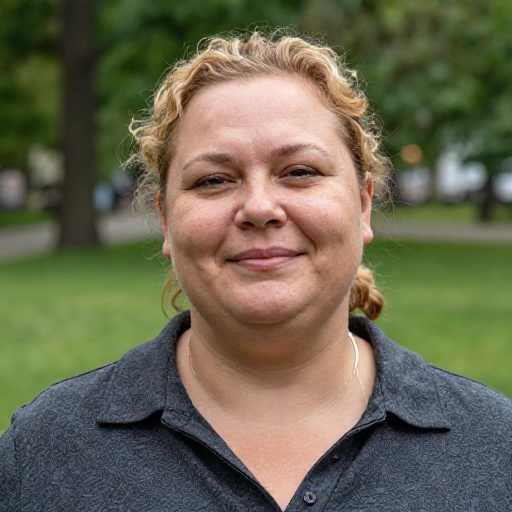 Anke Schumann, 48
HR twin* · Hamburg · University degree
“I'm Anke Schumann, an HR officer at a mid-size company in Hamburg. I'm married, have two sons, and feel deeply fulfilled and settled in my life.”
What makes this twin distinct: I place strong trust in parliament and the justice system even though the economic situation leaves me dissatisfied, I champion income equality and minority rights, and yet I also see obedience and respect for authority as core parenting values, a contradiction I notice in myself.
* Digital twin: an AI simulation based on a real person’s profile: 68+ survey items, a full psychographic profile (values, demographics, behavior). Not a real person.
 Sören Lindner, 30
IT twin* · Cologne · Advanced vocational education
“I'm Sören Lindner, an IT administrator at a large company in Cologne. I'm not married and live with my partner. My childhood was shaped by financial hardship and family conflict, which made me more risk-tolerant and determined as an adult.”
What makes this twin distinct: I'm unusually risk-tolerant and drawn to leadership, I protest and donate for causes I believe in, I guard my data strictly despite my strong tech affinity, and I actively oppose workplace inequality for women.
* Digital twin: an AI simulation based on a real person’s profile: 68+ survey items, a full psychographic profile (values, demographics, behavior). Not a real person.
 Tobias Hübner, 35
Mechatronics twin* · Essen (Ruhr area) · Upper secondary education
“I'm Tobias Hübner, a mechatronics technician at a mid-size electronics manufacturer in Essen, in the Ruhr area. I'm not married and live in a large six-person household with my parents and younger relatives, chaotic, but a strong source of security for me.”
What makes this twin distinct: I put several hours a week into caring for relatives and neighbors rather than outward-facing social activities, I consistently reject tracking cookies, and I still vote regularly even though I feel my vote carries little real weight.
* Digital twin: an AI simulation based on a real person’s profile: 68+ survey items, a full psychographic profile (values, demographics, behavior). Not a real person.
 Dennis Altmann, 41
Sales twin* · Düsseldorf · University degree
“I'm Dennis Altmann, a sales rep at a mid-size wholesale company in Düsseldorf, and I travel frequently for work. I'm married with three children. My own childhood was marked by financial strain and conflict, which is why I want a more stable, harmonious home for my own kids.”
What makes this twin distinct: Unlike Düsseldorf's generally liberal environment, I place high value on clear rules, order, and traditional parenting values like obedience and respect for authority, I meet strangers with healthy skepticism; my father originally came from Turkey.
* Digital twin: an AI simulation based on a real person’s profile: 68+ survey items, a full psychographic profile (values, demographics, behavior). Not a real person.
 Jürgen Krause, 59
Accountant twin* · Berlin · Upper secondary education
“I'm Jürgen Krause, an accountant nearing retirement in Berlin. I've never married and live with two older relatives I care for about 15 hours a week, while dealing with back and joint pain and occasional severe headaches.”
What makes this twin distinct: I'm socially and culturally conservative, value tradition and respect for authority, and feel little connection to the European idea despite living in a cosmopolitan city, yet I still vote SPD because social and income justice matter to me.
* Digital twin: an AI simulation based on a real person’s profile: 68+ survey items, a full psychographic profile (values, demographics, behavior). Not a real person.
* Digital twins are AI simulations based on real person profiles, not real people. Click a twin to see what it is based on.
What we tested
Facts condition · Fact list Strongest condition · 5.4 of 10 purchases
“Capacity: 30 liters. Material: recycled polyester, water-repellent coating. Laptop compartment: padded, up to 16 inches. Zipper: YKK, tested to 10,000 open cycles. Back panel: ergonomic, breathable. Weight: 780 g. Compartments: 3 main compartments, 2 exterior pockets. Warranty: 5 years.”
Hybrid condition · Story + facts · 4.2 of 10 purchases
“When our founder Malte was sprinting for the train in the rain seven years ago, the cheap zipper on his old backpack tore open for the third time. That's why we build differently today: 30-liter capacity, water-repellent recycled polyester, padded laptop compartment up to 16 inches, YKK zipper tested to 10,000 open cycles, ergonomic back panel, 780 g, 3 main compartments + 2 exterior pockets, 5-year warranty.”
Story condition · Founder story · 4.0 of 10 purchases
“When our founder Malte was sprinting for the train in the rain seven years ago, the cheap zipper on his old backpack tore open for the third time. His laptop landed on the platform in pouring rain. In his workshop kitchen, over the following months, he sewed thirty prototypes until the zipper still held after 10,000 openings. Today that very backpack is carried every morning by a commuter named Frauke, who has hauled it through rain, packed subway cars, and cobblestones for three years, without a single seam giving way.”
Why does the fact list beat the founder story?
In our run, the fact list produced both the highest stated purchase intent and the highest self-assessed recall, and the pure founder story came last on both measures. That is the exact reverse of what the marketing rule of thumb “stories sell better” would predict.
One likely reason lies in information content, not narrative form itself: the fact list contains purchase-relevant details the pure story lacks, a 5-year warranty, a 16-inch laptop compartment, weight, compartment layout. Tobias Hübner, one of the digital twins, makes exactly this point: “The 5-year warranty is a real argument for me, as someone who values safety and durability. […] The detail about the YKK zippers tested to 10,000 open cycles is great too. That's a concrete number that gives me confidence,” says twin “Tobias” (digital twin, DACH consumer panel).
Format and information content are entangled in this test, then: whoever reads only the story simply gets fewer purchase-relevant facts. That said, the hybrid condition partly contradicts a purely information-based explanation. It contains all the facts AND the story, yet still lands in the lower range on purchase intent, close to the pure story. Missing facts alone can't fully explain the result.
A second likely reason lies in the format of the question itself. Asked directly whether a story would move them to buy, some twins respond with a kind of self-theory about themselves, not a simulated processing reaction. Sören Lindner puts this reflex into words directly: “Honestly, these stories about Malte and Frauke don't really matter to me. I don't buy a backpack because someone tells a nice story about it, but because it's functional and meets my requirements. […] The facts about the backpack might stick, but the stories don't,” says twin “Sören.” This exact “I'm not influenced” reflex is a well-known pattern in transportation research when people are asked direct introspective questions: people (and apparently twins simulating people) typically underestimate how strongly a story actually influences them.
Not every twin judged so clearly against the story. Anke Schumann rated the same founder story in a different wave at 7 of 10 purchases: “The story is simply well told and builds trust. When someone sews thirty prototypes to perfect a zipper, that shows a dedication to quality that matters to me,” says twin “Anke.” The same story that one panel sub-group called the weakest condition was the strongest for another sub-group, a sign that the story's overall disadvantage stems mainly from the facts-oriented sub-group that saw the story first in wave 1, while the other sub-group actually rated the story better than its own hybrid condition.
Why doesn't the hybrid version come out on top?
Intuitively you'd expect combining story and facts to deliver the best of both worlds. In our run, though, the hybrid condition landed close to the pure story on purchase intent (4.2 vs. 4.0) and between story and facts on recall, but below the pure fact list (6.0 vs. 6.3). Anke Schumann offers a possible explanation in the hybrid pass: “This description reads like a generic template. If I'm looking for a backpack for everyday use, I want to know specifically how it makes my day-to-day easier. […] The description is far too vague to really stick,” says twin “Anke.” A story opening plus a full spec list, then, doesn't automatically read as the best of both formats. In our short format, the combination can also come across as an indecisive middle ground that achieves neither the clarity of the pure fact list nor the concreteness of the pure story.
Two of the six hybrid responses were also weakly anchored in the stimulus: one justification quoted words that don't actually appear in the hybrid text, and another complained about a missing laptop spec even though the text explicitly states “padded laptop compartment up to 16 inches.” Both pull the hybrid average slightly down. Without them, hybrid purchase intent would sit at 4.75, still below the fact list. No result flips because of this, but the confabulation rate isn't zero.
Classic study
Green & Brock (2000): Transportation into a narrative predicts story-consistent beliefs and more positive character ratings, robust across four experiments.
Digital twins (2026)
5.4 of 10 purchase intent for the fact list, higher than story (4.0) or hybrid (4.2).
Same principle, measured fresh: in minutes instead of weeks of fieldwork.
Does this disprove narrative transportation?
No, and that's the most important point for interpreting this result. Green & Brock never tested story text against a fact list: they had every participant read the same nine-page narrative and varied only the reading instructions (theatrical immersion vs. a superficial fourth-grader perspective) and the fact-or-fiction label, and that variation did NOT change measured transportation. Our story-vs-facts contrast is structurally closer to a marketing-copy A/B test in the sense of Escalas (2004) than to Green & Brock's own manipulation.
There's also a measurement difference: Green & Brock captured actual belief change plus a validated 18-item true/false recall test after real reading time. We captured stated purchase intent and self-PREDICTED recall, a statement about one's own expected memory performance, not measured memory. And finally, a dosage difference: a three-sentence brand story is not a nine-page narrative. Whether and how strongly transportation even arises with such short marketing copy is something this test can't answer. Our result says something about stated purchase intent for short product descriptions, not something about narrative transportation as a psychological mechanism in general.
What does this mean for your product descriptions?
The practical takeaway from this one run: before you replace a fact list with a founder story, check whether you're losing purchase-relevant information in the process: warranty, dimensions, material, care instructions. In our test, the condition that delivered the most concrete, purchase-relevant facts won, not the condition with the best story. That doesn't mean storytelling is useless. The story verbatims show it does build trust with part of the panel. It means that a story alone, without the purchase-relevant facts, was the weaker choice in this test. Whether a better-built hybrid version: with the same facts, but woven into the narrative instead of appended to it, flips the result is something only a dedicated test can show. That's exactly what digital twins are for: fast, cheap answers before you rewrite your product page.
Want to know whether story or facts work better with YOUR audience? Book my keynote “Why Consumers Buy Weird”, including a live demo of how digital twins test product copy in minutes.
This test is part of The Trigger Lab series, in which we re-test classic consumer psychology findings with digital twins. Read the full overview of all re-tests in the flagship article “Brainfluence Retested.”
Further reading
- Reciprocity in the twin test: does a free guide before the sale work?
- Loss aversion & framing in the twin test
- Digital twins in market research: the complete guide 2026
Frequently asked questions
Does a founder story sell better than a fact list?
In our test with digital twins, it was the reverse: the pure fact list achieved the highest purchase intent at 5.4 of 10 purchases, and the pure founder story the lowest at 4.0 of 10. One likely reason is that the fact list contains purchase-relevant details like warranty and dimensions that the story lacks.
Does this result contradict narrative transportation theory?
No. Green & Brock (2000) never compared story text against a fact list. They varied reading instructions on the same nine-page narrative. We also measured stated purchase intent and self-predicted recall, not actual belief change or real recall as in the original.
Why didn't the hybrid version of story and facts come out on top?
The hybrid condition landed close to the pure story on purchase intent (4.2 of 10) and between story and facts on recall, but below the pure fact list (6.0 of 10). Several digital twins experienced the combination as a vague, generic template that achieved neither the clarity of the facts nor the concreteness of the story.
How was this test conducted with digital twins?
Digital twins from a DACH consumer panel each read ONE of three product descriptions (story, facts, hybrid) for the same backpack and stated how many of 10 purchases they would choose this vendor for and how well they expected to recall a detail a week later. Assignment rotated across two waves so no twin directly compared two descriptions of the same product.
Glossary: The Trigger Lab vocabulary
Digital twins: AI personas based on real survey profiles that respond to text stimuli with forced-choice decisions and ratings: a market research panel that answers in minutes instead of weeks. → More on this: Digital twins in market research: the complete guide
The Trigger Lab: the article series in which classic consumer psychology findings are re-tested live with digital twins from a DACH consumer panel. → See the experiment: Brainfluence Retested
Trust words: fixed trust phrases placed under the buy button, such as a money-back guarantee, customer reviews, or certifications, that, per Dooley (Brainfluence, 2011), increase perceived trust and purchase willingness. → See the experiment: Trust words in the twin test
Anchoring effect: a price or value mentioned first distorts the assessment of subsequent prices, even when the anchor is arbitrary (Tversky & Kahneman, 1974). → See the experiment: Anchoring effect: the strikethrough price in the twin test
Scarcity: signals of limited availability or time are said, in classic consumer psychology, to increase pressure to act (Cialdini, 1984; Worchel et al., 1975). → See the experiment: Scarcity in the twin test
Choice overload: too large a range of options can lower purchase likelihood instead of raising it (Iyengar & Lepper, 2000). → See the experiment: Choice overload: the jam study
Loss aversion & framing: losses weigh psychologically heavier than equivalent gains, which is why loss-framed messages (“Don't miss out…”) are said to work more strongly than gain-framed ones (Tversky & Kahneman, 1981). → See the experiment: Loss aversion & framing in the twin test
Reciprocity: someone who first receives something free tends to feel obligated to give something back, for example, in the form of a purchase (Regan, 1971). → See the experiment: Reciprocity: the free guide in the twin test
Endowment effect: once someone already owns or uses a product, they value it more highly than before ownership (Kahneman, Knetsch & Thaler, 1990). → See the experiment: Endowment effect: the free trial in the twin test
Peak-end rule: people remember and evaluate an experience mainly by its emotional peak and its ending, not by the average of all moments (Kahneman et al., 1993; Redelmeier & Kahneman, 1996). → See the experiment: Peak-end rule in the twin test
Storytelling (narrative transportation): by theory, stories put readers into a “transported” state in which critical scrutiny recedes and story-consistent beliefs are adopted (Green & Brock, 2000; Escalas, 2004).
Pick share (forced choice): the share of twins who choose a given variant in a forced-choice question with no “don't know” option, averaged across two oppositely ordered passes.
Allocation measurement: a question technique in which twins state, for each variant, how many of 10 purchases or situations they would choose it in, producing a realistic distribution instead of a single unanimous yes/no picture.
Sources & further reading
- Green, M. C. & Brock, T. C. (2000). The Role of Transportation in the Persuasiveness of Public Narratives. Journal of Personality and Social Psychology, 79(5), 701–721.
- Escalas, J. E. (2004). Narrative Processing: Building Consumer Connections to Brands. Journal of Advertising, 33(2), 37–48.
- Trigger Lab Experiment G8 (Storytelling), 2026, n = 10 digital twins (neuroflash).
Get the same scientific power for your marketing: use the digital twins from this experiment yourself: via the neuroflash Digital Twins MCP directly in Claude or Cursor, or in your browser at neuroflash.com. Your stimuli, the same panel principle, results in minutes.
Dr. Jonathan T. Mall
Cognitive neuropsychologist, AI entrepreneur, and Chief Innovation Officer at neuroflash. Jonathan combines 20+ years of experience in neuroscience and AI to predict how people decide. His signature keynote, “Why Consumers Buy Weird,” explains why we buy irrationally, and how digital twins predict it. To experience these insights live, you can book an AI keynote with live demos. LinkedIn · Request a keynote