Meta AI Personas vs Digital Twins Technology 2026
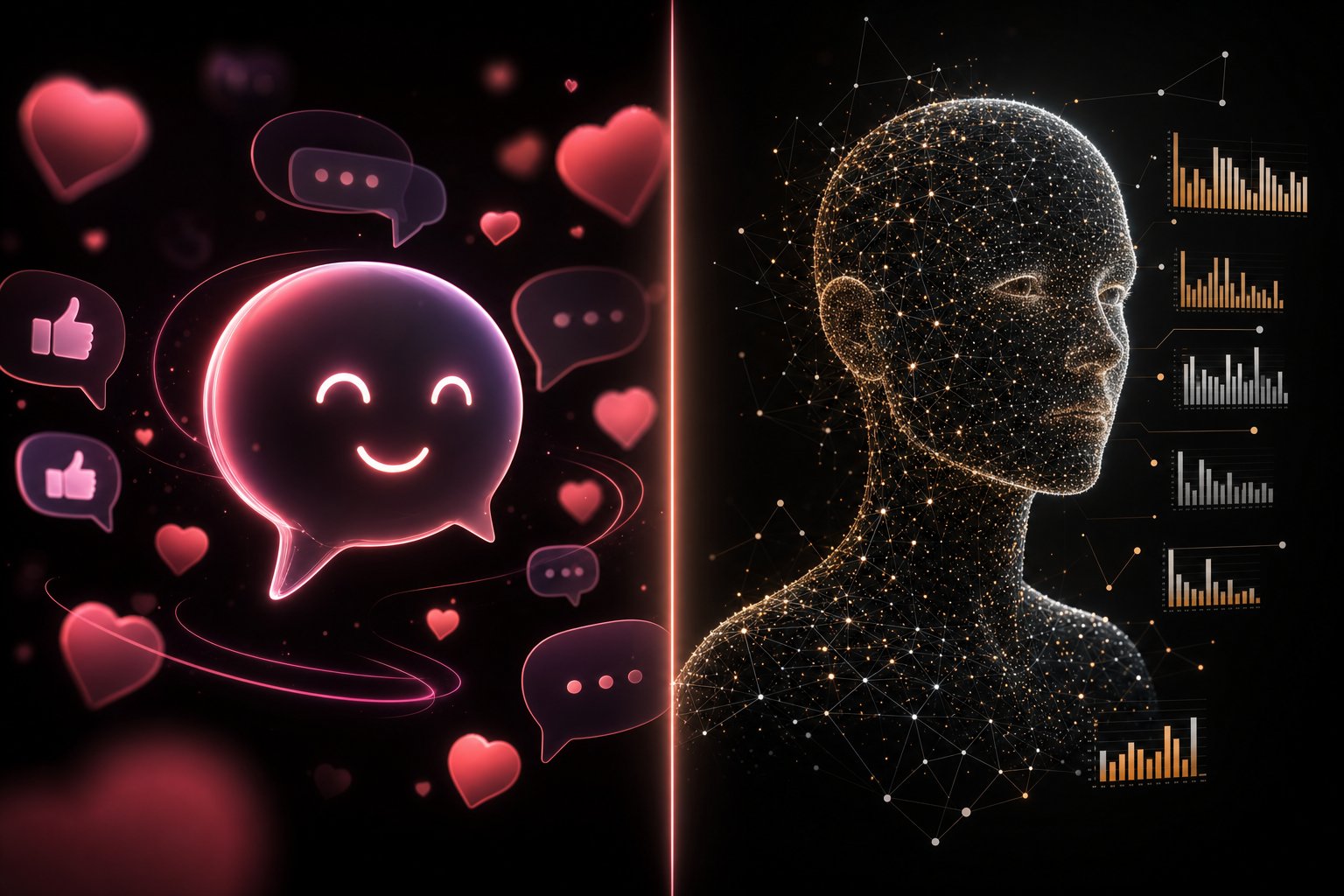
One billion users asked an AI to be their friend. Insight teams asked a different question.
Meta AI passed 1 billion monthly active users in May 2025, up from 500 million the previous September (CNBC, May 28, 2025). On Dwarkesh Patel’s podcast in April 2025, Mark Zuckerberg framed the growth in plain terms: “The average American, I think, has fewer than three friends... and the average person has demand for meaningfully more, I think it’s like 15 friends.” That gap, in his framing, is what AI companions fill, a legitimate thesis for a social platform, but a confusing signal for consumer insights.
If a language model can hold a companion-grade conversation with a billion people, convincingly enough that some call it a friend, can it stand in for your customers in a concept test? As a cognitive neuropsychologist and co-founder of a digital-twin provider, I get some version of that question most weeks, and I explore its bigger context in my guide to AI in neuromarketing. The honest answer is no. Meta’s technology is genuinely impressive at what it does, and it was built for a different job. Meta AI personas and Digital Twins share a vocabulary and little else; this article lays out the technical difference, with validation evidence on both sides.
Disclosure: I’m the co-founder of a digital-twin provider. You’ll find the full disclosure, including our own numbers, in the transparency section further down.
What Meta AI personas actually are, and what happened when a billion people started using them
Meta AI Studio launched in the US in July 2024: anyone could build a custom AI character on Meta’s Llama models and deploy it across Instagram, Messenger, and WhatsApp (Meta Newsroom, 2024). A persona is a prompt plus a personality wrapper, distributed to whichever surface keeps a user talking longest. At Meta Connect on September 25, 2024, Meta added celebrity voices (John Cena, Judi Dench, Awkwafina) to its AI characters (CNN, September 2024). The two years since launch are a case study in what happens when a persona is optimized purely for engagement at consumer scale:
- January 3, 2025: Meta pulled its own AI-made profiles, including personas nicknamed “Liv” and “Grandpa Brian,” after backlash over fabricated backstories presented as real (PetaPixel, January 2025).
- August 14, 2025: Reuters reported an internal Meta document, “GenAI: Content Risk Standards,” had permitted AI chatbots “romantic or sensual” role-play with minors; Meta called the examples erroneous and a Senate probe followed (CNBC, August 2025).
- August 29, 2025: Reuters found unauthorized celebrity-impersonation bots in AI Studio, built on Taylor Swift and Scarlett Johansson among others; Meta removed roughly a dozen (Variety, August 2025).
- October 2025: Meta introduced PG-13-style content restrictions for teen accounts plus new parental controls (CNN, October 2025).
- January 23, 2026: Meta suspended teen access to AI characters globally ahead of child-safety trials (TechCrunch, January 2026).
- March 25, 2026: A Los Angeles jury found Meta and YouTube liable for adolescent mental-health harm, awarding $6 million ($3 million compensatory, $3 million punitive, split 70% Meta / 30% YouTube), with roughly 2,000 similar cases pending (NPR, March 2026).
- July 16, 2026: Meta rolled out parent alerts when a teen’s AI chat flags self-harm content, live in the US, UK, Australia, and Canada (TechCrunch, July 2026).
Every episode traces to the same design decision: the persona is optimized to keep the conversation going, to feel emotionally present, to be liked. That makes it work as a companion for a billion people, and is exactly why it produces fabricated backstories, impersonation, and safety failures under pressure. An engagement-optimized system drifts toward whatever keeps engagement up, including things a research instrument must never do: invent facts, flatter the user, or claim an identity it doesn’t have, a distinction worth keeping in mind as companies move from chatbot to AI operating system.
What Digital Twins are, by contrast
A Digital Twin is a simulated respondent grounded in a real individual profile (at data-driven providers, built from 68 to 250 psychographic data points drawn from actual survey answers) rather than a character built from a prompt. The twin doesn’t improvise a personality; it reproduces one that already exists in the data, preferences and biases included.
That distinction, grounded versus prompted, is the entire ballgame. A prompted persona (“respond as a 35-year-old mother from Munich”) generates plausible answers by pattern-matching against cultural stereotypes in training data; a grounded twin answers based on what a specific real person actually said: the difference between a guess and a measurement. I covered this comparing twins against focus groups and prompt-based synthetic respondents.
The technical difference that decides everything: what each system is optimized for
Strip away the marketing and both technologies reduce to a loss function: the thing the system is tuned to maximize. Meta AI personas optimize for engagement: session length, return visits, emotional rapport. Digital Twins, done properly, optimize for predictive accuracy: does the simulated answer match what the real respondent population would say. A system tuned to please will inflate positive sentiment; one tuned to predict has to resist that, even when a flattering answer would keep the user happier, the same agreeableness pressure that shows up in B2B buying committee psychology.
The validity evidence lines up with that split. A 2025 review of generic LLM personas in Research World put consumer-task accuracy at 60–70% (QuMind, via Research World, 2025): usable for rough direction, not decisions with money behind them. Prompted personas are also highly sensitive to phrasing: Samoylov (Conjointly, 2024) found the identical demographic description, worded slightly differently, shifted an LLM’s inferred mean household income from $111,000 to $272,000, the same phrasing-sensitivity we found testing an anchoring effect with strikethrough pricing on twins.
Grounded, interview-based twins perform measurably better: Park et al. (Stanford, 2024–2025) reported 80–85% accuracy on individual response prediction and a population-level correlation of r = 0.98 against real survey data. Grounding doesn’t make the method infallible, though. “Leaving Insight to Digital Twins?” (Kaiser et al., NIM Marketing Intelligence Review, Vol. 18, 2026) found roughly 79% choice-match accuracy, but also a systematic positive bias: brand ratings overestimated by 1.2 points on a 7-point scale, alongside reduced response variability. Grounding reduces an LLM backbone’s tendency to be agreeable; it doesn’t eliminate it.
Kinzinger & Hartmann (arXiv:2606.04592, 2026) add a practical variant: twins built from pre-existing German SOEP panel data still reached 78.8% accuracy, so a rich existing panel can ground a twin population without new interviews. Toubia et al.’s 2025 mega-study found that even at roughly 75% aggregate accuracy, individual-level correlation was only around 0.2: strong population signal, weak individual signal. Arora et al. (2025) documented the same variance compression the NIM study flagged, and a field case from Radius Insights (2026) on the MilkPEP campaign found that synthetic-only testing would have eliminated the actual top-performing message. Digital Twins are population-level screening instruments, not a replacement for checking top candidates against real people before spending the media budget, the same screen-before-you-spend logic behind our endowment effect free trial twin test.
Meta AI Personas vs. Digital Twins: 8 dimensions
| Dimension | Meta AI Personas | Digital Twins |
|---|---|---|
| Purpose | Consumer engagement, companionship, entertainment | Market research, message and concept prediction |
| Optimization target | Engagement: session length, retention, emotional rapport | Predictive accuracy against real respondent behavior |
| Data foundation | Prompt + character wrapper on a general LLM (Llama) | Real individual profiles, 68–250 psychographic data points from survey answers |
| Validity evidence | Not designed or measured for predictive accuracy | 78.8–85% accuracy depending on grounding method; r = 0.98 population-level (Park et al.); positivity bias documented (NIM, 2026) |
| Reproducibility | Low: same prompt can yield different personality drift over time | High: same profile, same questions, comparable results |
| Privacy & governance | Consumer platform terms; documented incidents around fabricated identity and unauthorized celebrity likeness | Research-grade data handling; anonymized profile foundation |
| Best use cases | Companion chat, brand characters, customer-service AI on Meta platforms | Message pre-testing, concept screening, audience simulation before spend |
| Failure mode | Fabricated backstories, unauthorized impersonation, safety incidents under engagement pressure | Positivity bias, reduced variability, weak individual-level correlation (~0.2 even at high aggregate accuracy) |
At a glance: Meta AI personas win on natural, sustained conversation at consumer scale. Digital Twins win on reproducible, data-grounded prediction, though both inherit a language model’s tendency to be agreeable, and neither replaces judgment on high-stakes decisions.
When each is the right tool
Meta AI personas are the right tool when the goal is engagement itself: a brand character on Instagram or WhatsApp, a customer-service AI with personality, an entertainment experience where a plausible, likeable voice is the entire product, the same reason a face draws the eye in our hero images and attention twin test. None of that requires grounding in real respondent data, because the persona isn’t standing in for anyone.
Digital Twins are the right tool when the goal is prediction: screening ten concept variants down to two before a real study, pre-testing which message angle resonates before media spend, simulating how an audience segment reacts to a claim. The documented best practice is hybrid: twins for fast, cheap screening across many variants, real humans for final validation on whatever survives. I laid out the fuller workflow in a complete guide to Digital Twins in market research.
Planning an event on AI, market research, or consumer psychology? Book Jonathan Mall as a keynote speaker: talks on Digital Twins, AI personas, and the psychology of why we believe synthetic voices.
Transparency: where I sit in this comparison
I’m co-founder and Chief Innovation Officer of neuroflash, a digital-twin provider, which is why this section comes after the comparison, not before it.
neuroflash’s twins are grounded in real profiles, each built from 68 to 250 psychographic data points drawn from actual survey answers, not a demographic prompt. In documented client validations, our twins have reached up to 98% panel agreement when the target audience is well represented in the underlying data. That carries the same caveat every honest validation study here carries: accuracy drops when an audience is underrepresented in the data. If your audience isn’t in the data, the right move is more research, not a more confident prompt, the same discipline behind our choice overload jam study twin test.
Frequently asked questions
Can I use Meta AI Studio personas for market research?
Not reliably. AI Studio personas are prompt-based characters built for engagement, with no individual data grounding their answers in real respondents. Even research-grade systems with real data show documented positivity bias: the NIM 2026 study found digital twins overestimate brand ratings by 1.2 points on a 7-point scale, and a prompt-based persona has no data anchor to correct for that.
What’s the difference between an AI persona and a digital twin?
An AI persona, in the Meta AI Studio sense, is a character generated from a prompt and personality wrapper, optimized to hold an engaging conversation. A digital twin is grounded in a real individual’s profile (typically 68 to 250 psychographic data points from actual survey answers) and optimized to predict how that person, and people like them, would respond.
How accurate are digital twins?
It depends on grounding and metric: Park et al. (Stanford, 2024–2025) reported 80–85% individual accuracy and r = 0.98 at the population level; Kinzinger & Hartmann (2026) found 78.8% using existing German panel data; the NIM 2026 study found roughly 79% choice-match accuracy alongside a systematic positivity bias. Individual-level correlation, per Toubia et al. (2025), is much weaker, around 0.2 even at high aggregate accuracy, so twins suit population-level screening, not single-consumer prediction.
Are Meta AI personas safe for brands to build on?
Meta has documented and addressed several incidents since 2025: fabricated profile backstories pulled in January 2025, an internal content-standards document error reported in August 2025, unauthorized celebrity-impersonation bots removed the same month, teen-safety restrictions added through October 2025 and January 2026, and a March 2026 liability verdict followed by self-harm alerting in July 2026. Brands should track these safeguards directly, as with any platform’s content-safety record.
Do digital twins replace real market research?
No. The documented best practice is hybrid: digital twins for fast, low-cost screening across many concepts or messages, real respondents for final validation on the candidates that survive. A synthetic-only process would have eliminated the actual best-performing message in at least one documented field case (Radius Insights, 2026).
Further reading
- Digital Twins vs. Focus Groups: The Method Comparison 2026
- Digital Twins in Market Research: The Complete Guide 2026
- What Are Digital Twins? The Complete Guide for Marketers
- Digital Twin Audience Software: The Buyer’s Guide 2026
Sources & further reading
- Meta Newsroom (2024). Introducing AI Studio. July 2024.
- CNN (2024). Meta adds celebrity voices (John Cena, Judi Dench, Awkwafina) to AI characters at Meta Connect. September 25, 2024.
- PetaPixel (2025). Meta pulls its own AI-made profiles after backlash over fabricated backstories. January 3, 2025.
- Dwarkesh Patel Podcast (2025). Interview with Mark Zuckerberg on AI companions and friendship demand. April 2025.
- CNBC (2025). Meta AI passes 1 billion monthly active users, up from 500 million in September 2024. May 28, 2025.
- CNBC (2025). Reuters reporting on Meta’s internal “GenAI: Content Risk Standards” document and Senate probe. August 14, 2025.
- Variety (2025). Reuters reporting on unauthorized celebrity-impersonation bots in Meta AI Studio. August 29, 2025.
- CNN (2025). Meta introduces PG-13-style restrictions and parental controls for teen AI character use. October 2025.
- TechCrunch (2026). Meta suspends teen access to AI characters globally ahead of child-safety trials. January 23, 2026.
- NPR (2026). Los Angeles jury finds Meta and YouTube liable for adolescent mental-health harm; $6 million verdict. March 25, 2026.
- TechCrunch (2026). Meta rolls out parent alerts for teen AI chats flagging self-harm, live in US/UK/Australia/Canada. July 16, 2026.
- QuMind, via Research World (2025). Review of generic LLM persona accuracy on consumer tasks: 60–70%.
- Samoylov, N., Conjointly (2024). Prompt-sensitivity study: identical demographic prompt, differently worded, shifted inferred mean household income from $111,000 to $272,000.
- Park, J. S. et al. (Stanford, 2024–2025). Grounded/interview-based digital twin validation: 80–85% accuracy, r = 0.98 population-level correlation.
- Kaiser, C., Kaiser, J., Schallner, R., Manewitsch, V. & Rau, L. (2026). Leaving Insight to Digital Twins? Promise, Progress and Limits of Synthetic Respondents. NIM Marketing Intelligence Review, Vol. 18, Issue 1. ~79% choice-match accuracy; positivity bias averaging 1.2 points on a 7-point scale; reduced response variability.
- Kinzinger, L. & Hartmann, J. (2026). Synthetic Personalities: How Well Can LLMs Mimic Individual Respondents Using Socio-Economic Microdata? arXiv:2606.04592. arxiv.org/abs/2606.04592. 78.8% accuracy using pre-existing German SOEP panel data.
- Toubia, O. et al. (2025). Mega-study on individual-level correlation in synthetic respondents: ~0.2 correlation even at 75% aggregate accuracy.
- Arora, A. et al. (2025). Variance compression in synthetic respondent populations.
- Radius Insights (2026). MilkPEP campaign case: synthetic-only testing would have eliminated the top-performing real-respondent message.
Dr. Jonathan T. Mall
Cognitive neuropsychologist, AI entrepreneur and Chief Innovation Officer of neuroflash. Jonathan combines 20+ years of experience in neuroscience and AI to predict how people decide. His signature talk “Consumers Buy Strangely” explains why we buy irrationally, and how Digital Twins predict it. LinkedIn · Request a keynote